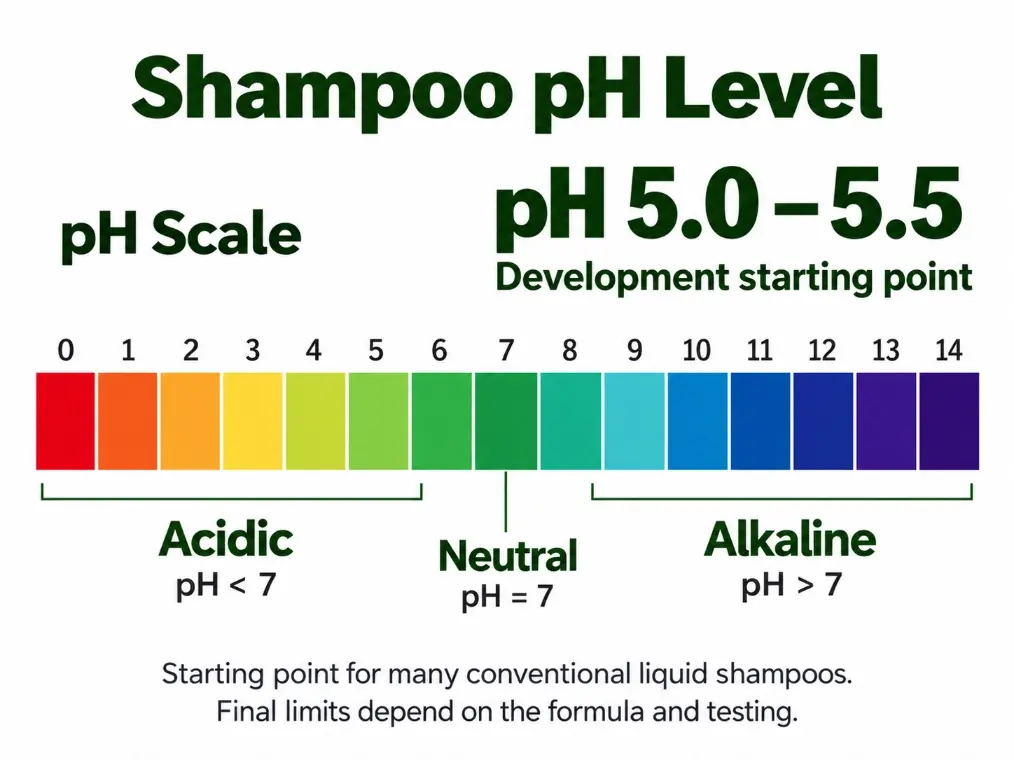
Shampoo pH level describes how acidic or alkaline the product is under defined test conditions. For many conventional liquid shampoos, a mildly acidic development target around pH 5.0 to 5.5 is a practical starting point. The finished formula still needs to work at that pH and pass the tests appropriate to its intended use.
If you’re developing a shampoo for your brand, asking for “pH balanced” leaves too much undecided. You need a target, an acceptable range, and a measurement method that your supplier can repeat. Those details give you a basis for comparing the approved sample with later production batches.
What Is a Good Shampoo pH Level?
A good shampoo pH level fits the formula, intended users, and product claims. For a conventional liquid shampoo, pH 5.0 to 5.5 can be a development starting point. Approve the final range after checking ingredient compatibility, performance, safety, and stability; don’t treat 5.5 as a universal pass mark.
On the usual aqueous scale at approximately room temperature, pH 7 is neutral, lower values are acidic, and higher values are alkaline. A low-pH shampoo is acidic relative to neutral water, but the term doesn’t tell you how well it cleans or conditions.
A 2014 survey of 123 shampoos found pH values ranging from 3.5 to 9.0. It measured products sold in Brazil and discussed implications for hair care. It did not establish a universal safety cutoff through controlled comparisons of otherwise identical shampoos.
For your own product, separate three decisions:
- The development target: the value the formulator aims for.
- The release range: the limits used to evaluate a production batch.
- The stability criteria: the results acceptable during the planned storage study.
Those decisions should be connected. A sample that meets its target on the day it’s made hasn’t yet demonstrated that it will remain suitable throughout storage.
How Is Shampoo pH Different From Scalp and Hair Surface pH?
The pH measured in a bottle, on the scalp, and in a hair-surface experiment describes different things. Treating them as interchangeable can lead you to approve the wrong specification.
Scalp surface pH is measured on living skin and varies with measurement conditions and the individual. Shampoo pH comes from a product sample, sometimes after a defined dilution. Neither reading tells you exactly what happens throughout a wash, when shampoo mixes with water and is then rinsed away.
You may also see a “hair pH” of 3.67. The 2014 paper discusses this as an approximate isoelectric point: a condition associated with electrical neutrality of the fiber. It is not a recommended shampoo specification.
Matching a quoted scalp or hair number doesn’t establish product suitability. You still need to assess the cleansing system and how the finished formula behaves in use.
How Does pH Affect Hair and Scalp?
pH can influence hair surface charge and the behavior of ingredients around the fiber. Higher pH can increase negative surface charge, with implications for friction and conditioning-agent interactions. That helps explain why pH deserves attention, but it doesn’t predict the entire wash experience.
Consider two hypothetical shampoos that both measure pH 5.3. One is designed for occasional removal of oily buildup; the other for frequent washing with a more conditioning finish. Their identical readings don’t make their cleansing strength, rinse feel, or suitability identical.
For a brand brief, translate the desired benefit into an assessment:
- Easier detangling calls for an appropriate combing or manageability evaluation.
- Color-care positioning needs evidence for the particular color-retention claim.
- Scalp-comfort positioning requires assessment of the complete formula and intended users.
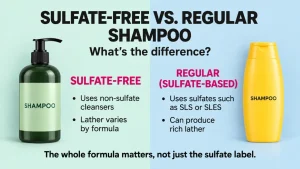
A pH result supports a statement about pH. It cannot replace those evaluations. The same distinction applies to a sulfate-free shampoo formulation: excluding certain surfactants doesn’t establish the finished product’s pH or mildness.
Can Shampoo Be Too Acidic or Too Alkaline?
Yes, a shampoo can fall outside the range appropriate to its formula. The response should be to investigate the result, rather than assume that lowering pH always improves the product or that every reading above 5.5 means damage.
Ingredient compatibility matters in both directions. Preservatives have supplier-defined working conditions, and some thickening systems respond to changes in pH. A formula adjustment can therefore change more than the number on the meter.
Suppose an adjustment brings pH into range but makes the product too thick for its pump. The sample still needs work. Likewise, an acceptable pH reading doesn’t demonstrate that the preservative system adequately protects the finished product.
Don’t add vinegar, lemon juice, or other acids to a finished shampoo to “correct” it. That changes the formula without the development controls used to assess it. For production batches, adjustments belong in a documented procedure with appropriate retesting.
Should pH Targets Change by Shampoo Type?
Different product briefs can justify different targets. Begin with what the shampoo needs to do, then assess a compatible formulation range. A universal chart assigning one exact pH to every shampoo category would hide the decisions that matter.
| Product brief | What to discuss with the formulator | What to evaluate beyond pH |
|---|---|---|
| Everyday liquid shampoo | Cleansing frequency and desired after-feel | Cleansing, rinsing, manageability, and stability |
| Color-care shampoo | The intended hair and coloring history | Color-retention claims under defined wash conditions |
| Scalp-care shampoo | Ingredients, intended users, and precise claims | Finished-product safety and claim support |
| Baby or children’s shampoo | Age group and expected exposure | Eye and skin considerations, packaging, and use instructions |
| Solid shampoo bar | Soap-based or synthetic-detergent system | Defined aqueous sample preparation and performance in use |
Our guide to different types of shampoo helps separate the product categories. Use those categories to clarify your brief, not to copy another product’s laboratory limits.
For solid shampoo, first identify the cleansing chemistry. Soap-based and synthetic-detergent bars aren’t interchangeable. A reported bar pH needs a stated water-based preparation method; pressing a strip onto a dry bar doesn’t give you a meaningful specification.
Hard-water performance also needs its own test conditions. A chelating and hard-water shampoo should be evaluated against the deposits and use conditions it addresses. Water hardness and water pH are different properties, and neither can substitute for evidence that the shampoo manages mineral deposits.
Medicated or treatment claims require a separate regulatory review for the target market. Setting a cosmetic pH range doesn’t settle ingredient or labeling requirements.
What Does “pH-Balanced Shampoo” Actually Mean?
The label may tell you that the brand has considered pH, but it doesn’t disclose a numeric range, test method, or evidence of gentleness. Ask the supplier what it means for that specific formula.
If you’re choosing a shampoo for yourself, ask the brand for the range and consider the product’s intended use alongside your experience with it. If you’re sourcing a private-label formula, request the method as well. A sales sheet stating “pH balanced” gives your quality team no clear acceptance criterion.
Avoid turning the phrase into stronger claims on packaging. “Non-irritating,” “repairs damaged hair,” and “protects color” each say something beyond acidity. Decide which claims you need before approving the testing budget and artwork.
How Do Formulators Choose and Adjust a pH Target?
Formulators look for a range that supports the complete product. The cleansing system, conditioning ingredients, thickener, preservative, and any specialty ingredients must work together. An attractive ingredient list is only the beginning of that assessment.
Start With the Formula’s Requirements
Your brief should describe the intended user, wash frequency, hair needs, target market, and desired claims. From there, the formulator can assess ingredient compatibility and propose a starting range. Resolve these choices during custom hair care formulation development, before treating a pleasant-smelling sample as production-ready.
A useful public example is Colonial Chemical’s Clean & Simple Shampoo starter formula. It specifies pH 5.0 to 5.5 and notes that viscosity increases as pH decreases in that formulation. This illustrates a formula-specific relationship, not a rule that all shampoos become thicker when acid is added.
Adjust, Mix, and Recheck the Affected Properties
Citric acid is one material used to lower pH in suitable formulas. Other approved adjustments may be needed to raise it. The material, concentration, amount, and addition sequence belong in the formula and process instructions; there is no reliable universal “drops per bottle” recipe.
After an adjustment, allow the mixture to become uniform and test a representative sample under the agreed conditions. Recheck relevant properties such as viscosity and appearance. Record the adjustment and formula version so the approved sample can be reproduced.
If a batch needs repeated corrections, stop and review the ingredients, calculations, mixing, and measurement procedure. Record each addition; otherwise, the team investigating the problem won’t know exactly what is in the sample.
How Do You Test Shampoo pH Level Accurately?
Use a calibrated pH meter, a suitable electrode, and a written sample-preparation procedure for development or batch decisions. METTLER TOLEDO’s guide to measuring shampoo pH identifies viscosity, slow readings, and sensor-junction clogging as practical challenges. An instrument must suit the sample, not simply display more decimal places.
Keep Sample Preparation Consistent
Decide whether the method measures shampoo as supplied or after dilution. If diluted, specify the concentration and its basis, water quality, mixing procedure, and measurement temperature. For a bar, define the slurry or extraction method as well.
For example, 10% by mass means 10 g of shampoo in 100 g of total test mixture, such as 10 g shampoo plus 90 g water. This is an explanation of concentration, not a recommended test method for every shampoo. Writing only “1:10” can leave room for different interpretations.
A supplier’s undiluted reading and a buyer’s diluted reading are not automatically comparable. First bring the methods into agreement, then investigate whether the products differ.
Make the Measurement Record Useful
Calibrate according to the instrument’s instructions with appropriate buffers covering the expected measurement range. Control or record temperature, allow the reading to stabilize, and clean the electrode as recommended. Temperature compensation doesn’t remove the need to compare samples under defined conditions.
Your laboratory record should include:
- Product identity, formula version, batch, and sampling stage.
- Direct measurement or dilution details, including the water used.
- Instrument, electrode, calibration record, and sample temperature.
- Stabilized result, repeat results when required, date, and operator.
Strips can help with a rough check, but assess whether their resolution supports your acceptance range. The 2014 shampoo survey used indicator paper with a stated uncertainty of 0.5 pH unit. A screening method doesn’t automatically suit a narrow production specification.
Why Can pH Change During Stability Testing?
A fresh sample and a stored sample answer different questions. Ingredients may continue interacting, and storage or packaging can affect the product. Investigate a shift alongside appearance, odor, viscosity, and the other checks in the stability plan.
First rule out a measurement difference. If one reading came from a warm production sample and another from a cooled retained sample, compare them again under the same conditions. If a change remains, review the formula, manufacturing record, package, and storage history.
Agree in advance on the package to test, storage conditions, time points, and criteria that trigger investigation. These should be justified for the product. Avoid assuming that one generic accelerated-storage schedule proves the same shelf life for every shampoo.
Stable pH alone doesn’t prove microbiological protection or overall shelf life. Keep preservation assessment and the other stability checks in the plan. Routine checks described in the shampoo manufacturing process help control production; storage studies examine what happens afterward.
What Should a Brand Include in Its Shampoo pH Specification?
Put the requirement in writing before production, alongside the approved formula and reference sample. The following template gives your buyer and laboratory the same basis for discussion. It deliberately leaves the numeric limits to product-specific development.
| Field | What to document |
|---|---|
| Product identity | SKU, formula version, target market, and approved reference sample |
| Target and limits | Development target, release range, stability criteria, and rationale |
| Method | Direct or diluted measurement; preparation, temperature, equipment, and calibration requirements |
| Sampling | Which bulk, finished-pack, and retained samples are assessed |
| Related checks | Viscosity, appearance, preservation, packaging, and claim-specific assessments |
| Deviations | Investigation, permitted adjustment, retesting, and release authority |
Consider an illustrative disagreement: your approved sample was measured directly, while the bulk report uses a dilution. The values differ. Before anyone changes the batch, ask both laboratories to test comparable samples using the agreed method. That separates a measurement problem from a possible manufacturing problem.
If the batch is still outside specification, document the investigation and disposition. Don’t widen the limits simply to make that batch pass. A justified specification change needs its own review and supporting evidence.
Our guide to sampling and formula approval for private-label hair care covers the wider approval process. pH should be one clear part of that package, rather than an isolated number in an email.
If you’re preparing a launch, send your product type, target market, reference product, and intended claims to Keronhair’s shampoo manufacturing team. Ask us about formulation and sampling options, including a proposed pH range and measurement method for your project. Review those decisions alongside performance, packaging, and the supporting test plan.
Shampoo pH Level FAQs
These answers address common selection and testing questions. For a specific product, its approved formula and documented method take priority over a generic range.
Is pH 5.5 Good for Shampoo?
It can be a useful target for a conventional liquid shampoo. The complete formula must still meet its performance, safety, and stability requirements; 5.5 isn’t a universal pass mark.
Does Lower pH Always Mean a Gentler Shampoo?
No. Surfactants, concentration, fragrance, and other ingredients also affect suitability. Judge gentleness using evidence for the finished formula, rather than ranking products by pH alone.
Is pH 7 Acceptable for Shampoo?
It depends on the formula and intended use. A pH 7 result needs review if your specification calls for a mildly acidic product, but it doesn’t establish harm by itself.
Can Hard Water Change a Shampoo pH Test?
Water used for dilution can affect the result. Follow the method’s water specification. Hardness and pH are different properties, so test hard-water performance separately.
Can I Use pH Strips Instead of a Meter?
Strips can provide a rough indication. For narrow batch limits, use a method with suitable accuracy and repeatability, typically a calibrated meter with documented sample preparation.
Is Sulfate-Free Shampoo Always pH Balanced?
No. Sulfate-free describes an ingredient exclusion, not a pH specification. Ask for the actual range and evaluate the complete formula’s cleansing and conditioning performance.
Can I Lower Shampoo pH With Vinegar?
Don’t modify a finished shampoo with vinegar or other acids. You would change the formula without verifying its stability, preservation, or suitability. Choose an appropriately formulated product instead.
References & Sources
These selected sources support the discussion of shampoo pH, formula-specific adjustment, and measurement. A supplier’s starter formula is a development example, while a product survey cannot establish universal performance or safety limits.