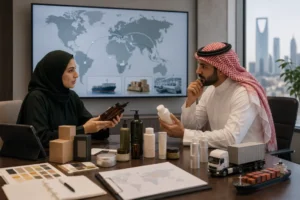
Retailers and distributors often tell me they feel like they’re gambling when they choose a manufacturing partner. That stops today. In this industry, your supplier isn’t just a vendor; they’re the silent co-founder of your brand’s consistency. I’ve built and managed production for over fifteen years, and I’ve watched too many great retail concepts crumble under poor manufacturing matches.
This checklist is my way of tipping the odds back in your favor. It’s warm, straightforward, and built entirely around the questions your future hair care factory should be able to answer without flinching.

Build a Product Brief Before Contacting Factories
A factory cannot quote or assess feasibility accurately from a request such as “I need a premium shampoo.” Before searching, prepare one version of the brief and send the same core information to every candidate. That makes later comparisons far more meaningful.
| Brief item | What to specify | Why it matters |
|---|---|---|
| Product and customer | Shampoo, conditioner, mask, serum, styling product, hair color, or treatment; intended user and use case | Determines equipment, technical expertise, packaging, testing, and regulatory pathway |
| Target market | Countries, sales channels, salon or retail use, and launch claims | Changes label, ingredient, responsible-party, notification, and documentation needs |
| Development route | Ready formula, semi-custom adjustment, buyer-owned formula, or full custom development | Affects cost, ownership, sampling, MOQ, testing, and timing |
| Performance direction | Benchmark product, texture, fragrance, foam, hold, shade, finish, and measurable priorities | Gives the laboratory a specific target instead of subjective words such as “luxury” |
| Formula constraints | Preferred or excluded ingredients, claim restrictions, allergen concerns, and certification goals | Allows an early feasibility and sourcing review |
| Packaging | Fill size, format, dispensing system, decoration, carton, and sustainability requirements | Component MOQs and compatibility can control the whole project |
| Commercial plan | Number of SKUs, quantity per SKU, target cost, forecast, launch date, and delivery country | Helps the factory propose a realistic production route and quotation |
Also decide which points are mandatory and which are preferences. If the target cost, packaging, formula complexity, quantity, and deadline conflict, the factory should be able to explain the trade-off rather than simply promise everything.
Why Partner with a Professional Manufacturer?
Partnering with a professional hair care manufacturer does more than streamline production—it accelerates your market growth. Whether you are launching a startup line or expanding an existing retail footprint, an experienced partner provides the resources and scalability needed to stay competitive in the hair care industry.
- Access to Formulation Expertise: Experienced labs offer advanced R&D capabilities to help create effective, market-ready formulas.
- Cost-Effective Production: Working directly with a manufacturer reduces sourcing costs while improving supply chain efficiency.
- Customization Options: Many facilities provide OEM and private label services, allowing you to customize formulas, packaging, and branding to your exact specifications.
- Consistent Quality Control: Reliable partners follow strict safety standards, ensuring every batch complies with industry regulations.
- Scalable Capacity: As your business grows, a properly vetted facility can comfortably support larger volumes and faster turnaround times.
Where to Find a Hair Care Factory: The Best Sourcing Channels
Finding a hair care factory isn’t the hard part—finding the right one is. The sourcing channels you leverage shape the quality of your initial leads and the transparency of your early conversations. Successful brand founders treat sourcing like a multi-channel campaign, casting a wide net before narrowing down with precision.
1. Online Directories and B2B Platforms
For most founders, the search begins online. B2B platforms give you immediate access to hundreds of suppliers and verified business credentials. The challenge is filtering intelligently so you don’t waste weeks chasing unqualified leads.
The Platforms Worth Your Time:
- Alibaba & Made-in-China: Best for broad OEM/ODM capabilities and highly competitive pricing. Look for Gold/Audited Supplier badges and Trade Assurance coverage.
- Keychain & ThomasNet: Ideal for North American contract manufacturers with transparent MOQ and verified production capabilities.
- ICMAD Directory & Kompass: Excellent for independent cosmetic manufacturers and global supplier discovery across specific product depths.
Search Smarter, Not Harder:
Typing broad terms yields thousands of generic results. Instead, search by product specificity (e.g., “keratin treatment OEM”). Before reading a listing, filter by GMP or ISO certifications to eliminate unqualified suppliers instantly. Finally, read the negative reviews—how a supplier handles problems tells you far more than a five-star rating.
2. Trade Shows and Industry Events
If online platforms give you breadth, trade shows give you depth. The ability to physically handle a product, look a representative in the eye, and assess their technical knowledge is irreplaceable. These events consistently attract serious manufacturers of hair products and generate meaningful sourcing conversations.
Key Trade Shows for Sourcing:
- Cosmoprof Worldwide Bologna (Italy)
- Cosmoprof North America (USA)
- in-cosmetics Global (Rotating European locations)
- China Beauty Expo (Shanghai)
How to Prepare:
A trade show without preparation is expensive sightseeing. Six weeks before the show, research exhibitor lists and pre-identify target facilities. While there, ask formulation-level questions. A sales representative who cannot speak to ingredient functionality is a red flag regarding the facility’s actual R&D depth.
3. Referrals, Industry Networks, and Social Media
The sourcing channel most people underestimate is their existing network. A referral from a brand owner who has navigated quality issues and bulk orders is invaluable, especially if you are seeking specialized natural hair products manufacturers.
Communities on LinkedIn, specialized Facebook groups, and industry Slack channels are active ecosystems where founders share genuine recommendations. When reaching out for referrals, be specific. Asking, “Can you recommend an OEM manufacturer for sulfate-free scalp serums?” yields much better results than “Do you know any good factories?”
The Pre-Qualification Checklist: What to Verify
There is a version of the sourcing process where a founder contacts ten facilities, falls in love with the first hair care factory that sends a beautiful sample, and signs an agreement weeks later. That rarely ends well. Run every candidate through this verification framework before sending a single inquiry.
Certifications and Compliance
Certifications are independently verified evidence that a facility operates at a defined standard of safety and consistency.
- GMP and ISO 22716: GMP is the foundational quality framework for cosmetics. ISO 22716 is the internationally recognized standard for cosmetic manufacturing, verifying everything from raw material intake to finished product testing. Verify the issuing body and the expiration date.
- FDA Registration: For U.S. brands, the Modernization of Cosmetics Regulation Act (MoCRA) requires mandatory facility registration. A partner producing for the U.S. market should already be compliant.
- Regional Standards: Ensure compliance with CPNP for the EU market, BPOM for Indonesia, or COSMOS for certified organic claims.
Factory Ownership vs. Trading Company
A factory and a trading company can look identical online. However, factories own their production floor and control raw material quality directly. Trading companies act as intermediaries.
To tell the difference, request their manufacturing permit. Ask for unedited production floor photos with visible company signage. If they hesitate or provide suspiciously round capacity numbers, you are likely speaking with a trading company.
Production Capacity and MOQs
Even when a hair product factory checks every certification box, Minimum Order Quantities (MOQs) determine if the partnership is viable.
- Private Label: 48 – 500 units per SKU
- OEM (Standard Packaging): 500 – 2,000 units per SKU
- Custom Formula: 3,000 – 10,000+ units per SKU
Ask about their monthly capacity and lead times for reorders. A facility that fits your needs today but creates a bottleneck during your peak season is not the right long-term partner.
The 4-Step Process of Collaborating with Your Hair Care Factory
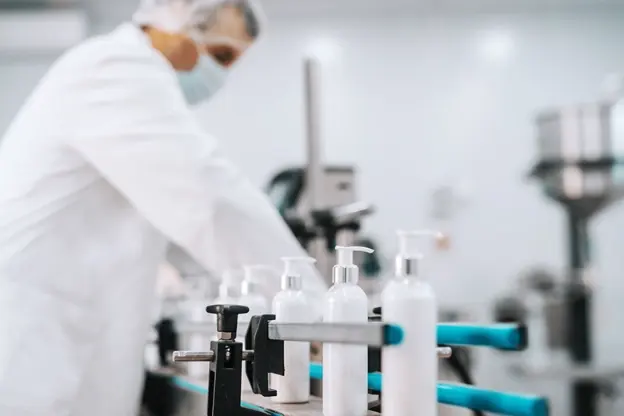
You’ve pre-qualified the facility and agreed on terms. Now, the real work begins. Bringing a cosmetic product to life is a methodical chemical process. Here is the exact collaboration process you should expect.
Once a factory passes pre-qualification, convert the sales conversation into documented product development. The exact stages may overlap, but approval points should remain clear.
Step 1 — Briefing and Formula Development
Share the approved brief, benchmark, target market, claims direction, formula constraints, packaging idea, cost target, and timeline. Agree whether the route is ready formula, semi-custom, buyer-provided formula, or full custom development. Define sample fees, feedback format, revision scope, ownership, and what constitutes formula approval.
Before contacting a factory, make the requested development role explicit. The OEM hair products sourcing guide explains what buyers should prepare when they need production support for their own hair care concept.
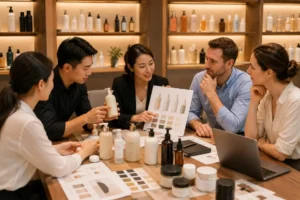
Evaluate samples against written criteria such as appearance, fragrance, viscosity, foam, spread, hold, rinse feel, shade, and packaging behavior. The number of iterations should follow the project rather than a fixed rule.
Step 2 — Testing and Product Specification
Testing should be risk-based and aligned with the formula, packaging, claims, intended use, target market, and available safety information. Possible work includes stability, packaging compatibility, microbiological quality, preservative-effectiveness assessment for relevant products, safety substantiation, performance or claim support, and market-specific testing.
The FDA’s cosmetics testing overview notes that there is no single prescribed test list for every cosmetic, while manufacturers or distributors remain responsible for product safety. Agree who commissions each test, which method or acceptance criteria apply, how failures are handled, and who owns the reports.
Step 3 — Packaging, Artwork, and Production Setup
Approve the bottle or tube, closure, pump, liner, decoration, label, carton, case pack, fill volume, batch-code location, and transport packaging. Review formula-packaging compatibility and confirm component specifications before purchasing large quantities.
Artwork approval should include the INCI list, net contents, directions, warnings, responsible-party information, language, claims, and market-specific elements. A pilot or line trial may be appropriate for a new component or difficult formula, but the size and scope should be agreed according to actual risk and factory setup.
Step 4 — Bulk Production, Release, and Shipping
Before production, approve the final formula, specifications, packaging, artwork, purchase order, and inspection criteria in writing. During or after production, review the agreed in-process and finished-product checks.
Before release or final payment, confirm batch codes, quantity, packaging, case marks, relevant test results, and the Certificate of Analysis when applicable. A CoA reports results against defined batch specifications; it does not by itself prove every aspect of formula identity or regulatory compliance. Use retained samples, approved references, batch records, and inspection evidence together.
Why Source Hair Care Products from China?
If you are dismissing Chinese manufacturing due to outdated stereotypes, you are leaving margin on the table. China features a highly mature, localized supply chain where raw material providers, packaging extruders, and filling lines operate within massive industrial hubs. This vertically integrated ecosystem means lower MOQs and the agility to scale rapidly.
Before choosing a country for the shortlist, separate the brand address from the manufacturing site. Our global hair product manufacturing guide explains how formula development, ingredients, packaging and production can involve different locations.
Global Sourcing Comparison
| Evaluation Criteria | Chinese Manufacturers | Western Manufacturers (US/EU) |
| Unit Cost | Highly cost-effective; localized raw materials. | Premium pricing; higher labor/operational costs. |
| Integration | Exceptional; ingredients and packaging are co-located. | Fragmented; often requires multi-state shipping. |
| MOQs | Lower and highly flexible. | Often steep to offset setup costs. |
| Communication | Requires patience with time zone differences. | Seamless aligned working hours. |
| R&D | Rapidly replicates trends and tweaks bases. | Cutting-edge clinical and highly specialized formulations. |
How We Help Brands Evaluate Manufacturing Fit at Keronhair
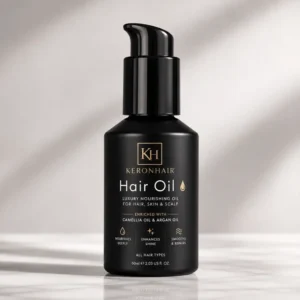
At Keronhair, we prefer to begin with the same information this guide recommends: product category, market, benchmark, formula direction, packaging, quantity, cost target, and launch timing. That lets us discuss fit and trade-offs before asking a buyer to commit to production.
- Formula route: We discuss whether a ready formula, semi-custom adjustment, or full custom project is the practical starting point.
- Sampling: We coordinate sample feedback around specific attributes such as texture, fragrance, viscosity, shade, application, and performance direction.
- Packaging: We review component options alongside fill size, formula, dispensing method, decoration, component MOQ, and transport needs.
- Quality review: We can organize applicable facility information, current certificates, product specifications, ingredient information, batch documents, and project-specific records for buyer review.
- Production planning: Written formula, packaging, artwork, quantity, and inspection approvals help define the move into bulk production.
If you are comparing manufacturers, send the same brief and document request to Keronhair and the other shortlisted candidates. Our OEM/ODM manufacturing overview explains the development routes we support. A useful first conversation should clarify what fits, what needs testing, what affects MOQ, and what still requires verification.
Conclusion
Finding the right hair care factory is a sequence of informed decisions. From clarifying your manufacturing model and identifying credible sourcing channels to verifying custom formulation capacities, every step compounds. The brands that succeed do not just find a supplier—they build a resilient partnership dedicated to growing your brand for the long haul. Start methodically, and the results will follow.
Frequently Asked Questions
What is the MOQ for a hair care factory?
The MOQ typically ranges from 1,000 to 3,000 units for private label and 5,000 to 10,000+ units for custom formulations. This covers raw materials, lab testing, and line setup. Many facilities offer lower MOQs for trial orders.
What certifications should a hair care manufacturer have?
A reputable manufacturer must hold ISO 22716 and cGMP. Depending on your market, verify region-specific compliance, such as FDA registration (US), CPNP (EU), or COSMOS (for clean beauty claims).
How do I know if a hair care factory is a direct supplier or a trading company?
Check their business license for a scope stating “Manufacturing” rather than “Trading.” Request dated photos of the production floor with your company name visible, and ask for precise daily output data. Real factories know their exact vat volumes.
What is the difference between OEM, ODM, and private label?
Private label uses the factory’s pre-existing stock formula with your branding. ODM allows slight modifications to existing base formulas. OEM involves creating a completely custom formulation from scratch, requiring higher MOQs and longer lead times.
How many factories should I compare?
Compare enough qualified candidates to understand realistic options without creating an unmanageable sampling process. Use the same brief and scorecard. Remove candidates that cannot meet non-negotiable legal, technical, quality, quantity, or market requirements before paying for multiple samples.
What should I include in a factory scorecard?
Score legal and site verification, relevant product capability, quality system, regulatory support, sample performance, testing plan, packaging, MOQ, total landed cost, lead time, capacity, communication, contract terms, change control, and corrective-action handling. Weight the factors according to your product risk and business model.