Choosing between wholesale hair dye suppliers is not simply a matter of comparing catalogs and unit prices. An authorized distributor, a private label supplier, and an OEM manufacturer may all sell hair color in bulk, but they offer very different levels of product control, technical support, documentation, and customization.
The right partner fits your supply model, hair color system, target market, evidence requirements, and reorder plan. A strong selection process therefore moves through four stages: define what you need, compare candidates against the same scorecard, test samples under controlled conditions, and use a pilot order to approve or reject the final supplier.
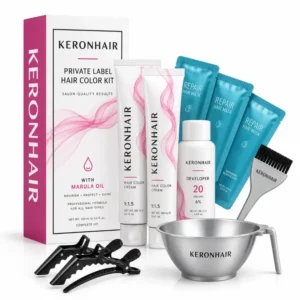
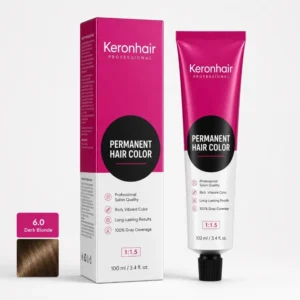
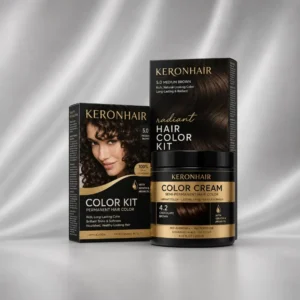
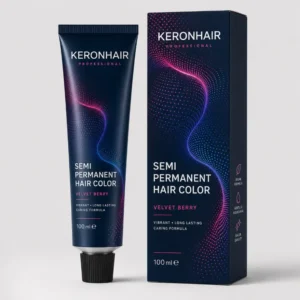
For brands considering an own-label range, Keronhair’s private label hair dye manufacturing page provides a useful starting point for discussing formula direction, shade planning, sample approval, packaging, and production scope.
Wholesale Hair Dye Supplier, Distributor, or Manufacturer: Which Do You Need?
The word “supplier” describes a commercial relationship, not necessarily the company’s role in the supply chain. Before comparing candidates, confirm what each business actually controls. Does it own inventory, hold authorization to resell a brand, manage product development, operate production, or coordinate several third parties?
| Supplier type | What you typically buy | Best fit | Customization level | Main verification question |
|---|---|---|---|---|
| Authorized wholesaler | Finished products from an established brand | Salons and retailers that want recognized professional products | None or very limited | Can the seller document authorization and product traceability? |
| Multi-brand distributor | Finished products from several brands | Retailers, importers, and salons building a broad assortment | Usually limited | How are authenticity, storage, expiry, territory rights, and replenishment controlled? |
| Ready-made private label supplier | Existing formulas sold under the buyer’s brand | New brands testing a focused range | Branding, packaging, and selected product adjustments | Which elements are truly customizable, and which remain standard? |
| OEM/ODM manufacturer | Ready-to-brand, adapted, or custom hair color products | Brands seeking greater control over formula, shades, packaging, or a complete color system | Moderate to extensive, depending on the project | Who develops, manufactures, approves, and releases each product component? |
An independent salon restocking established color brands may benefit from an authorized wholesaler with dependable local inventory. A distributor may prioritize assortment breadth, territory rights, and consolidated shipping. A beauty brand building proprietary packaging or a coordinated color-and-developer system is more likely to need a manufacturer.
It helps to compare the supply channel before comparing individual companies. Our seven-source bulk hair dye comparison separates distributors, salon wholesalers, marketplaces and manufacturing partners by the buying model they support.
The labels OEM, ODM, private label, and white label are not used consistently across the industry. Compare the work included rather than relying on terminology alone. Keronhair’s overview of OEM and ODM manufacturing options can help buyers frame that discussion.
A salon, distributor and own-label brand can require different supply structures from the same supplier. The hair dye wholesale guide provides a buyer-type framework for choosing the assortment and approval process before comparing offers.
Define Your Requirements Before You Build a Supplier Shortlist
A vague request for “your best wholesale price” encourages vague proposals. Before contacting suppliers, prepare a one-page sourcing brief that gives every candidate the same commercial and technical starting point.
Define the Product System and Sales Channel
Start with the product the customer will actually buy or use. It may be a permanent color cream, a semi-permanent direct dye, a color-depositing shampoo, a developer, a lightener, or a multi-component retail kit. A supplier that performs well in one format may not be the right choice for another.
Your channel also changes the project. A professional salon range needs practical shade identification, mixing instructions, developer pairing, and convenient replenishment. A retail or ecommerce kit needs clear contents, consumer-facing directions, warning space, durable packaging, and a controlled experience for a less experienced user. A distributor needs an assortment that can be registered, stored, sold, and reordered across its intended territory.
Set the Target Market and Claim Boundaries
Name the destination market before asking whether a formula is “compliant.” Hair dye ingredients, warnings, labeling, responsible-party obligations, and notification or listing processes depend on the product and jurisdiction.
The European Commission describes hair dye products as cosmetics regulated under the EU Cosmetic Products Regulation. In the United States, hair dyes sit within the cosmetics framework, with additional nuances for certain hair-dye colorants and warning language. Buyers should review the current FDA hair dye information and obtain market-specific professional advice where necessary.
Treat claims such as ammonia-free, PPD-free, vegan, natural, botanical, or professional-grade as specifications that need definitions and support. The supplier may contribute formula information and documentation, but the brand, importer, distributor, or responsible person may retain important market obligations.
Estimate the Launch Range, Volume, and Customization Level
Provide the proposed number of shades, quantity per shade, fill size, packaging format, target launch date, and an honest reorder forecast. Mark each requirement as must-have, preferred, or open to recommendation.
Also identify the development route:
- Ready-made formula with standard packaging for a faster, simpler launch
- Existing formula platform with selected shade, fragrance, ingredient, or packaging adjustments
- Custom development based on a detailed performance and positioning brief
Minimums may arise at formula, shade, filling, tube, label, carton, insert, or kit level. Ask candidates to expose those dependencies instead of quoting one unexplained MOQ. If the concept needs meaningful formula differentiation, review the scope of custom hair care formulation support before assuming every requested change is a simple private label adjustment.
Use a Scorecard to Compare Wholesale Hair Dye Suppliers
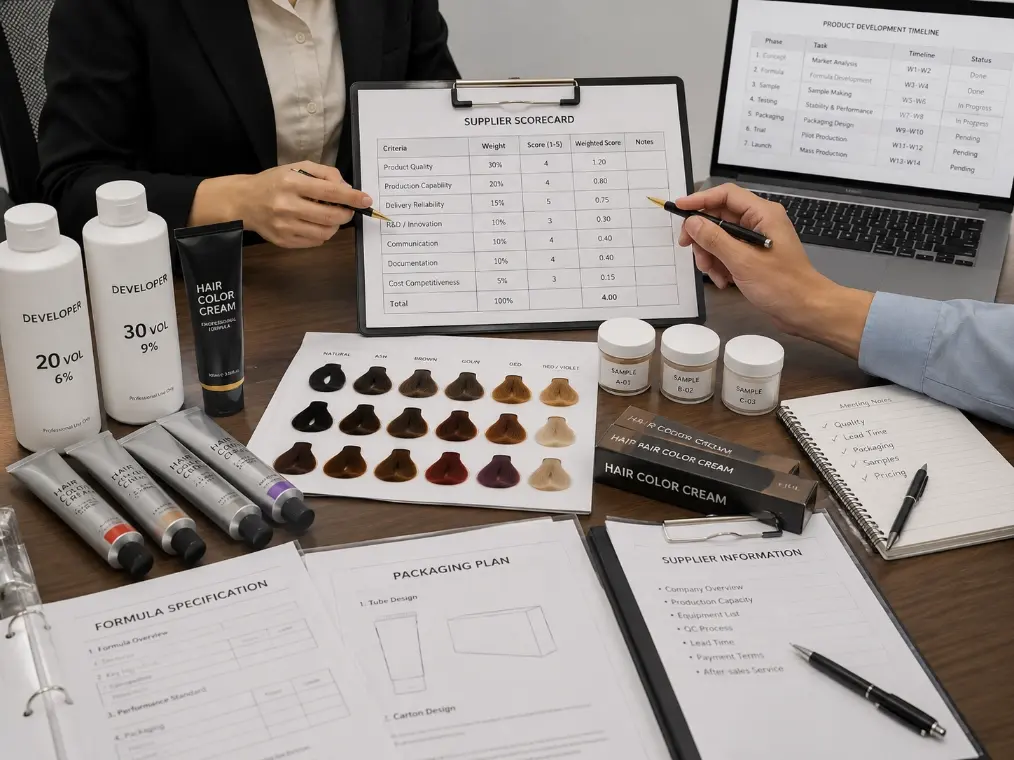
Supplier websites are designed to present strengths. A scorecard helps buyers compare the evidence behind those claims. Send the same questions to each candidate, record what was reviewed, and separate confirmed facts from open risks.
| Evaluation area | What to examine | Useful evidence | Buyer decision |
|---|---|---|---|
| Product and technical fit | Relevant formats, shade development, developer pairing, packaging, and kit scope | Product specifications, coded samples, shade records, component scope, and technical discussion | Can this supplier execute the actual project? |
| Quality systems and market readiness | Manufacturing controls, certificate scope, product documents, and target-market support | Current certificates, document samples, batch information, test summaries, and responsibility matrix | Is the evidence relevant, current, and connected to the product? |
| Operational and reorder fit | MOQ structure, planning, component sourcing, approved versions, and change notification | Written commercial scope, version-controlled specifications, reorder terms, and change process | Can the supplier reproduce and replenish the product? |
| Communication and issue response | Ownership, response quality, escalation, complaints, and corrective action | Named contacts, written decisions, issue workflow, and example forms where available | Will problems be visible and manageable? |
Use a simple one-to-five score if it helps, but do not let a high total conceal a critical failure. A supplier that cannot support the intended hair color format or target market should not pass merely because it communicates quickly.
Product and Technical Fit
Ask for exact product formats rather than a general claim that the company “makes hair dye.” Permanent oxidative color, direct dyes, color shampoos, bleaching products, developers, and care products involve different formulation, use, packaging, and approval considerations.
Formula Formats and Shade Capability
Discuss how the supplier develops or selects a shade, what reference it uses, and how it records revisions. If the project involves gray coverage, lift, fashion shades, or a particular fade direction, define the starting hair and application system before evaluating promises.
The objective is not to count the largest shade library. It is to determine whether the supplier can translate your brief into a controlled, repeatable specification.
Developer, Kit, and Packaging Coordination
If the offer includes color cream and developer, confirm the exact pairing, mixing ratio, intended use, and approval method. A catalog containing both components does not prove that the quoted combination has been evaluated as one system.
For retail kits, assign responsibility for every element: colorant, developer, gloves, applicator, instructions, aftercare, carton, labels, coding, and assembly. Packaging should be reviewed together with formula compatibility, filling, closure performance, label space, and transport conditions.
Evidence, Quality Systems, and Market Readiness
Certificates and documents are useful only when their identity, scope, and relevance are understood.
Certificate Identity, Scope, and Validity
For each certificate, check the legal company name, facility address, certificate number, scope, issuing body, and validity dates. Confirm that it relates to the site performing the work, rather than an unrelated office, trading company, or partner.
ISO 22716, for example, provides cosmetics GMP guidelines covering production, control, storage, and shipment. A certificate associated with that standard may support a facility review, but it does not automatically establish that every product meets every destination-market requirement.
Product-Specific Documents and Market Support
Agree on the information required for the actual product and market. Depending on the project, that discussion may include the ingredient declaration, safety data sheet, certificate of analysis, batch details, specifications, relevant testing information, labeling inputs, and traceability records.
Be cautious with “FDA approved” claims. The FDA explains that it does not approve cosmetics before marketing in the way it approves drugs; color additives have specific rules, and coal-tar hair dyes have particular statutory treatment. Facility registration or product listing should not be presented as FDA endorsement. The MoCRA framework also places responsibilities on relevant industry parties, including safety substantiation and, where applicable, facility registration and product listing.
Operational Fit and Reorder Reliability
Ask how the first approved sample becomes a repeatable order. The supplier should be able to identify formula, shade, packaging, and artwork versions; explain minimums by component; and describe how it handles discontinued materials or proposed substitutions.
Confirm whether sample, pilot, first-production, and reorder quantities follow different conditions. If the supplier buys extra printed packaging, establish who owns it, where it is stored, and whether it can be used later. A low opening price can lose its value if a second order requires unexpected component purchases or an unapproved material change.
For overseas sourcing, compare the complete operating model rather than treating country as a shortcut for quality or risk. This China vs. local manufacturer guide offers additional comparison dimensions.
Communication, Ownership, and Issue Response
Good communication is specific, traceable, and connected to a responsible person. Confirm who owns commercial decisions, formulation questions, packaging, quality review, and shipment coordination. Important approvals should be written and versioned.
Ask what happens if a batch differs from the approved sample, packaging leaks, labels are incorrect, or quantities are short. The supplier should explain what evidence it needs, who investigates, how temporary actions are taken, and how corrective action is recorded. Commercial remedies belong in the agreement; the evaluation stage should establish whether a workable process exists.
Test Product Performance Before You Trust the Sample
A sample is useful only when the buyer knows what was tested and can reproduce the conditions. Hair color results depend on the starting substrate, previous processing, developer, mixing ratio, application amount, processing time, temperature, rinse method, and aftercare.
Plan a Comparable Sample Round
Give shortlisted suppliers the same brief. Record the supplier name, sample code, formula and shade version, date received, intended market, and intended use. Do not compare one candidate’s permanent cream with another candidate’s semi-permanent direct dye as though they answer the same project.
Decide who will evaluate the samples and which observations matter. Use qualified technical or salon professionals where appropriate. Product-performance screening does not replace a suitable safety assessment, regulatory review, or testing program.
Evaluate Each Shade Under Controlled Conditions
Create a test sheet for every sample and keep photographs as supporting records, not as the only acceptance criterion.
Starting Hair Level and Substrate
Record the starting level, color history, gray percentage where relevant, porosity, condition, and whether the swatch is natural, previously colored, or bleached. A vivid result on a light pre-bleached swatch cannot predict performance on dark untreated hair.
Developer, Mixing Ratio, and Processing Time
Document the exact developer or activator, strength where applicable, mixing ratio, application quantity, processing time, temperature, rinse method, and post-color care. If the product is claimed for several application conditions, decide which ones require separate evaluation.
Shade Result, Gray Coverage, and Uniformity
Compare the result with the agreed reference. Review depth, tone, unwanted shift, coverage, and uniformity. For a shade family, check whether the coding and tonal logic remain coherent rather than judging each tube in isolation.
Wash, Fade, and Tonal Shift
Plan a consistent wash evaluation suited to the product. Observe how quickly intensity changes, whether the tone shifts in an undesirable direction, and whether shade behavior remains understandable for the intended user. Avoid promising a universal wash count unless it is supported under defined conditions.
Review Application and Sensory Performance
Record mixing behavior, texture, spreadability, odor, application control, rinsing, and after-feel. These observations can affect salon workflow and user acceptance even when the final shade appears acceptable.
Separate objective findings from preferences. “The mixture remained uniform during the agreed processing period” is more useful than “the texture felt premium.” If several evaluators are involved, use the same rating definitions.
Check Formula and Packaging as One System
Evaluate leakage, sealing, dispensing, tube or bottle deformation, legibility, instruction space, and the condition of components after relevant handling or transport simulation. A technically suitable formula can still fail commercially if the pack is hard to use or cannot protect the product as intended.
When one supplier provides dye and developer, confirm that both components and their packaging belong to the approved system. This guide to sourcing hair dye and developer together explains why component ownership and pairing matter.
Freeze the Approved Reference
Approval should identify the sample code, formula and shade version, test conditions, packaging components, artwork version, dated approvers, and any unresolved limits. Both parties should know which sample, swatch, photographs, specifications, and documents are retained.
The FDA notes that it does not prescribe one universal list of tests for every cosmetic product or ingredient. Companies remain responsible for safety, and testing decisions should be scientifically sound and appropriate to the available information, formula, packaging, and intended use. Its cosmetic product testing guidance is a useful regulatory starting point.
Red Flags That Should Stop or Slow the Buying Process
Red flags do not always require immediate rejection. Some justify a pause and a request for better evidence; others reveal a mismatch that should end the discussion.
Unclear Business Identity or Brand Authorization
Slow down if the company name, payment recipient, certificate holder, manufacturer, and shipping party do not align and the supplier cannot explain the relationships. For established branded products, request authorization and traceability evidence. For private label work, ask who actually makes and releases the product.
Unverifiable or Overbroad Compliance Claims
Treat cropped certificates, unexplained logos, “approved in every country,” and “100% compliant worldwide” as warnings. A responsible supplier asks about the destination market, formula, user, label, and claims before defining its support. Registration is not approval, and a factory certificate is not a substitute for product-specific review.
Moving Sample, MOQ, or Specification Terms
Repeated changes are concerning when they lack reasons and version control. Watch for samples that change without new codes, unexpected per-shade minimums, packaging substitutions after approval, or late quotation exclusions.
No Written Path for Batch Issues
“There will never be a problem” is not a quality process. A credible partner should be willing to discuss retained evidence, investigation, nonconforming goods, corrective action, and commercial escalation. If the supplier refuses to define how bulk production will be compared with the approved reference, the buyer cannot meaningfully control the order.
Run a Pilot Order and Approve the Best-Fit Partner
A pilot order tests more than the formula. It shows whether the supplier can transfer the approved project into production, coordinate packaging, maintain records, communicate changes, and prepare the shipment as agreed.
Freeze the Pilot Scope Before Paying a Deposit
The pilot purchase order or attached specification should identify:
- Formula and shade versions
- Quantity by SKU and approved packaging components
- Artwork, labeling, coding, and case configuration
- Documents and inspection evidence included in the scope
- Acceptance criteria and comparison method
- Named contacts and written change-approval path
Resolve open assumptions before payment. If an item remains provisional, label it as provisional and assign an owner and deadline.
Review the First Production Run Against the Approved Reference
The review should follow the agreed risk level and scope. It may be performed by the buyer, supplier, or a qualified third party, depending on the project.
Product and Shade Comparison
Compare coded production samples with the approved reference using the same defined conditions. Record acceptable variation, any deviation, and the disposition decision. Do not rely solely on supplier photographs or a verbal statement that the products are “the same.”
Packaging, Coding, and Shipment Readiness
Check the correct component and artwork versions, fill presentation, closures, labels, batch coding, case packing, and visible shipment condition. For kits, verify that all required items and instructions are present.
Batch Records and Release Evidence
Confirm that the agreed batch or release information is available and matches the products being shipped. The exact documents depend on the product, market, and commercial agreement, so they should be defined before the order rather than requested at the last minute.
Record an Approve, Conditional Approval, or Reject Decision
Use one of three documented outcomes:
- Approve: The agreed critical criteria are met, and the supplier may proceed under the defined reorder controls.
- Conditional approval: The supplier can proceed only after named open items are closed by an agreed date.
- Reject: A critical product, evidence, responsibility, or reliability requirement has not been met.
Store the supplier scorecard, approved sample record, pilot evidence, deviations, corrective actions, and final decision together. This file becomes the starting point for the second order.
Match the Final Partner to Your Business Model
| Buyer | Best-fit starting partner | Main priority | Evidence to confirm | Practical next step |
|---|---|---|---|---|
| Independent salon buying known brands | Authorized wholesaler or distributor | Authenticity and convenient replenishment | Authorization, traceability, storage, and stock terms | Test ordering and replenishment service |
| Salon group launching an own-label line | Private label supplier or manufacturer | Professional usability and a focused shade system | Samples, developer pairing, instructions, and reorder controls | Pilot a small core range |
| Distributor or importer | Distributor, manufacturer, or mixed supply base | Market readiness and portfolio continuity | Rights, documents, case configuration, forecast, and change control | Approve suppliers by category |
| Startup beauty brand | Ready-made or adapted private label partner | Controlled complexity and inventory exposure | Exact customization, component minimums, samples, and total scope | Validate a limited hero range |
| Established beauty brand | OEM/ODM manufacturer with relevant technical depth | Differentiation and repeatable scale | Development records, specifications, production transfer, and change management | Run a formal development and pilot program |
No wholesale hair dye supplier is the best fit for every buyer. Choose the partner whose actual controls match the business you are building—not the one with the largest catalog or the boldest promises.
Keronhair supports project discussions for private label and OEM/ODM hair color. To request a supplier-fit review, share your target market, product format, shade plan, packaging direction, quantity per shade, and preferred launch timing. These inputs allow the team to discuss a relevant route without relying on a generic catalog request.
Frequently Asked Questions About Wholesale Hair Dye Suppliers
How Do I Find Reliable Wholesale Hair Dye Suppliers?
Start with the supplier type your business needs, then verify company identity, product fit, documentation, samples, and pilot-order performance. Use the same scorecard for every candidate.
Is It Better to Buy Hair Dye from a Distributor or a Manufacturer?
Choose a distributor for established brands, assortment breadth, and convenient replenishment. Choose a manufacturer when you need private labeling, formula or shade control, custom packaging, or a coordinated product system.
What Should I Request Before Placing a Bulk Hair Dye Order?
Request the approved sample and specification, component scope, artwork versions, MOQ breakdown, quotation inclusions, production plan, agreed documents, change procedure, and process for handling nonconforming goods.
Can I Test Hair Dye Samples Before Committing to a Supplier?
Yes. Compare coded samples under controlled conditions, recording the starting hair, developer, mixing ratio, processing time, shade result, application properties, packaging, and sample version.
How Can I Check Whether a Supplier’s Certifications Are Valid?
Check the legal name, facility address, scope, certificate number, issuing body, and validity dates. Where possible, confirm the certificate through the issuer or certification body.
Can One Supplier Provide Both Hair Dye and Developer?
Yes, but confirm the exact formula pairing, mixing instructions, manufacturer of each component, packaging responsibility, sample approval method, and who releases the finished color system.