Choosing between China vs local hair care manufacturers is not only a question of price. For a beauty brand, salon line, ecommerce brand, distributor, or sourcing team, the real decision is product fit, development speed, quality evidence, compliance responsibility, packaging, logistics, and supply stability.
Some brands assume China manufacturing is always cheaper. Others assume local manufacturing is always safer or easier. Both assumptions can lead to weak supplier decisions. A stronger sourcing process compares the actual project: formula complexity, target market, order plan, documentation needs, and the supplier’s ability to support the brand after the first sample.
This guide explains how to compare China and local hair care manufacturers in a practical B2B way for shampoo, conditioner, masks, scalp care, oils, serums, hair dye, styling products, and private label hair care lines. It also shows where Keronhair may fit, while keeping exact MOQ, lead time, certifications, and documentation support subject to direct confirmation.
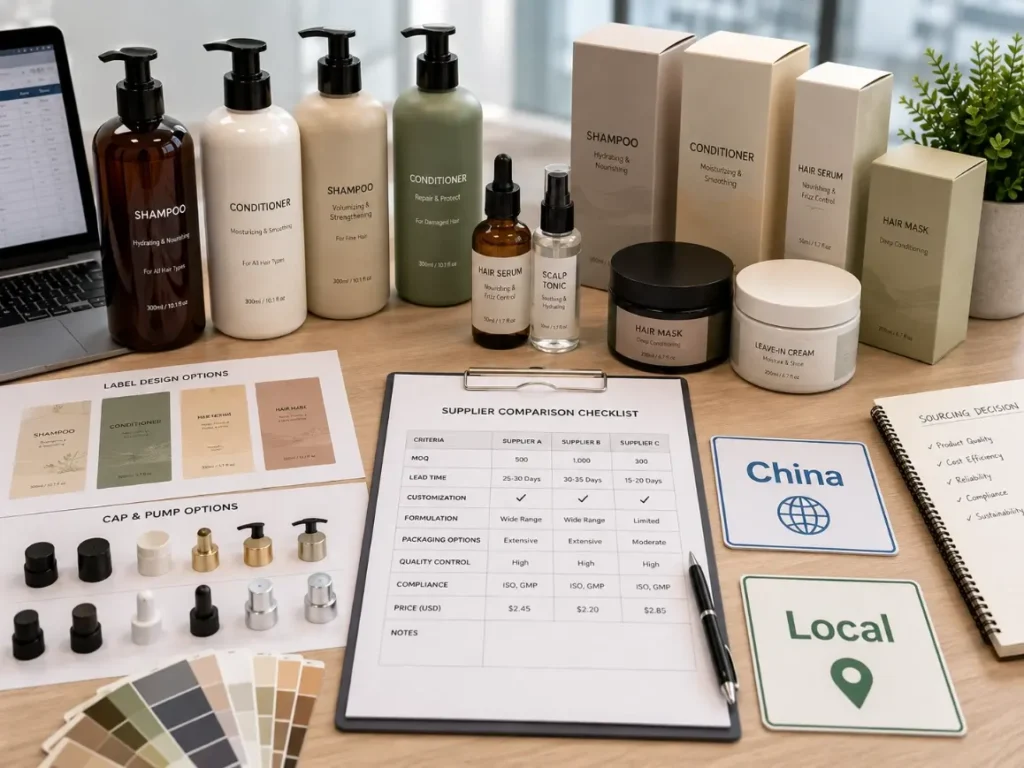
China vs. Local Hair Care Manufacturers: What Buyers Are Really Comparing
When buyers compare China and local hair care manufacturers, they are usually comparing much more than geography. A China manufacturer could mean an OEM/ODM factory, private label supplier, formula developer, or packaging-heavy sourcing partner. A local manufacturer could mean a domestic contract manufacturer, small-batch lab, salon-focused supplier, or regional cosmetic manufacturer.
The supplier’s actual process matters more than country alone.
Why Country Alone Is Not a Supplier Strategy
Country-based assumptions are risky because supplier quality varies widely in every market. A China-based manufacturer may have strong category experience and clear export communication. A local manufacturer may be easier to visit but less suitable for a complex hair color line or custom packaging project. The reverse can also be true.
Instead of asking, “Which country is better?” ask, “Which supplier can support this product, target market, launch stage, and risk profile?”
What “Local” Means for U.S., EU, UK, or Australian Brands
“Local” usually means a manufacturer in the brand’s home market or primary sales region. For a U.S. brand, it may mean a domestic contract manufacturer. For an EU brand, it may mean an EU or nearby regional partner.
Local manufacturing can help with time-zone alignment, sample review, domestic positioning, and smaller trial runs. It does not automatically solve compliance, quality, or cost issues. The brand still needs to verify formula ownership, ingredient documentation, label responsibility, quality records, and consistency.
The Core Comparison Dimensions Buyers Should Use
Product and Formulation Fit
Start with the product, not the country. Shampoo, salon hair color, scalp serum, and hair wax all require different formulation, packaging, stability, and claim review questions.
Cost, MOQ, and Landed Cost
Unit price is only one part of sourcing. Compare sampling, packaging, tooling, freight, duties, warehousing, inventory risk, payment terms, and the cost of delays or rework.
Quality, Compliance, and Documentation
Ask what evidence the manufacturer can provide. Look for process documents, sample approval records, batch traceability, test reports where applicable, certificate details, and clear responsibility for target-market requirements.
Speed, Logistics, and Communication
Speed depends on sample feedback, packaging, artwork approval, production scheduling, shipping, and how quickly both sides make decisions.
Keronhair’s public pages position the company around hair care product manufacturing, OEM/ODM, private label hair care, and custom formulation support in China. If you are evaluating this route, Keronhair’s hair care product manufacturer page can be used as a starting reference, with exact project details confirmed during inquiry.
Quick Decision Matrix: When China, Local, or Hybrid Manufacturing Makes Sense
Most brands need a route that matches their launch plan. The table below gives a practical first filter.
| Manufacturing Route | Best Fit | Possible Trade-Offs | Questions to Ask |
|---|---|---|---|
| China manufacturer | Brands seeking OEM/ODM support, private label hair care, cross-category sourcing, packaging flexibility, or scale potential | Longer-distance communication, shipping planning, import responsibility, need for stronger supplier verification | Can the supplier show category experience, sample process, packaging options, QC records, and export-document support? |
| Local manufacturer | Brands prioritizing proximity, in-market communication, domestic positioning, smaller pilot runs, or local warehouse coordination | Potentially higher unit cost, narrower product or packaging options, capacity limits, less export-oriented support | Can the supplier support your formula, packaging, claims, order plan, and replenishment schedule? |
| Hybrid strategy | Brands testing locally before scaling, using different suppliers by category, or combining overseas production with local warehousing | More coordination, split responsibility, possible consistency issues between suppliers | Who owns formula control, packaging specs, documentation, quality feedback, and reorders? |
When a China Hair Care Manufacturer May Be a Good Fit
A China hair care manufacturer may be worth considering when the brand needs OEM/ODM support, private label products, custom formulation, multiple categories, packaging sourcing, or an export-oriented partner.
For example, a brand planning shampoo, conditioner, hair mask, hair oil, styling wax, and hair color products may want broad sourcing options. Still, verify category experience, sampling workflow, packaging fit, quality documentation, and communication standards.
Keronhair’s OEM/ODM hair product manufacturing page can help buyers frame the type of service discussion to have with a China supplier. Exact MOQ, lead time, sample policy, certificates, and document support should still be confirmed directly.
When a Local Hair Care Manufacturer May Be a Better Fit
Local manufacturing may fit brands that need in-person meetings, domestic positioning, small pilot batches, short replenishment, or a supplier familiar with local retail expectations.
Still, local does not mean effortless. Ask the same hard questions about formula development, batch consistency, packaging compatibility, documentation, claims, and quality controls.
When a Hybrid Manufacturing Strategy Is Worth Considering
Some brands use a hybrid model instead of choosing one route.
Local Pilot, China Scale-Up
A brand may validate positioning, fragrance, texture, or packaging locally, then explore China-based manufacturing when order volume or category needs grow.
China Base Formulas, Local Final Packaging or Warehousing
Some teams split bulk manufacturing, final packaging, labeling, warehousing, or distribution. This requires careful control of formula stability, filling conditions, label responsibility, and batch tracking.
Different Suppliers for Different Product Categories
A brand may use one supplier for shampoo and conditioner, another for hair color, and another for styling products. This works only when specifications and documentation are tightly managed.
Decision Matrix for Brand Teams
Before choosing, score each route against category experience, sampling workflow, total landed cost, target-market support, reorder reliability, and quality feedback.
The strongest route reduces uncertainty.
Original Viewpoint: Build a Sourcing Control System, Not a Country Preference
The most useful question is not “China or local?” It is “Which route gives our team the most control over the risks that can stop the launch?”
For hair care products, that control usually has three layers:
- Formula control: Can the supplier translate the approved sample into repeatable production?
- Evidence control: Can the supplier provide documents, quality checkpoints, certificate details, and label support that your target market requires?
- Replenishment control: Can the supplier support the second and third order without changing packaging, formula feel, or communication quality?
This control-system view is where many generic comparison articles fall short. A nearby supplier with weak documentation can be riskier than a well-managed overseas supplier. A low-cost China supplier with unclear sample control can be more expensive than a higher-priced local supplier. The sourcing route should be judged by how well it protects product consistency, launch timing, and future reorders.
Compare by Product Category and Formula Complexity
Hair care manufacturing decisions change by product type. A basic shampoo is not the same sourcing challenge as a salon hair color system, leave-in serum, scalp care product, or styling wax.
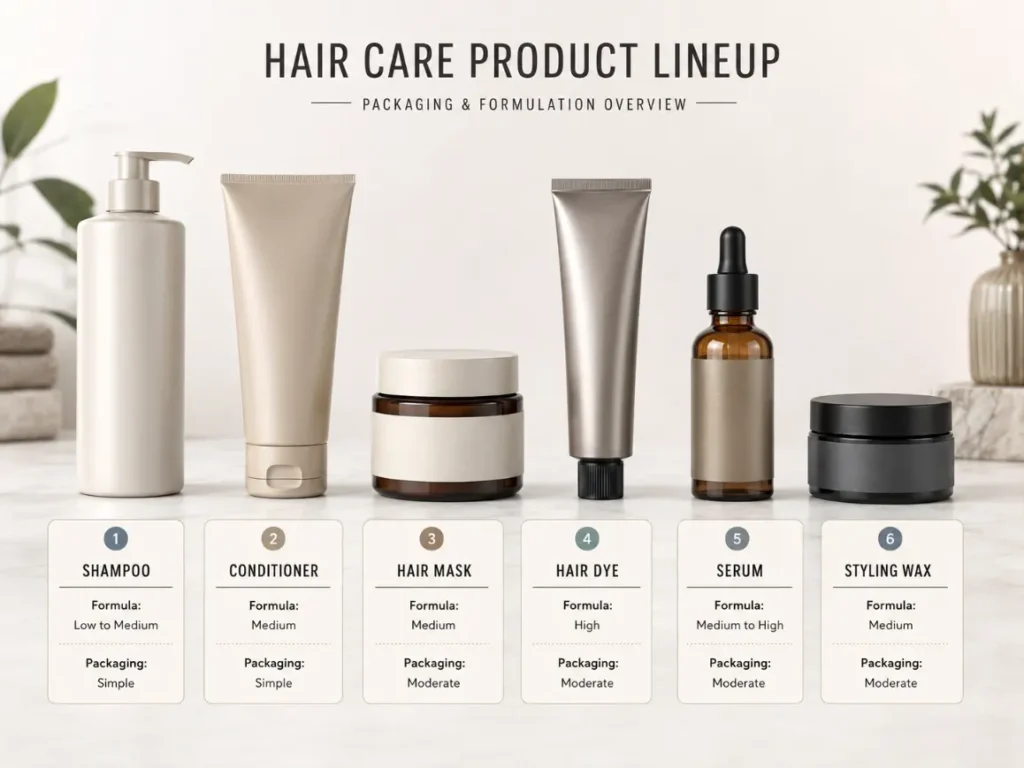
Basic Rinse-Off Products: Shampoo and Conditioner
Shampoo and conditioner are common starting products for private label and OEM hair care brands. They still require decisions around hair type, texture, fragrance, surfactant system, conditioning feel, viscosity, packaging, and claims.
For China vs local comparison, ask whether the supplier can show experience with your intended positioning: moisturizing, clarifying, smoothing, color care, salon backbar, ecommerce retail, hotel amenities, or professional sizes. Keronhair’s custom shampoo manufacturer page is one internal reference for shampoo-related manufacturing discussions, with formula details confirmed case by case.
Treatment Products: Masks, Oils, Serums, and Scalp Care
Treatment products often depend on sensory profile, ingredient positioning, packaging compatibility, and claim boundaries. A hair mask needs texture and rinse feel. A serum may need dropper, pump, or bottle compatibility.
If a supplier says it can make “all hair care products,” ask for category-specific samples, packaging examples, formula route options, and compatibility discussion.
Hair Color and Chemical Treatment Products
Hair dye, developer, bleach, straightening cream, and related products need extra caution. They can involve warnings, patch-test language, oxidation systems, developer compatibility, shade control, salon instructions, and target-market labeling.
Hair Dye, Color Cream, and Shade Systems
Hair color products are more complex than a single SKU. A brand may need shade families, developer pairing, usage instructions, warning language, packaging consistency, and market-specific review. Buyers should consult official sources such as the FDA’s hair dyes page before launch.
Keronhair’s hair dye manufacturer page can be a category reference, but exact product scope, formula options, safety documentation, label support, and testing claims must be confirmed directly.
Developer, Bleach, Straightening, and Related Products
Products involving oxidizing systems, bleaching, smoothing, or straightening may carry higher safety, label, instruction, and claim risks. Do not assume a manufacturer handles every regulatory responsibility.
Styling Products and Format-Specific Packaging
Styling wax, pomade, clay, gel, and creams are often judged by hold, shine, texture, fragrance, residue, washability, and packaging. A jar, tube, tin, or bottle can change cost, MOQ, and filling process.
Keronhair’s hair wax manufacturer page can help frame styling product questions. Buyers should still ask for samples, packaging compatibility checks, and clear specifications before approving production.
How Product Complexity Changes Supplier Evaluation
The more complex the product, the more evidence you should request. For shampoo, focus on sensory profile, packaging, and claims. For masks, oils, and serums, focus on texture, ingredient positioning, and compatibility. For hair dye or chemical treatments, focus on instructions, warnings, documentation, and target-market review. For styling products, focus on hold, shine, texture, filling, and packaging fit.
Cost, MOQ, and Total Landed Cost: What to Compare Beyond Unit Price
The most common sourcing mistake is comparing unit price without comparing the whole project. A China supplier may offer a lower production quote for a suitable order size. A local supplier may reduce shipping distance or inventory pressure. Neither route is automatically cheaper once all costs are included.
Why Unit Price Can Be Misleading
A low unit price can hide packaging, labels, tooling, artwork revisions, freight, duties, warehousing, inspection, launch delays, or extra sample rounds. A higher unit price can sometimes include easier domestic communication or smaller starting quantities.
For a fair comparison, send the same product brief to every supplier. If one quote includes packaging and another does not, you are not comparing the same project.
Cost Items to Compare Before Requesting Quotes
Formula Development and Sampling
Clarify whether the quote includes stock formula selection, modification, custom formulation, sample shipping, revision rounds, and testing discussion.
Packaging, Labels, Tooling, and Artwork
Packaging can change cost dramatically. Ask who sources bottles, tubes, pumps, labels, cartons, or custom molds, who approves artwork, and what happens if packaging fails compatibility checks.
Freight, Duties, Warehousing, and Inventory
For cross-border projects, include freight, customs, duties, receiving, importer responsibility, and reorder timing. For local projects, include domestic freight, storage, capacity, and replenishment constraints.
If you need current duty or import information, use official customs or tariff sources for the target market and qualified customs support. Do not rely on general supplier estimates as final landed-cost advice.
Quality Issues, Rework, and Delayed Launch Costs
The real cost of a manufacturing mistake may be delayed launch, unusable packaging, label reprints, complaints, or stockouts. Price risk, not just units.
MOQ Trade-Offs for Startups and Growing Brands
MOQ varies by supplier, formula, packaging, filling method, and customization level. Some local suppliers support smaller pilots. Some China suppliers may be flexible for certain private label formats but require higher quantities for custom packaging or special formulations.
Do not write off either route before asking. Instead, ask suppliers to separate MOQ by formula, packaging, label, carton, and production batch.
How to Request Comparable Quotes From Different Suppliers
Before comparing quotes, align product category, formula route, target market, packaging, label scope, order quantity, reorder expectations, sample process, documentation assumptions, shipping terms, payment terms, and exclusions.
Keronhair’s private label hair care products page can be used as a service reference. Exact MOQ, pricing, timeline, packaging support, and sampling terms should be confirmed during inquiry.
Sampling, Lead Time, and Communication: How Projects Actually Move
Manufacturing speed is not only about distance. It is about how many decisions must be made before production starts.
The Real Stages That Affect Project Speed
A typical hair care project moves from product brief review to feasibility discussion, formula or stock base selection, first sample, feedback, revision, packaging confirmation, label review, pre-production confirmation, production, quality checks, and delivery preparation.
A local supplier may make sample shipping easier. A China supplier may still move efficiently if the buyer provides a clear brief, answers quickly, and plans shipping time. The weak point is often vague feedback.
How Sample Feedback Works Across Distance
First Sample Review
When reviewing the first sample, document fragrance, texture, viscosity, foam, rinse feel, residue, packaging fit, and benchmark comparison. Avoid vague comments such as “make it better.”
Revision Feedback and Approval Criteria
Set approval criteria early. Decide what must change, what is acceptable, and what will be locked for production.
Packaging and Artwork Confirmation
Packaging can delay a project as much as formula work. Confirm bottle or tube size, closure, label material, carton, barcode area, warnings, language, and artwork before production planning.
Communication Risks to Manage With Any Manufacturer
Communication risk can appear with both China and local suppliers. Watch for unclear answers, changing terms, vague documentation, slow sample feedback, or promises not reflected in the written quote.
For cross-border work, agree on the main contact, response expectations, file formats, sample shipping method, time-zone rhythm, and approval process.
Questions That Reveal Whether a Supplier Can Manage Your Timeline
Ask what information is needed before sampling, what usually causes delays, how sample versions are tracked, when packaging is confirmed, who reviews labels, and what happens before production starts.
Keronhair’s custom hair care formulation page is relevant for brands that need formula discussion. Exact development steps, sample timing, testing support, and revision policy should be confirmed directly.
Quality Control, Certifications, and Factory Transparency
Quality is not proven by a country name. It is proven by evidence. A strong supplier should explain how it controls raw materials, formula consistency, packaging, filling, batch records, sample approval, inspection, storage, and feedback.
What Quality Evidence to Request
Ask for evidence that matches product risk. For a rinse-off product, focus on sample consistency, packaging compatibility, batch records, and basic documentation. For hair dye or chemical treatments, discuss instructions, warnings, ingredient restrictions, and target-market requirements.
Useful evidence may include approved sample records, batch notes, packaging specifications, ingredient or INCI information, QC check points, retained sample policy, relevant test reports, certificate copies, and factory or audit information where appropriate.
How to Verify Certifications Without Overstating Them
Certifications can support trust, but only when they are specific and verifiable.
Certificate Issuer and Scope
Check who issued the certificate and what it covers. One certificate does not automatically cover every product, claim, or export market.
Entity Name and Valid Date
Make sure the certificate belongs to the correct legal entity or facility and is still valid. If the name on the certificate does not match the supplier, ask for clarification.
Product Relevance and Audit Coverage
Some certifications relate to manufacturing practices, while others relate to audits, testing, or facility registration. Do not treat every logo as the same evidence.
For cosmetic manufacturing quality discussions, ISO 22716 is commonly referenced as a cosmetics good manufacturing practices guideline. Buyers can review the official ISO 22716 page and should verify any supplier-specific certificate before citing it.
Factory Transparency Signals to Look For
Useful transparency signals include clear product categories, realistic process explanations, sample workflow, quality steps, packaging examples, certificate details, and a willingness to answer specific questions. Factory photos can help, but ask what they show and which processes are relevant.
Red Flags in Supplier Claims and Documents
Pause the project if a supplier:
- Promises full compliance without knowing your target market
- Uses certification logos without certificate details
- Refuses to clarify MOQ, sample terms, or packaging responsibility
- Cannot explain how approved samples are controlled
- Gives inconsistent answers about product scope or lead time
- Pushes production before formula, packaging, and labels are approved
How Keronhair Can Support Credibility If Evidence Is Available
Keronhair has public pages for certification information and factory information. Before using any specific certification, facility, testing, or capacity claim, verify certificate names, issuing bodies, valid dates, scope, and relevance.
Compliance, Labeling, Claims, and Target-Market Responsibility
Compliance is not decided by manufacturing location alone. It depends on where the product is sold, what the product is, which ingredients it uses, what claims appear on the label, who imports it, and who holds market responsibility.
This section is for planning supplier questions, not legal advice. Brands should work with qualified regulatory support for final market-entry decisions.
Target Market Comes Before Manufacturing Location
Before choosing China or local manufacturing, define the sales market. A product sold in the United States, European Union, United Kingdom, Australia, Canada, or another market may require different label information, ingredient review, notification, registration, responsible person arrangements, documentation, and claim controls.
A local manufacturer may understand local expectations. A China manufacturer may support export-oriented projects. In both cases, the brand should confirm what the manufacturer provides and what remains the brand owner’s responsibility.
United States: FDA and MoCRA-Related Questions to Confirm
For U.S. cosmetics, brands should review official FDA materials, including Cosmetics & U.S. Law and the FDA’s MoCRA page. MoCRA changed several U.S. cosmetic obligations, so do not rely on outdated blog posts or supplier summaries alone.
Ask what ingredient documents, label information, product listing support, batch traceability, and post-market support the supplier can provide. The brand, responsible party, importer, or distributor may still have obligations.
European Union: Responsible Person, CPNP, Safety Assessment, and Labeling
For the EU, review the European Commission’s cosmetics legislation and Cosmetic Products Notification Portal information.
Responsible Person and Notification Responsibility
EU cosmetics require a responsible person arrangement. Do not assume a manufacturer outside the EU fills that role unless it is clearly agreed and legally appropriate.
Ingredient, INCI, Label, and Claim Review
Ask who prepares INCI information, checks ingredient restrictions, reviews label language, and approves claims. Supplier information still needs target-market review.
Safety Assessment and Product Information File
For EU projects, ask how the product information file and safety assessment will be handled. If the supplier does not provide this service, use qualified EU regulatory support.
Other Markets: Confirm Local Requirements Before Production
If selling in the UK, Australia, Canada, ASEAN, the Middle East, or other markets, check official local requirements before production. Rules may differ for ingredients, language, warnings, claims, importers, and notification.
What Not to Assume From Supplier Marketing Claims
Do not treat FDA registration as approval, a logo as product compliance, or one market’s formula as automatically suitable for another.
For Keronhair-related projects, confirm label support, documentation, export documents, and target-market discussion before ordering.
Packaging, Logistics, and Supply Chain Risk
Packaging and logistics can decide whether a manufacturing route works in practice. A good formula can still fail commercially if the bottle leaks, the pump does not fit the texture, the label is wrong, or the shipment plan misses the launch calendar.
Packaging Availability and Customization Depth
China manufacturing may offer broad packaging options, but more options mean more decisions. Ask about bottles, tubes, jars, pumps, caps, labels, cartons, minimums, artwork proofing, compatibility, and packaging changes.
Local manufacturing may simplify packaging communication, but formats, pricing, and capacity still need comparison.
Keronhair’s private label hair care products page is relevant for packaging discussions. Specific options and minimums should be confirmed directly.
Freight, Customs, Warehousing, and Replenishment Planning
Air Freight vs Sea Freight Planning
Air freight may help urgent samples or small shipments, while sea freight may suit larger orders. The right option depends on value, weight, urgency, packaging, and launch timing.
Inventory Buffer and Reorder Timing
Cross-border projects often require more reorder planning. Local projects may replenish faster only if capacity and packaging are available.
Import Documents and Customs Coordination
For China manufacturing, clarify export documents, incoterms, importer responsibility, customs coordination, and receiving requirements. For local manufacturing, clarify domestic shipping, storage, and batch delivery.
How Packaging Mistakes Affect Launch Timelines
Packaging errors can cause label reprints, leaks, pump issues, carton delays, or retailer rejection. Before production, confirm the finished sample, artwork, barcode, warnings, ingredient list, carton marks, and case pack.
Questions to Ask Before Approving Packaging and Shipment
Ask whether the formula has been checked with the packaging, artwork is final, carton details are confirmed, barcode and INCI placement have been reviewed, export or receiving documents are clear, and reorder timing is realistic.
For supplier discussion, use the Keronhair contact page.
Supplier Vetting Checklist for China and Local Hair Care Manufacturers
A supplier checklist turns opinion into a decision process. Use the same core logic for China and local manufacturers, then add route-specific questions.
Product and Formula Questions
Ask whether the supplier has experience with your product category, formula route, target texture, benchmark, fragrance, claim boundaries, ingredients, and packaging.
For custom work, ask whether the supplier supports stock formula adjustment, semi-custom development, or full custom formulation. Keronhair’s custom formulation support page can help buyers prepare.
Sampling, Packaging, and Production Questions
Ask how samples are created, revised, approved, and linked to production. Also ask who sources components and what happens if packaging changes.
Quality, Documentation, and Compliance Questions
Ask what quality records, ingredient information, test reports, certificates, label support, export documents, or market-specific documentation the supplier can provide.
Commercial, Communication, and Contract Questions
Use the checklist below before choosing a supplier.
| Question Area | Ask China Manufacturers | Ask Local Manufacturers | Evidence Required |
|---|---|---|---|
| Product fit | Which hair care categories have you produced? | Which categories and formats do you specialize in? | Samples, product examples, process explanation |
| Formula route | Do you support OEM, ODM, stock formula, or custom formulation? | Do you support formula development or only production? | Written scope and sample workflow |
| Packaging | Can you source or fill the packaging we want? | What packaging formats are available locally? | Packaging samples, specs, compatibility checks |
| MOQ and quote | What MOQ applies to formula, packaging, and labels? | What pilot and reorder quantities are realistic? | Itemized quote and exclusions |
| Quality | What QC steps and records can you share? | What batch and inspection records are available? | QC checklist, retained sample policy, reports where applicable |
| Compliance | What target-market information can you support? | What local compliance support is included? | Official-source review, regulatory consultant input, supplier documents |
| Logistics | What export documents and shipping terms apply? | What domestic delivery and warehouse terms apply? | Incoterms, shipping plan, receiving requirements |
Questions for China Manufacturers
Ask about export experience, sample shipping, time-zone communication, packaging sourcing, incoterms, customs documents, target-market labels, and approved-sample control.
Questions for Local Manufacturers
Ask about pilot batches, domestic capacity, packaging constraints, warehouse proximity, label support, replenishment speed, and scale-up ability.
Questions for Both Supplier Types
Ask who owns the formula, approves changes, manages artwork, reviews claims, stores retained samples, handles feedback, and resolves batch differences.
Red Flags That Should Pause the Project
Pause if a supplier avoids clear answers, pushes production before sample approval, cannot explain documentation, gives inconsistent MOQ or timeline details, or promises full compliance without knowing your target market.
How to Avoid Common Mistakes When Choosing Between China and Local Manufacturing
Many sourcing problems begin when the buyer compares the wrong things.
Comparing Quotes Without Matching Specifications
If one supplier quotes a stock shampoo in a standard bottle and another quotes a custom formula in specialty packaging, the lower price tells you little. Align specifications first.
Choosing Based Only on Low Unit Price or Geographic Proximity
A low unit price can become expensive if packaging fails, labels need reprinting, or the shipment misses launch. Choose based on total project risk.
Skipping Sample Review, Packaging Checks, or Documentation Review
Do not approve production from a concept alone. Review samples, packaging, label layout, carton information, ingredient documents, and required quality records.
Overlooking Formula Ownership, Confidentiality, and Change Control
Formula Ownership and Modification Rights
Clarify whether the formula is supplier-owned, modified, fully custom, or brand-owned. Ask what can move to another supplier.
Confidentiality and Benchmark References
If you provide benchmarks, ingredient targets, or brand strategy, discuss confidentiality. For legal protection, use qualified legal support.
Approved Sample and Production Tolerance
Define the approved sample and production tolerance. If color, fragrance, viscosity, hold, shine, or foam matters, describe approval criteria.
Ignoring Post-Launch Replenishment and Quality Feedback
Ask how reorders work, whether packaging materials are reserved, how complaints are handled, and how formula or packaging changes are recorded.
For China OEM/ODM options, Keronhair’s OEM/ODM hair care manufacturing page can support early discussion. Keep exact commercial, quality, and documentation terms in writing.
Next Step: Prepare a Product Brief Before Choosing a Manufacturing Route
The best way to compare China vs local hair care manufacturers is to give each supplier the same clear brief. A vague inquiry creates vague answers.
What to Include in Your Hair Care Product Brief
Product and Formula Information
Include product type, target user, hair concern, benchmark, texture, fragrance, ingredient preferences, claim boundaries, and formula route.
Packaging and Label Information
Include bottle, tube, jar, pump, label, carton, size, fill volume, artwork stage, barcode, language, and retailer or ecommerce requirements.
Target Market and Order Assumptions
Include target market, sales channel, launch timing, first-order assumption, reorder plan, warehouse or importer details, and compliance questions.
How to Ask Suppliers for Comparable Proposals
Ask every supplier to respond using the same categories: formula route, sample process, packaging scope, MOQ by component, timeline subject to confirmation, available documents, exclusions, payment terms, shipping terms, and next information needed.
CTA: Discuss Your China Hair Care Manufacturing Project With Keronhair
If your team is considering China-based hair care manufacturing, prepare your brief and contact Keronhair to discuss OEM/ODM, private label hair care, or custom formulation.
Share your product category, target market, formula goals, packaging needs, quantity assumptions, and launch timeline. Keronhair’s public pages cover China OEM/ODM hair product manufacturing, private label hair care manufacturing, custom hair care formulation support, and related categories. Exact MOQ, lead time, sample policy, documentation, testing, and certification details should be confirmed directly.
For a direct inquiry, use the Keronhair contact page.
FAQ
Is it better to manufacture hair care products in China or locally?
Neither route is always better. Choose based on product complexity, target market, total landed cost, sampling needs, supplier evidence, communication, and long-term reorder requirements.
Are China hair care manufacturers cheaper than local manufacturers?
They may be cheaper in some projects, but compare total landed cost, including sampling, packaging, freight, duties, warehousing, documentation, quality risk, and launch delays.
Are local hair care manufacturers safer for compliance?
Not automatically. Local suppliers may understand local expectations, but compliance still depends on ingredients, labels, claims, documentation, responsible parties, and official market requirements.
What products can China hair care manufacturers make?
Depending on the supplier, China manufacturers may support shampoo, conditioner, masks, oils, serums, scalp care, hair dye, styling wax, and OEM/ODM hair care products.
How do I compare quotes from China and local manufacturers?
Send the same product brief, packaging specification, order quantity, target market, documentation assumptions, and shipping requirements to every supplier before comparing quoted prices.
What documents should I ask a hair care manufacturer for?
Ask about ingredient information, INCI names, batch records, QC checks, test reports where applicable, certificate evidence, packaging specs, export documents, and label support.