Hair Care Brand Launch Guide
How To Start A Hair Care Brand In Saudi Arabia
Starting a hair care brand in Saudi Arabia takes seven steps: write a product brief, choose between an overseas OEM and local manufacturing, vet the factory, set up a Saudi entity and notify your products through the SFDA’s GHAD system, get Arabic labelling and claims right, certify each shipment for customs, and launch. What sets your launch date is not the factory — it is the licensing layer, and it has to run in parallel with product development rather than after it.
7 steps
From product brief to first shipment on shelf, in the order they actually happen
2 parallel tracks
Product development and SFDA licensing run together — sequencing them costs months
12-point checklist
Questions to send every factory, four of them written for this market alone
Halal is optional
Certification is not legally required for cosmetics here — ingredient records still are
Introduction
Most new hair brands in the Kingdom do not fail on formula. They fail on sequence. The product is finished, the pallets are sitting at Jeddah port, and only then does the founder discover they are not eligible to notify the product to the Saudi Food and Drug Authority at all — because a GHAD account requires a Saudi commercial registration and an SFDA cosmetics licence that take weeks to put in place.
That is the single most expensive mistake in this market, and it is entirely avoidable. This guide covers how to start a hair care brand in Saudi Arabia following the actual local pathway rather than a generic private-label template: what to put in your product brief, how to choose between importing and manufacturing locally, what SFDA notification really demands and how early it starts, and what the whole thing costs in time and money.
What this guide covers
- A product brief template a factory can quote from — including what to specify for Saudi conditions
- Overseas OEM versus local manufacturing: MOQ, cost, and speed to shelf
- A 12-question vetting checklist, with the four questions specific to this market
- The legal entity and GHAD notification pathway, and why it belongs at the start of your timeline
- Arabic labelling tiers, claim rules, and a straight answer on halal certification
- Cost drivers, a backward timeline, and the seven mistakes that delay launches
Is Saudi Arabia a good market for a new hair care brand in 2026?

Yes — but the opportunity is not where most founders look first.
Mordor Intelligence puts the Saudi hair care market at roughly USD 1.67 billion in 2025, rising to USD 1.78 billion in 2026 and USD 2.43 billion by 2031, a compound growth rate of about 6.45%. Estimates vary considerably by scope — other firms size the same market well below one billion dollars — so treat any single figure as directional and check what a report is actually counting before you build a business case on it. The segment structure matters more than the headline number anyway.
| Segment | Position in 2025 | What it means for a new brand |
|---|---|---|
| Shampoo | Largest share, about 45.6% | Shelf is owned by multinationals — the hardest place to launch |
| Hair treatments | Fastest growing, about 7.02% a year | The most realistic entry point for an independent brand |
| Conventional formulas | About 64.8% of the market | Natural and clean positioning is the minority — and growing faster, at about 8.06% |
| Hypermarkets & supermarkets | Largest channel, about 39.9% | Requires negotiating power and payment terms most startups lack |
| Online retail | Fastest growing channel, about 8.11% a year | Where a new brand can prove demand before pitching retail |
Read those five rows as one instruction. Do not launch with a shampoo into hypermarkets. Launch with a treatment, a scalp product, or a styling product, sell it online first, and use the sell-through data as your argument when you eventually walk into a retail buyer’s office.
Step 1: Write a product brief a factory can actually quote
“Send us your hair care ideas and pricing” is the most common opening email factories receive, and it is the reason quotes come back slow, vague, or wrong. A manufacturer needs seven pieces of information before it can give you a price and a lead time it will stand behind.
The seven things every factory needs from you
| What the factory needs | Example of a usable answer |
|---|---|
| Product type & format | Leave-in scalp serum, 60 ml, pump bottle |
| Target user & the problem | Women 25–40 covering their hair daily; oily roots and itch by day two |
| Hero claim & key ingredients | Scalp soothing, argan oil and niacinamide |
| Texture, colour, fragrance | Light watery serum, clear, low-intensity clean musk |
| Formulation constraints | Sulfate-free, no animal-derived ingredients, no ethanol |
| Order volume & SKU count | Three SKUs, around 1,000 units each for the first run |
| Target cost & retail price | Target shelf price SAR 89; landed cost ceiling you can work back from |
Fill those seven rows before you contact anyone. It takes an afternoon and it changes the quality of every conversation that follows.
Designing for Saudi hair, not generic hair
This is where imported brand playbooks fall apart. The conditions hair is exposed to here are not the conditions most global formulas were designed around.
- Heat, sun and dust. Colour fades faster and hair reads drier. UV-protective colour-care systems and lightweight leave-in protection perform better than heavy conditioning that feels suffocating in summer.
- Mineral-heavy water in many households. Buildup leaves hair rough and colour dull. Chelating systems and a well-positioned clarifying shampoo solve a problem consumers can feel but usually cannot name.
- Daily head covering. For a large share of women this means oily roots, a warm and itchy scalp, and friction breakage along the hairline. Scalp care, dry shampoo, lightweight leave-ins and anti-breakage serums are the least crowded shelves in the market — and they map directly onto the fastest-growing treatment segment.
- Hair fall as a stated concern. Demand for anti-shedding and volumising ranges is strong. The constraint is not the formula, it is the claim — see the claims rules below before you write a word of packaging copy.
- Heritage ingredient affinity. Argan oil, black seed oil, henna, aloe vera, olive oil and sidr carry built-in trust. An ingredient story rooted in what people already use at home outperforms an imported clean-beauty concept.
- A sophisticated fragrance culture. Scent is not a finishing touch here, it is a reason to buy. Hair mists and hair perfumes are an underexploited category, and oud, amber and musk accords have a genuine home advantage.
- Growing male grooming. Styling wax, pomade and beard-adjacent products are expanding alongside barbershop culture.
- Salon culture. Colouring, keratin smoothing and in-salon treatments are widespread, which makes a professional line a high-margin route for salon groups building their own label.
Step 2: Choose your model — import from an overseas OEM or manufacture locally

For most first-time Saudi brands, importing from an overseas contract manufacturer is the more realistic starting point — not because it is cheaper, but because the entry MOQ is low enough to test several products at once.
| Factor | Overseas OEM/ODM | Local manufacturing in Saudi Arabia |
|---|---|---|
| Entry MOQ | Commonly from 1,000 units per SKU at hair specialists | Varies by plant — request in writing |
| Formulation depth | Specialist hair factories carry deeper libraries for colour, wax and smoothing systems | Strongest in core wash-and-care formats; confirm technical categories |
| Unit cost | Often lower per unit | Often higher per unit, but no freight or duty |
| Regulatory path | Needs a licensed Saudi entity to notify, plus a conformity certificate per shipment | No import certificate; the plant must hold its own SFDA manufacturing licence |
| Time to shelf | Longer — sea freight and clearance stack on top of notification | Shorter |
| Best for | Multi-SKU launches, technical categories, tighter capital | Proven demand, volume runs, or a “made locally” brand story |
Import from an overseas OEM if…
- You want to test three to five SKUs at 1,000 units each
- Your concept depends on colour cream, wax or smoothing systems
- Unit economics matter more than the earliest possible launch date
- You are prepared to build the licensing layer in parallel
Import from an overseas OEM if…
- You want to test three to five SKUs at 1,000 units each
- Your concept depends on colour cream, wax or smoothing systems
- Unit economics matter more than the earliest possible launch date
- You are prepared to build the licensing layer in parallel
The path most brands actually take
Launch three to five SKUs through an overseas specialist to find out what sells, then move the volume winners to local production once the demand is proven and the numbers justify the higher minimum. You accept two supply chains in exchange for testing cheaply and scaling locally — and a locally made hero product carries real weight in a market where domestic manufacturing is actively encouraged.
Step 3: Find and vet your hair care manufacturer
Hair and skin are two different manufacturing disciplines. A skincare plant that “also does shampoo” will not produce the colour cream or smoothing system you have in mind, because those are separate processes with their own equipment and safety controls.
General cosmetics contract manufacturers
Broad category coverage with hair as one line among many. Competent for shampoo, conditioner and masks, and often the easiest to reach for a first small order. Ask which technical categories actually run in-house before assuming the catalogue reflects the factory floor — colour and smoothing are usually the outsourced ones.
Hair-care-only specialists
Factories that make nothing but hair products, mostly in China, Korea and Türkiye. Entry minimums are typically around 1,000 units per SKU, and formula libraries run deeper in oxidative colour, wax-based styling and smoothing systems. The trade-off is structural: an overseas specialist supplies your documentation but cannot hold your Saudi notification.
Local Saudi manufacturers
No import layer, no shipment certificate, and a domestic-origin story that carries weight here. Speed to shelf is the main advantage. Category range is narrower for technical products, so confirm what genuinely runs locally — and verify the plant’s own SFDA manufacturing licence rather than taking it from a brochure.
The 12-question vetting checklist
Send these to every shortlisted factory. How fast and how specifically they answer tells you more than any company profile. The four highlighted in orange are the ones that separate factories with real Gulf experience from factories that have never shipped here.
- Do you manufacture hair care in-house, or subcontract it?Subcontracting is not disqualifying — but you need to know who controls quality.
- Which hair categories run on your own lines, and which are outsourced?Colour and smoothing systems are the usual outsourced categories.
- What is your MOQ per SKU, and does it change for custom formula or custom packaging?These are frequently three different numbers.
- How many days from brief to first sample, and from purchase order to shipment?Get both in writing, not “about a month.”
- Can you supply the full ingredient list with INCI names and percentages?Your notification file will not proceed without it.
- Do you hold ISO 22716 or GMPC, and will you share the certificate?A factory that hesitates here has already answered you.
- Can you confirm the formula complies with GSO 1943 and carries no substance restricted by recent SFDA circulars?Saudi-specific. Most general factories will need to check — that is fine; evasion is not.
- Will you supply a Product Information File in the format required by GSO 2636?Saudi-specific. This is a defined document, not a folder of PDFs.
- Can you provide a Free Sale Certificate and a Certificate of Analysis for each batch?Saudi-specific. Both are requested during notification.
- What stability, compatibility and microbiological testing do you run, and will you share reports?Packaging compatibility is the test most often skipped.
- Can you document animal-derived ingredients and ethanol content for every raw material?Saudi-specific. Needed whether or not you pursue halal certification.
- Who owns the formula after the project ends?The most common contractual regret in private label — settle it in writing before the first run.
Sampling and testing before you commit
Specialist hair factories often ship standard samples within 3–7 days; fully custom development takes considerably longer. Before you approve anything for production, insist on three tests: stability, packaging compatibility, and microbiological challenge testing.
Stability deserves particular attention in this market. A sample that passes at standard laboratory conditions can still separate, discolour or corrode its own closure inside a warehouse or delivery van in a Saudi summer. Ask for accelerated stability data run at elevated temperatures, and specify that you are shipping into Gulf conditions.
Step 4: Set up the legal entity and notify your products on GHAD
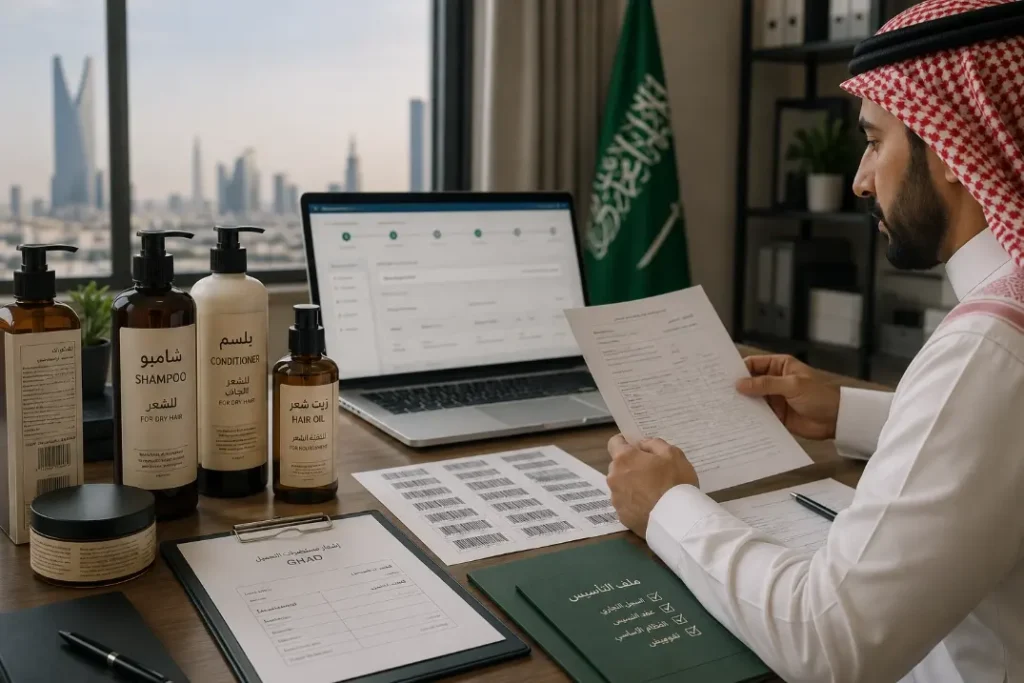
In practice, you cannot notify your own products to the SFDA as a foreign brand owner. A GHAD account requires a Saudi commercial registration and an SFDA cosmetics licence, which means the notification is submitted by a licensed Saudi importer or distributor. Your legal entity and licence need to exist before you place a bulk order — not after.
The most expensive sequencing error in this market
Brands routinely build the product first and the licensing layer last. The result is stock sitting in a bonded warehouse, accruing storage charges, while a commercial registration is processed and a warehouse inspection is scheduled. Run the two tracks in parallel from day one. Narrow exemptions to the licensing route exist for certain supply arrangements — confirm your specific case with the SFDA rather than assuming.
The entity and licence layer
- A Saudi commercial registration (CR) whose activity scope covers importing and distributing cosmetics.
- For foreign ownership, an investment licence from the Ministry of Investment (MISA). Saudi nationals follow the domestic CR route. Requirements and fees differ substantially — take advice on your specific structure.
- An SFDA cosmetics licence covering your warehouse or storage space. The warehouse is physically inspected, and passing that inspection is a precondition of being able to notify products at all.
What GHAD is
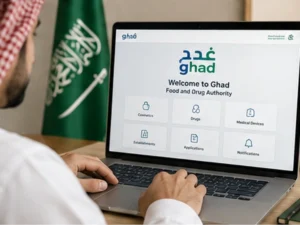
GHAD is the SFDA’s unified electronic system. It has been mandatory since 30 March 2023, replacing the older eCosma platform, whose database was retired later that year. Some third-party guides still refer to eCosma — that is legacy naming, not a live system.
It is not a cosmetics database alone: GHAD also handles perfumery notification, manufacturing-site registration and warehouse licensing. The structure runs company, then establishment, then product, and your overseas manufacturing site has to be registered in the system too. An approved listing certificate is valid for five years and is renewable.
On timing, there is a real gap between the official window and what practitioners report. The SFDA’s stated position is a decision within around 15 days of a notification being accepted; consultants commonly describe four to six weeks end to end, with additional time if laboratory testing is requested. Plan against the longer figure and treat the shorter one as the best case.
The documents you will be asked for
- Product name, barcode, category and country of manufacture, in English and Arabic
- Full ingredient list with INCI names, concentrations and functions
- Arabic and English label artwork
- Manufacturer details, plus registration of the manufacturing site
- GMP certificate — ISO 22716 or the equivalent Gulf standard
- Free Sale Certificate and Certificate of Analysis
- Product Information File, per GSO 2636
- Cosmetic product safety report or safety assessment
- Stability and microbiological test reports
Step 5: Get labelling, claims, and halal positioning right
Saudi Arabia enforces some of the strictest labelling and claim rules in the region, and the most common reason a shipment is rejected is not the formula — it is the copy.
What has to be in Arabic
The requirement is tiered, not blanket. Under the Gulf technical regulation for cosmetics, four elements must appear in both Arabic and English: the product name, the function or directions for use, warnings and precautionary information, and storage instructions. Remaining elements — manufacturer and origin, net content, batch code, expiry, the ingredient list — may be in either language. The SFDA does, however, retain the ability to require Arabic, so build for the stricter case.
There is a design consequence founders underestimate: Arabic sets right to left. Lay out bilingual packaging from the first artwork round rather than retrofitting translation onto a finished English design — reworking approved artwork costs more than designing it correctly once.
One more labelling rule worth knowing: SFDA Circular No. 37719/2, issued on 14 February 2025, prohibits phrasing that suggests a product is primarily intended for another market. Wording such as “For Export Only”, “European Market Edition” or “Exclusive for [Region]” must be removed, and non-compliant products risk being refused customs clearance.
Claims — where most brands get rejected
Claims are governed by GSO 2528. Two categories cause most rejections: implied medical claims, and absolute claims. Decide your compliant wording at the product brief stage, not after packaging has been printed.
Do not write
- Stops hair loss
- Cures dandruff
- 100% natural
- Instant results, the best serum
Write instead
- Helps reduce the appearance of hair fall caused by breakage
- Helps relieve the appearance of flaking
- Formulated with [x]% naturally derived ingredients
- Visible improvement in [x] weeks in a consumer use test of [n] participants
The halal question — the honest answer
At the time of writing, halal certification is not a legal requirement for cosmetics in Saudi Arabia. The Kingdom’s mandatory halal certification framework centres on food categories. This surprises people, partly because the opposite is true elsewhere: in Indonesia, halal certification for cosmetics becomes mandatory from 17 October 2026 under its own regulations, and a valid product notification there does not exempt you.
What does apply in Saudi Arabia is ingredient compliance — non-halal animal derivatives are not acceptable, and alcohol content is scrutinised — combined with consumer expectation that runs very high. The commercial conclusion is straightforward: certification is optional, ingredient documentation is not. Ask your factory for an animal-derived and ethanol status list covering every raw material at the quotation stage, and confirm the current regulatory position with the SFDA before you build halal into your positioning.
Step 6: Ship, certify, and clear customs
Lorem ipsum dolor sit amet, consectetur adipiscing elit. Ut elit tellus, luctus nec ullamcorper mattis, pulvinar dapibus leo.
Three platforms people confuse
- FASEH — the SFDA conformity platform where the shipment certificate is requested.
- FASAH — the national single-window platform used for customs clearance.
- SABER — the SASO system, which generally does not apply to SFDA-regulated cosmetics.
On duty: hair preparations sit in HS Chapter 33, heading 3305. As a planning baseline, expect the GCC common external tariff of at least 5% on CIF value plus 15% VAT — but the Kingdom raised duties across many tariff lines in 2020 and now operates a twelve-digit tariff, so confirm the exact rate for your specific code in ZATCA’s integrated tariff or with a licensed customs broker. Do not build a margin model on a rate you found in a blog post, including this one.
A practical suggestion: run the first shipment small. Proving the entire chain — certificate, clearance, warehouse, listing — on 1,000 units is far cheaper than discovering a mismatch on a full container.
Step 7: Launch — pricing, channels, and the first 90 days
Online is the fastest-growing channel but hypermarkets remain the largest, which sets the realistic sequence for a new brand: prove it online, then scale into retail.
Build your price from landed cost, not from competitors
Work out what a unit actually costs you on the shelf before you decide what it sells for. That figure includes bulk formula, packaging, international freight, duty, clearance, testing and certification, warehousing, platform commission, marketing and returns. Packaging is frequently more expensive than the formula inside it — particularly custom bottles, airless pumps and foil stamping. Founders who price against a competitor first and squeeze costs afterwards usually end up with a margin that cannot fund reordering.
Where to sell first
- Your own store — Salla, Zid or Shopify. Best margin, but you supply all the traffic.
- Marketplaces — Noon and Amazon.sa. Fast reach, with commission and price pressure attached.
- Beauty verticals — specialist platforms reach a more targeted customer and suit brand-led positioning. Confirm current onboarding terms with each platform directly.
- Salons and offline retail — salon channels suit professional formulas and carry strong margins; hypermarkets require negotiating power and the ability to absorb payment terms.
E-commerce registration — a commonly outdated instruction
You will still read that selling online in Saudi Arabia requires a Maroof registration. That is no longer where official e-store documentation happens: since 2023 the Ministry of Commerce has directed e-stores to register through the Business platform run by the Saudi Business Center. Maroof continues to operate as a consumer-facing verification and ratings service, which payment gateways and marketplace platforms commonly still require. The underlying framework is the Saudi E-Commerce Law.
The first 90 days
Days 0–30: seed content, a small number of genuine trial placements, and the collection of real reviews. Days 31–60: identify which SKU is actually reordering, and put the marketing behind that one rather than spreading it evenly. Days 61–90: take the sell-through data to salon groups, offline retail or vertical platforms.
And launch with three SKUs, not eight. Every additional SKU multiplies notification work, inventory and cash tied up — while making the data harder to read, not easier.
What it actually costs and how long it actually takes
Anyone quoting you a single all-in number for launching a hair care brand is guessing. What is useful is knowing which line items exist and which of them move.
| Cost item | What drives it | How to budget it |
|---|---|---|
| Formulation & samples | Stock formula versus custom development | Quote-dependent; standard samples often 3–7 days |
| First production run | MOQ × number of SKUs | From around 1,000 units per SKU at hair specialists |
| Packaging & artwork | Bottle format, printing, bilingual layout | Routinely underestimated — often exceeds formula cost |
| Testing | Number of SKUs, not order size | Charged per SKU; budget stability, compatibility and micro |
| Entity, CR & SFDA licensing | Local versus foreign ownership | One-off plus annual renewals — take local advice |
| GHAD notification | Number of SKUs | Main cost is the licensing and warehouse layer beneath it |
| Conformity certificate | Number of shipments | Recurring — every shipment, not once per product |
| Freight, duty & clearance | Volumetric weight and HS code | 5% baseline tariff plus 15% VAT — verify your line rate |
Run the two tracks in parallel
This is the single most useful planning idea in this guide. Product development and regulatory setup are not sequential steps — they are two tracks that must run at the same time, and the regulatory track is almost always the longer one.
Product track
- Brand and product brief
- Sampling and formula sign-off
- Stability, compatibility and micro testing
- Bilingual packaging artwork finalised
- Bulk production
- Sea freight
Regulatory track — start on day one
- Entity and commercial registration
- SFDA cosmetics licence application
- Warehouse inspection
- Manufacturing site registration in GHAD
- Product notification submitted
- Conformity certificate, then clearance
Your factory can have product ready long before you are legally able to sell it. Sequencing these one after the other is how a six-month launch becomes an eleven-month one.
Seven mistakes that delay Saudi hair care launches
1. Ordering stock before the entity and licence exist
Goods arrive that cannot be notified and cannot clear. Storage charges accumulate while paperwork that should have started months earlier is processed.
2. Treating halal as a certificate rather than an ingredient question
Paying for certification without raw material traceability documentation solves nothing. The documentation is what an audit examines — and it is what you need whether or not you certify.
3. Printing packaging before claims are compliance-checked
One phrase like “stops hair loss” can write off an entire packaging run. Claim wording belongs in the product brief, not the design review.
4. Shipping labels that differ from the notified artwork
A different typeface, a moved batch code, an added promotional line. Any mismatch against the filed artwork can hold a shipment at the border.
5. Choosing a skincare factory that "also does shampoo"
Hair emulsification and rheology behave differently from skincare, and oxidative colour and smoothing systems are separate processes with their own equipment. Ask what runs on their own lines before you fall in love with a sample.
6. Skipping high-temperature stability testing
A formula that is stable in a temperate laboratory can separate, discolour or corrode its closure in a Saudi summer warehouse. Specify accelerated testing at elevated temperatures.
7. Launching with eight SKUs instead of three
Notification work, inventory and cash requirements all multiply, while the sell-through signal gets weaker. Three products give you a cleaner read and a faster second order.
Frequently asked questions
Can I start a hair care brand in Saudi Arabia without setting up a company?
Not in practice. A GHAD account requires a Saudi commercial registration and an SFDA cosmetics licence, so notification is submitted by a licensed Saudi importer or distributor. You either establish your own entity or partner with a licensed distributor who acts as notification holder. Narrow exemptions exist for certain supply arrangements — confirm your case with the SFDA.
Do I need halal certification to sell shampoo in Saudi Arabia?
At the time of writing, halal certification is not a legal requirement for cosmetics in Saudi Arabia — the mandatory framework centres on food. Ingredient restrictions still apply and consumer expectation is high, so document animal-derived and ethanol content for every raw material regardless. This differs from Indonesia, where cosmetics halal certification becomes mandatory in October 2026.
How long does SFDA notification through GHAD take?
The SFDA’s stated decision window is around 15 days after a notification is accepted, though consultants commonly report four to six weeks end to end, and longer if laboratory testing is requested. The real critical path is usually earlier: obtaining the commercial registration, the SFDA licence and passing warehouse inspection before you can notify at all.
What is a typical MOQ for private label hair care?
Hair-focused specialist factories commonly start at 1,000 units per SKU. General cosmetics manufacturers and local plants vary far more widely, and custom formulas or custom packaging usually carry higher minimums than stock options. Ask for all three figures — stock, custom formula, custom packaging — rather than one headline number.
Can I use an overseas manufacturer and still sell legally in Saudi Arabia?
Yes. Imported cosmetics are legal, provided the overseas manufacturing site is registered in GHAD, a licensed Saudi entity acts as notification holder, and every shipment carries a valid Certificate of Conformity. Your factory supplies the technical documentation; it cannot hold the registration for you.
Which hair care category is easiest for a new Saudi brand to enter?
Treatments and scalp care. Hair treatments are the fastest-growing segment at around 7% a year, multinational coverage is thinner there than in shampoo, and the category maps directly onto local concerns like scalp comfort under daily head covering and hair fall. Shampoo is the hardest first product to launch.
Where to start this week
The hard part of launching a hair care brand in Saudi Arabia is not the formula — it is the order in which you do things. Product development and the licensing layer have to run in parallel, because the regulatory track takes longer and cannot be compressed at the end.
Two things to do this week, at the same time: fill in the seven-row product brief above and send it to three factories, and get advice on your entity and SFDA licensing route. Doing both together, rather than one after the other, is worth months. If you are also weighing suppliers across the region, our comparison of hair care manufacturers serving Indonesian brands uses the same evaluation framework in a market with stricter halal rules.