Clients walk into salons wanting vivid, long-lasting color. What they’re terrified of is the damage that comes with it. If you’re building a hair care line or curating your salon’s retail shelf, understanding this tension — and solving it credibly — is the shortest path to lasting brand loyalty.
That’s exactly where keratin infusion protects hair at its most practical level. It’s no longer just a smoothing trend. Used strategically around chemical color services, keratin acts as a genuine structural shield: rebuilding what the dye process breaks down and preserving what clients care about most — shine, vibrancy, and healthy-feeling hair.
Here’s the science, the sequencing, and the professional consensus that experienced colorists and reliable hair product manufacturers actually rely on.
What Keratin Infusion Actually Does to the Hair Shaft
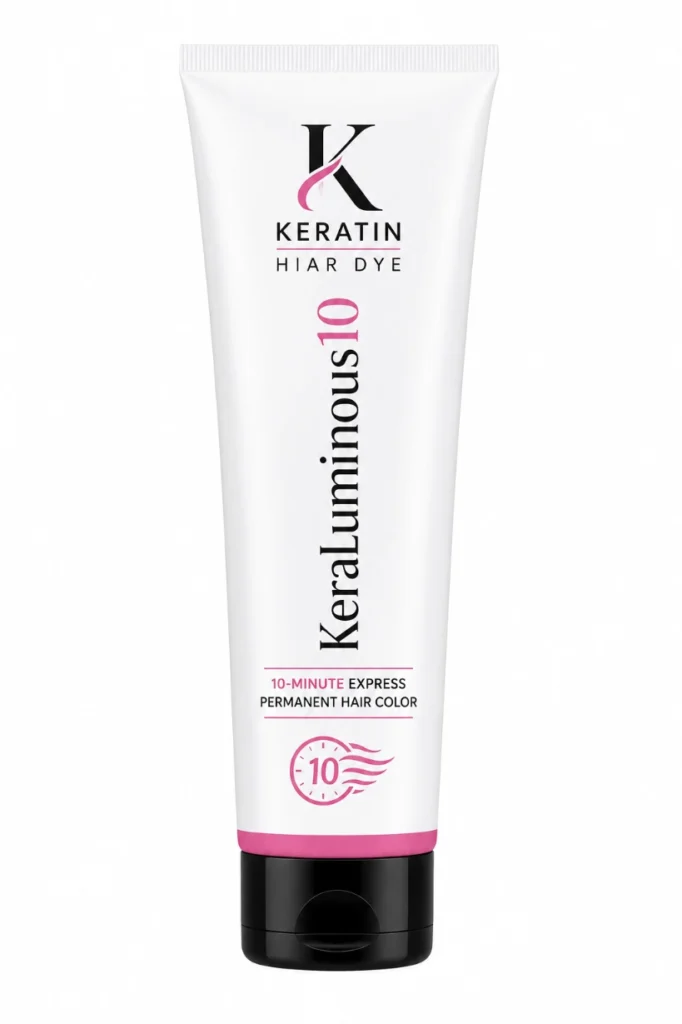
The visible hair shaft is a nonliving fiber composed largely of keratin proteins. Its overlapping cuticle protects the cortex, which contributes much of the strand’s strength and contains natural pigment. Repeated bleaching, oxidative coloring, high heat, friction, and environmental exposure can remove surface lipids, increase porosity, roughen the cuticle, and weaken the fiber.
Not every hair color works the same way. Temporary and many semi-permanent colors mainly deposit preformed dyes, while permanent color normally uses an alkalizing system and an oxidizing developer. Bleach produces more extensive lightening and can cause greater structural change. The guide to different types of hair color explains why the starting level of damage varies by product and service.
How Hydrolyzed Keratin Can Condition Damaged Hair
Whole keratin is too large and insoluble for many cosmetic uses, so formulas often use hydrolyzed keratin, keratin amino acids, or other hydrolyzed proteins. These smaller materials can have an affinity for damaged, negatively charged hair. Depending on their molecular distribution and the product system, they may adsorb to the surface, reduce friction, improve combability, and temporarily fill irregular areas.
A dermatology review in the PubMed Central archive explains that smaller polypeptides may diffuse farther into the fiber while larger materials primarily act near the cuticle. It also cautions that amino acids do not replace or restore the original damaged keratin molecule. That distinction is essential: cosmetic conditioning and structural regeneration are not the same claim.
| Common claim | More accurate interpretation | Important limitation |
|---|---|---|
| “Repairs damaged hair” | May improve surface smoothness, lubrication, combability, or measured fiber properties for a period | The hair shaft does not biologically heal, and results depend on the exact formula and test |
| “Rebuilds broken bonds” | Some ingredients may form temporary interactions or films on damaged hair | Hydrolyzed keratin should not automatically be described as recreating native disulfide bonds |
| “Seals the cuticle” | Conditioning deposits may reduce roughness and friction or make raised cuticle edges lie more smoothly | This is not an airtight or permanent seal around dye molecules |
| “Locks in color” | A suitable conditioning system and gentler routine may help reduce some contributors to fading | Color retention also depends on dye type, shade, porosity, washing, water, heat, UV exposure, and product compatibility |
Keratin Infusion Is Not the Same as a Salon Smoothing Treatment
The word “keratin” appears on many products, but it does not tell you how the product works. A rinse-out protein conditioner may be a conventional cosmetic treatment. A salon smoothing service may use a separate chemical system, high heat, and ventilation controls. Confusing the two can lead to poor timing advice and overlooked safety risks.
| Product type | Typical purpose | Heat or chemical service | What to verify |
|---|---|---|---|
| Protein-containing shampoo or conditioner | Routine cleansing or temporary conditioning | Normally no high-heat sealing step | Ingredient source, use frequency, hair response, and color compatibility |
| Protein mask or leave-in treatment | Improve feel, manageability, or apparent smoothness | May use ordinary blow-drying; follow the label | Rinse-out versus leave-in use, heat directions, and risk of stiffness or buildup |
| Professional porosity equalizer or protein filler | Prepare selected porous areas for more even color uptake | Used as part of a defined salon color protocol | Compatibility with the color system, amount, drying/rinsing step, and strand-test result |
| Keratin-labelled smoothing or straightening service | Reduce curl, frizz, or volume for a longer period | May involve reactive chemistry, repeated flat-ironing, and occupational exposure controls | Full ingredient list, Safety Data Sheet, heat instructions, ventilation, stylist training, and formaldehyde-release risk |
The FDA warns that many hair smoothing products can release formaldehyde gas when heated, while also noting that not every smoothing product contains it. Before a salon service, ask for the ingredient list and Safety Data Sheet. Formaldehyde, formalin, or methylene glycol on the label indicates that the product contains or will release formaldehyde. “Keratin” and “formaldehyde-free” should not be accepted as complete safety explanations.
Why Color and Keratin Work Better Together
The Problem With Color Alone
Freshly colored hair is porous, reactive, and structurally compromised — even when the color result looks flawless. The lifted cuticle that allowed pigment inside is now an open door for everything else: humidity, hard water minerals, UV radiation, and heat. Each wash strips a little more pigment. Each blow-dry pulls at weakened bonds. Within weeks, what looked like a pristine salon result starts to feel dull and brittle.
Where Keratin Changes the Equation
When keratin infusion protects hair after color, it closes what the dye opened. The cuticle compresses tightly around freshly deposited pigment molecules, slowing their migration out of the cortex with every wash. Frizz disappears because there are no lifted scales for humidity to grip. The result is genuinely glossy — not a surface sheen that disappears after the first shampoo, but a structural smoothness that lasts.
For brands developing professional hair dye formulations, pairing color chemistry with keratin-based protective agents isn’t a marketing add-on. It’s a performance differentiator that clients will notice, measure in weeks of extended color life, and associate with your brand.
Pre-Treatment vs. Post-Treatment: When to Apply Keratin
Sequencing matters more than most clients — and some brands — realize.
Pre-Treatment: Creating an Even Canvas
Damaged, high-porosity hair absorbs dye unevenly. The most porous sections — typically mid-lengths and ends — pull excess pigment while healthier sections absorb less. The result is patchy, inconsistent color even with a perfect application technique.
A pre-treatment keratin infusion resolves this by equalizing porosity before the dye goes on. Structural voids along the shaft are filled, creating a smooth, uniform surface that accepts color evenly from root to tip and prevents fragile ends from over-saturating.
Post-Treatment: Sealing and Protecting the Result
Applying keratin treatment for dyed hair immediately after a color service is widely considered the professional standard — and for good reason. It actively:
- Forces chemically raised cuticles back to a flat, sealed position
- Traps artificial pigment molecules within the cortex before they can migrate
- Rebuilds protein cross-links weakened by peroxide exposure
- Delivers a high-gloss, frizz-resistant finish that extends the perceived freshness of the color
This combination of mechanical sealing and structural reinforcement is why colorists consistently report longer intervals between client touch-ups when keratin is part of the service protocol.
The Right Sequence: Color First, Keratin Second
The professional consensus on keratin with color is clear: color first, keratin second — with a minimum two-week gap between services whenever possible.
Dye requires an open cuticle to penetrate and deposit pigment properly. Applying keratin beforehand seals exactly what the dye needs access to, leading to uneven absorption, muted tonal payoff, and color that fades patchily within weeks. Reversing the order undermines both treatments.
The two-week spacing rule matters even when the order is correct. Stacking both services on the same day — or within a few days — compounds chemical stress before the hair has stabilized. Spacing them out allows:
- Pigment to fully set within the cortex
- Ammonia residue to dissipate before keratin bonds form
- The hair to recover its baseline moisture balance before the next round of heat
When the order genuinely can’t be changed, practical risk-reduction applies: wait at least two weeks after keratin before applying color, avoid ammonia-heavy permanent formulas, skip bleach entirely during this window, and have a professional colorist assess porosity before selecting a developer volume.
Keratin with Hair Color: What the Science Says About Bleached Hair
Bleached hair is a distinct clinical category. The bleaching process doesn’t just lift pigment — it severely disrupts the disulfide bond network that gives each strand its structural integrity, leaving hair with significantly elevated porosity and reduced tensile strength.
For this hair type, keratin with hair color isn’t an optional upgrade. It’s load-bearing. Without structural reinforcement between color services, the cumulative damage from repeated bleaching accumulates faster than the hair can recover — leading to progressive thinning, elasticity loss, and ultimately, breakage that no color service can mask.
The American Academy of Dermatology consistently highlights that minimizing chemical overlap and reinforcing hair between treatments is essential to preserving long-term hair health — particularly for clients undergoing repeated lightening services.
Professional-grade keratin formulations address this specifically by providing amino acid building blocks that help the hair begin reforming damaged disulfide bonds, directly reducing mid-shaft breakage and split end frequency in repeatedly processed hair.
Keratin-related product claims should be considered alongside the chemical service itself. Our comparison of bleach and permanent hair dye helps frame the differences in processing and aftercare that a single ingredient story cannot explain.
Maintaining Color and Keratin Together at Home
Getting the salon result right is only half the job. What happens at home over the following weeks determines how long both the color and the keratin last.
Do You Really Need to Keep Hair Dry for 72 Hours?
Not for every keratin product. A conventional protein mask or color conditioner may be rinsed out immediately. Some smoothing systems have historically required a no-wash period, while others allow same-day washing. “Protein bonds are still setting for exactly 72 hours” is not a universal explanation.
Follow the instructions for the exact smoothing or conditioning product. Do not automatically use a flat iron on damp hair to “reactivate” a treatment; unnecessary heat can damage already processed strands.
How to Choose a Keratin Product for Colored Hair
- Identify the format: Shampoo, rinse-out conditioner, mask, leave-in, porosity filler, and smoothing solution require different use.
- Check the protein source: Hydrolyzed keratin is commonly animal-derived, while some products use plant proteins or amino-acid blends. Verify the source if vegan positioning matters.
- Read the full directions: Confirm frequency, contact time, rinsing, heat, ventilation, and color-service compatibility.
- Look beyond one hero ingredient: Cationic conditioners, fatty alcohols, silicones, oils, humectants, pH, and the total formula can contribute as much as the keratin claim.
- Start conservatively: If hair becomes stiff, rough, coated, tangled, or unusually dry, reduce frequency or change products.
“Protein overload” is not a precise medical diagnosis. However, repeated use of a highly depositing treatment can make some hair feel stiff or less flexible. Product buildup, insufficient lubrication, aggressive cleansing, existing damage, and heat may also contribute, so do not assume protein is the only cause.
A Practical Color-Care Routine
- Wash as often as the scalp needs using a cleanser that leaves the hair manageable; no surfactant category guarantees zero fade.
- Condition after cleansing and detangle gently from the ends upward.
- Limit very high heat, repeated passes, and hot-tool use on fragile sections.
- Use a heat-protective product as directed, while remembering that it reduces rather than eliminates thermal risk.
- Protect colored hair from prolonged sun and rinse after swimming to remove pool or saltwater residues.
- Avoid overlapping bleach or permanent color on already lightened lengths unless a qualified professional and product instructions support the plan.
The American Academy of Dermatology’s coloring guidance notes that lightening farther from the natural shade generally requires more peroxide and can cause more damage. It also advises following product testing instructions and taking scalp reactions seriously.
Three Persistent Myths — Addressed Directly
Myth 1: “Keratin treatments strip your color”
There’s a kernel of partial truth here: the flat iron heat used during a keratin service can lift artificial color by one or two tones on very light or freshly bleached hair. That’s real. The broader claim — that keratin infusion protects hair and somehow damages color as a rule — is not. In most cases, the opposite is true. By compressing the cuticle and slowing moisture penetration, a keratin treatment extends color life.
Clients with platinum or very pale blonde shades should discuss flat iron temperature settings with their stylist before proceeding. A lower heat setting or a post-color gloss can correct minor tonal shifts without compromising the keratin result.
Myth 2: “You can’t use keratin on already-colored hair”
Color-treated hair is precisely the hair type that benefits most from keratin infusion. It’s more porous, structurally weaker, and more prone to frizz than unprocessed hair — and keratin directly addresses all three. The treatment doesn’t interfere with existing color; it reinforces the hair that’s holding it.
Myth 3: “Keratin permanently locks in your color”
This overclaim does keratin a disservice — and sets clients up for disappointment when color fades, as it always will. What keratin treatment for dyed hair genuinely delivers is slower, more even fading. By stabilizing the cuticle and reducing moisture fluctuation during washing, it eliminates the irregular, patchy fade that makes color look tired before it actually needs refreshing. That’s a meaningful, honest benefit. Framing it as permanence damages credibility faster than the color fades.
What This Means for Brands Formulating or Retailing These Products
The client demand is consistent: vivid color without visible damage. The product solution is equally consistent: professional formulations that combine effective color chemistry with structural keratin protection.
For brands entering this space — whether through OEM hair product manufacturing or developing proprietary lines — the technical and marketing case for integrating keratin into color-adjacent products is strong. Clients notice the difference in measurable ways: longer time between touch-ups, less breakage between appointments, and a finish that holds its gloss past the first few washes.
At Keron Hair, our formulation and manufacturing capabilities are specifically built around this intersection — where structural protein science meets professional-grade color performance.
The professional consensus holds across stylists, colorists, and formulation chemists: sequence correctly, choose the best hair dye for keratin treated hair category wisely, support the result with sulfate-free aftercare, and be precise about what these treatments deliver. Accurate claims build the kind of trust that brings clients back — and keeps brands relevant.
Conclusion
Keratin infusion protects hair during and after chemical color services by rebuilding the bonds that dye breaks down and sealing the cuticle tightly around freshly deposited pigment. Used in the right sequence — color first, keratin second, with proper spacing — these two treatments compound each other’s benefits rather than competing.
The result is color that fades slower and more evenly, hair that feels structurally stronger between services, and a glossy, frizz-free finish that lasts well beyond the first wash. Pair it with sulfate-free maintenance at home and clients have a complete protocol that genuinely protects their investment — in both their hair and your brand.
Frequently Asked Questions
Can keratin prevent hair dye damage?
No product can guarantee that coloring causes no damage. A suitable keratin-containing conditioner may improve lubrication, smoothness, manageability, and resistance to everyday handling, but dye type, developer, bleach, overlap, heat, hair condition, and application technique remain important.
Does hydrolyzed keratin permanently repair colored hair?
No. It may deposit on damaged areas and sometimes diffuse into more porous parts of the fiber, creating temporary cosmetic or measurable improvements. It does not regenerate the nonliving shaft or restore its original molecular structure permanently.
Should keratin be used before or after hair color?
Use a pre-color protein filler only when it is designed for that color system. Use an after-color conditioner or mask according to its directions. Schedule a separate high-heat smoothing service based on its formula, manufacturer instructions, strand testing, stylist assessment, and the condition of the hair.
How long should I wait between hair color and a keratin smoothing service?
There is no universal waiting period. Some systems are designed for coordinated use; others recommend separation because heat or chemistry may shift color or increase stress. Follow both manufacturers’ instructions and use the longer interval when they differ.
Can a keratin treatment change freshly colored hair?
A conventional conditioner may cause little change, but smoothing chemistry, repeated flat-iron passes, and high heat can shift certain tones, especially on lightened or freshly toned hair. Ask for a hidden-strand test before a full service.
Are keratin smoothing treatments formaldehyde-free?
Not necessarily. Not every smoothing product contains formaldehyde, but some contain or release it when heated. Review the ingredient list and Safety Data Sheet, ask about ventilation and training, and do not rely only on a front-label claim.
When should I stop coloring or using another treatment?
Pause if the hair is gummy, excessively stretchy, or snapping, or if the scalp is irritated or damaged. Rinse and seek appropriate medical help for significant burning, blistering, facial swelling, breathing difficulty, or another serious reaction. For home coloring, follow the exact product instructions and use a careful at-home hair dye checklist.