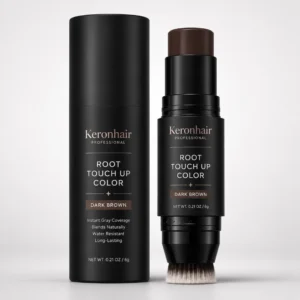
Learning how to dye your hair at home starts before the color touches your hair. You need to choose a realistic result, understand the type of dye, read the complete instructions, perform the required allergy alert or skin test, test a strand, and prepare enough time and product for an even application.
The instructions supplied with your exact product take priority over any general online tutorial. Application order, mixing method, processing time, test procedure, and aftercare can differ between temporary color, direct semi-permanent dye, demi-permanent color, permanent color, high-lift color, and bleach.
This guide covers a standard at-home coloring workflow while showing where you must stop and follow the package instead of using a universal rule.
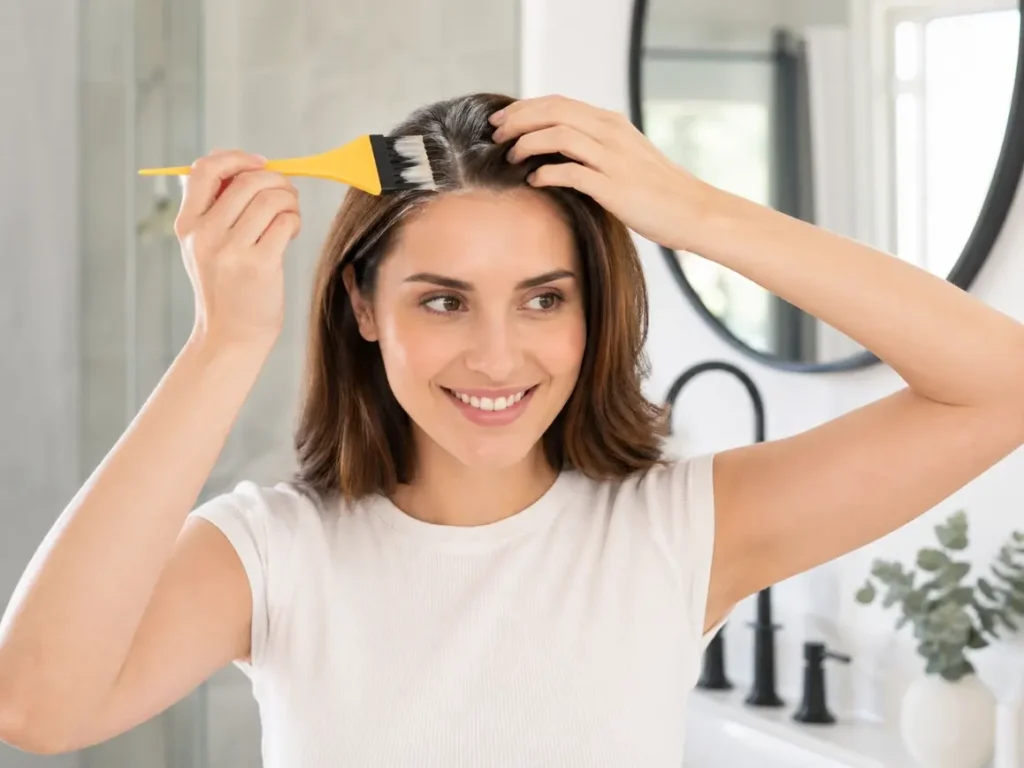
Why More People Are Dyeing Their Hair at Home
At-home color can be convenient for maintaining roots, blending gray, refreshing tone, or trying a lower-commitment shade. It also gives users control over timing and privacy. Those benefits do not make every transformation suitable for DIY application.
Product cost, salon pricing, available shades, and professional services vary widely by country and hair goal, so fixed price comparisons are rarely useful. A successful home service depends more on choosing an achievable result, understanding previous color, and applying the formula correctly.
Before choosing a box or tube, review the differences between temporary, semi-permanent, demi-permanent, and permanent color. A product that deposits a darker tone is not equivalent to one that lifts natural pigment.
Is This Color Change Suitable for DIY?
This new section helps you decide whether to continue at home before purchasing multiple products or attempting a correction.
| Your Goal or Starting Point | May Be Suitable for At-Home Color | Consider a Professional Assessment |
|---|---|---|
| Temporary change or color refresh | A labeled temporary, semi-permanent, or color-depositing product used as directed | If the hair is highly porous, stained, fragile, or uneven |
| Gray or root maintenance | The same compatible permanent shade applied only to new growth | If there are bands, resistant areas, scalp sensitivity, or an unknown prior formula |
| Going darker or changing tone | A modest change that the product specifically supports | A large change on bleached, highlighted, or very porous hair |
| Going lighter | A small change within the product’s labeled capability on appropriate virgin hair | Dark-to-blonde changes, previous permanent dye, bleach overlap, or color correction |
| Previously treated hair | A compatible maintenance product with a successful strand test | Henna, metallic-salt dye, relaxer, perm, bleach, unknown box color, or significant breakage |
| Scalp or medical concerns | Only after the scalp is healthy and relevant professional advice has been obtained | Active dermatitis, broken or sunburned skin, previous dye reaction, or treatment-related scalp changes |
The American Academy of Dermatology advises staying within three shades of your natural color when dyeing at home. Lightening by more than three shades generally requires more peroxide and can cause more damage.
Do not try to correct an uncertain chemical history by layering another product over it. A strand test or professional consultation can prevent a manageable color problem from becoming a breakage problem.
Everything You Need to Gather Before You Start
Skipping this step is the most expensive mistake you can make — and I don’t mean financially. Running out of clips mid-application, realizing your gloves have a hole in them, or hunting for a timer while dye is already processing — these are the moments that throw off an otherwise solid result. Get everything together before you open a single bottle. It takes ten minutes and genuinely changes how the whole thing goes.
The Essential Hair Dye Kit: Tools and Materials
Your box kit covers the basics, but a few extras are worth grabbing ahead of time.
- Applicator brush and mixing bowl. Nozzle bottles are fine for quick root touch-ups, but if you want real control — especially around the hairline, ears, and part — a brush and bowl is the better tool. Precision matters most in those spots.
- Sectioning clips. Four to six clips, depending on your hair’s thickness. Trying to work through unsectioned hair is where uneven results begin. It’s a small thing that makes an outsized difference.
- Gloves, petroleum jelly, and a towel you don’t love. The gloves included in most kits are workable but thin — a backup pair costs almost nothing. Run petroleum jelly along your hairline and the tops of your ears before you start. It creates a barrier that keeps staining off skin without affecting the dye near your roots. However, if a smudge does happen, knowing exactly how to get hair dye off skin at home will save you from harsh and irritating scrubbing.
Setting Up Your Workspace for a Mess-Free Experience
Choose a bright, well-ventilated area with a mirror and easy access to water. Cover the counter, floor, and nearby surfaces before you begin — hair dye stains quickly, and once your gloves are on, you won’t want to be searching for paper towels.
Lay your tools out in application order: dye, bowl, brush, clips, gloves, towel, timer, conditioner. This small step makes the process feel calmer and more controlled. One safety note worth taking seriously: keep hair dye away from your eyes and never apply it to eyebrows or eyelashes, as the FDA has cautioned that doing so can cause serious eye injury.
Step-by-Step: How to Dye Your Hair at Home
This is where preparation pays off. If you’ve got everything laid out, your sections planned, and your timing ready, learning how to color hair at home is more straightforward than most people expect. Work through each step in order — skipping ahead is where things tend to go wrong.
Step 1: Read the Instructions Carefully
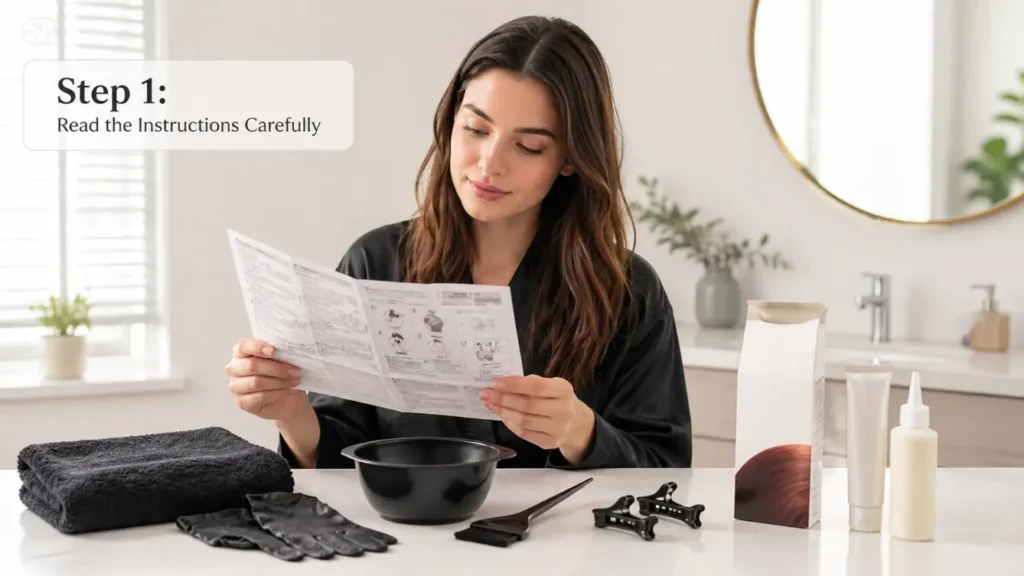
Read the warnings, test requirements, application sequence, mixing ratio, processing time, rinse directions, and disposal instructions before putting on gloves or opening the components. Do not rely on instructions from a different shade, brand, or previous kit.
Postpone the application if your scalp is irritated, scratched, sunburned, or damaged. FDA guidance also advises waiting at least 14 days after bleaching, relaxing, or perming before using hair dye.
Step 2: Mix the Dye Correctly
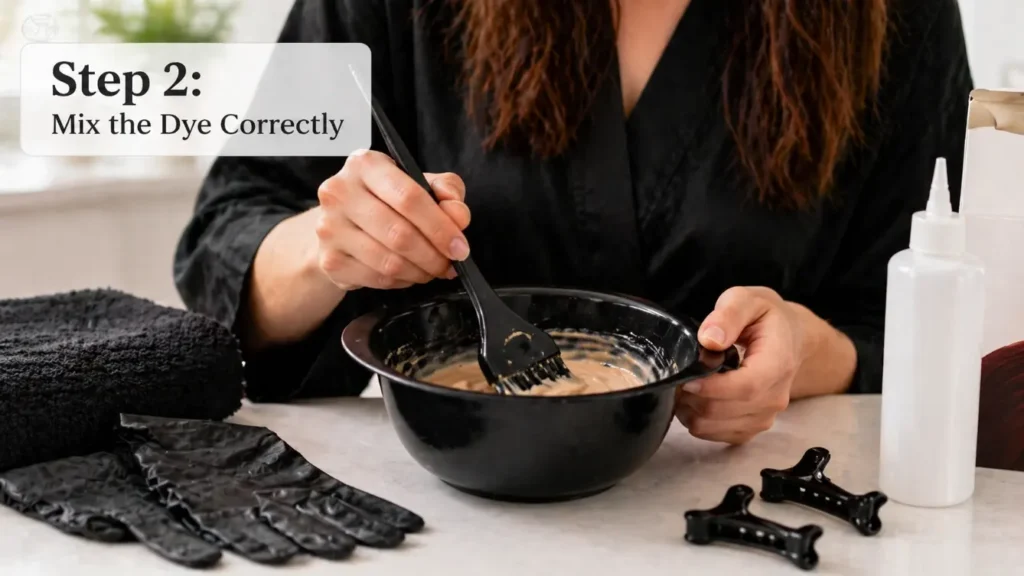
Some permanent and demi-permanent colors require colorant and developer. Many semi-permanent products are ready to use. Mix only the components included or specifically identified by the manufacturer, in the stated ratio and container.
- Begin application within the product’s stated working time.
- Do not combine different brands, shades, developers, or leftover mixtures unless the instructions explicitly approve it.
- Do not add conditioner, shampoo, oil, water, or heat to change the strength.
- Do not save mixed oxidative color for later use.
Step 3: Divide Hair Into Clean Sections
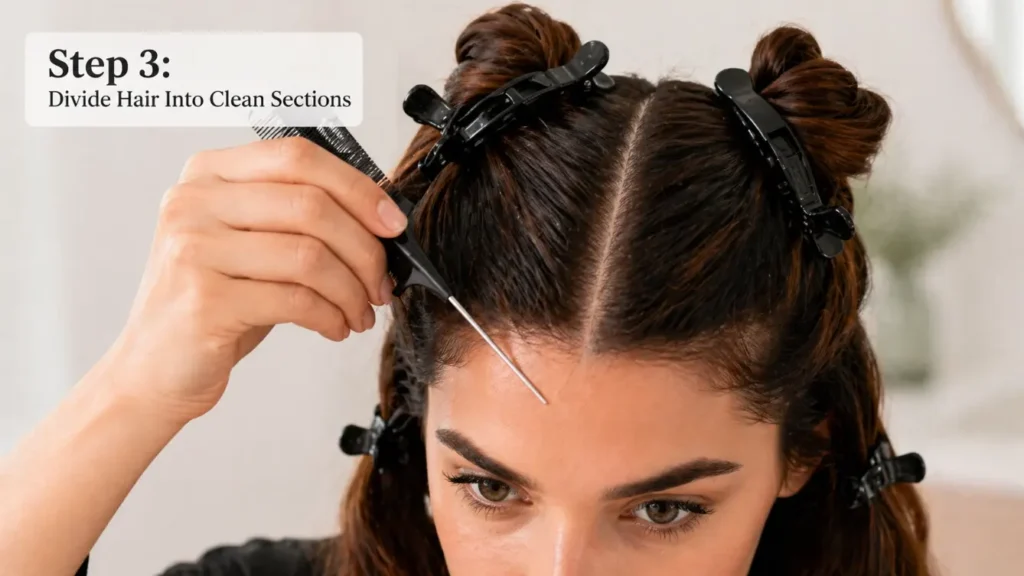
Detangle gently before application if the instructions allow it. A common starting point is four sections—center part from forehead to nape and a second part from ear to ear—but very thick or long hair may need more sections.
Plan the order before mixing. Identify new growth, previously colored lengths, gray-resistant areas, porous ends, and any sections that must not be overlapped.
Step 4: Apply Dye to Roots, Lengths, or Ends Based on Your Goal
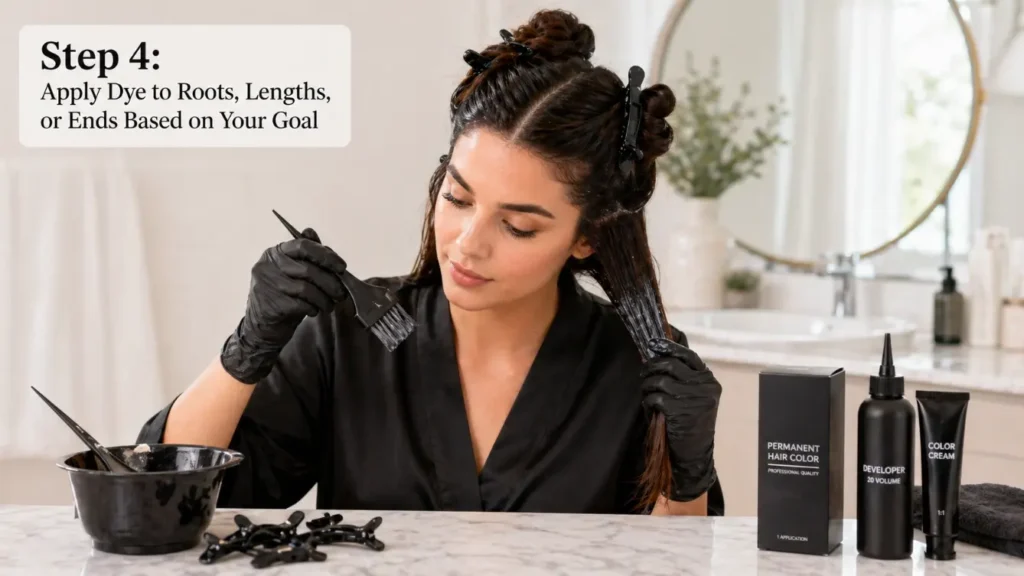
There is no universal rule that every first-time application should begin on the mid-lengths or that every refresh should begin on the ends. Scalp heat, shade, product chemistry, gray coverage, and starting color can change the correct sequence.
- Root touch-up: apply only to the new growth and stop at the previous color line. Refresh the lengths only if the label specifically directs it.
- First permanent-color application: follow the virgin-application sequence in the package; do not substitute a generic “roots last” rule.
- Semi-permanent or color-depositing product: apply to clean, dry or damp hair exactly as stated, because preparation varies by formula.
- Previously colored hair: use the strand-test result to judge whether porous sections need less exposure or should be excluded.
Use enough product to saturate each intended section without flooding the scalp. If you realize midway that you do not have enough product, do not dilute it or improvise a new mixture.
Step 5: Set a Timer and Wait
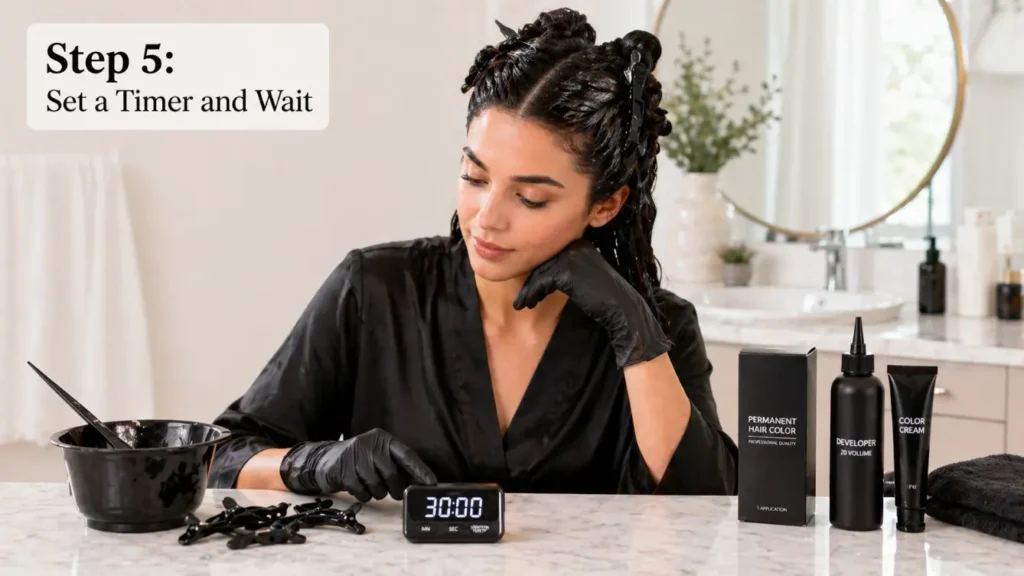
Some products define processing time after the full application; others provide section-specific timing. Follow the stated starting point. Do not extend the processing time, cover the hair, or add heat unless the instructions explicitly tell you to do so.
Check how your scalp feels. Mild product odor or warmth is different from intense burning, rapidly increasing itching, facial swelling, dizziness, or breathing difficulty. Stop when symptoms suggest a reaction.
Step 6: Rinse Until the Water Runs Mostly Clear

Wear gloves during the initial rinse if instructed. Keep the product away from the eyes and rinse with the specified water temperature until the package’s endpoint is reached. “Until the water runs clear” or “mostly clear” is not the correct endpoint for every highly pigmented formula.
Do not scrub an irritated scalp. If the product enters the eyes, follow the emergency directions on the package immediately and obtain urgent professional advice when symptoms persist or the label requires it.
Step 7: Condition and Style Gently
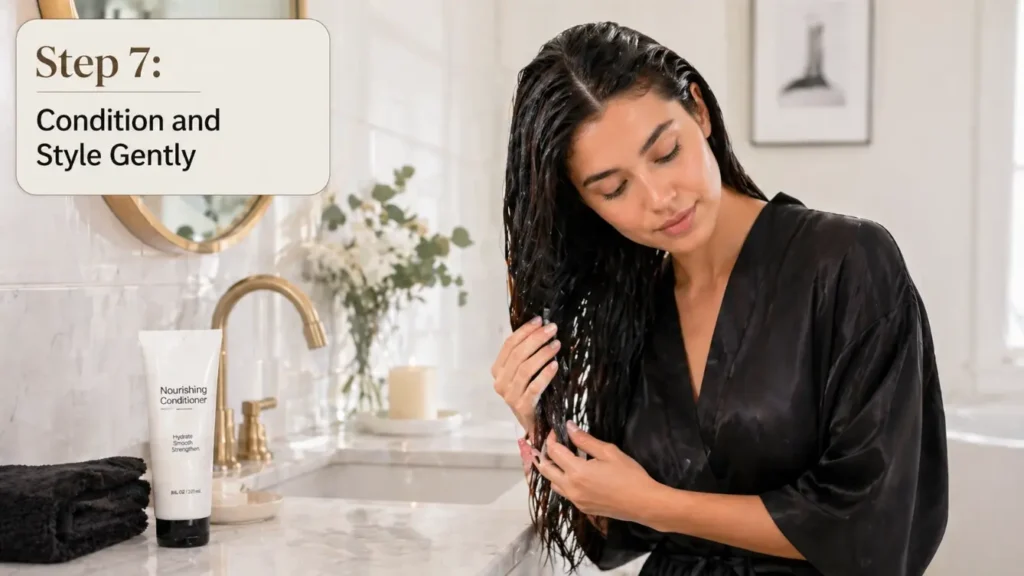
Use the supplied conditioner or post-color treatment only as instructed. Conditioner can improve smoothness and manageability, but saying it permanently “closes the cuticle and locks in color” is too absolute.
Blot rather than rub with a towel, detangle gently, and use lower heat if styling. There is no universal 48-hour ban on heat tools or shampooing for every dye; follow the product’s aftercare directions and consider the condition of your hair.
How Long Should You Leave Hair Dye In?
It’s one of the most searched questions in the at-home color space, and it deserves a better answer than “check the box.” Processing time is one of the few variables where guessing carries real consequences — in both directions.
Why Processing Time Varies by Formula
- Oxidative versus direct-dye chemistry
- Developer strength and mixing ratio
- Gray coverage, root touch-up, or first application
- High-lift, darkening, toning, or vivid-color goals
- Manufacturer testing and the product’s stated intended use
What Happens If You Rinse Too Early
Cutting the colouring process short means uneven saturation — often lighter at the roots, faded at the ends, or missing the depth the shade was designed to deliver. Gray coverage is especially sensitive to early rinsing; those resistant strands need the full processing window to absorb pigment reliably.
What Happens If You Leave Dye on Too Long
Longer isn’t better — it’s just more exposure. Once the color has fully developed, the developer continues working on the hair structure rather than the pigment. That translates to unnecessary dryness, a rougher cuticle, and sometimes a result that reads darker or flatter than intended. Leaving it on an extra 20 minutes doesn’t deepen the color — it just stresses the hair.
Why Timers Matter for Beginners
Memory is unreliable when you’re multitasking or doing this for the first time. A timer removes the guesswork entirely. Set it the moment the last section is coated — not when you started mixing, not when you began applying. That window is what counts, and protecting it is one of the simplest things you can do to protect your result.
Common At-Home Hair Dye Mistakes to Avoid
Every at-home color experience teaches you something. The goal, ideally, is to learn from other people’s lessons rather than your own. These are the mistakes that come up most consistently — not because they’re hard to avoid, but because most people don’t know to look out for them until it’s too late.
Choosing a Shade Too Far From Your Natural Color
Going one or two shades lighter or darker than your natural color is well within what at-home dye handles reliably. Anything more dramatic — dark brown to bright blonde, or black to a vivid fashion shade — involves a level of chemical lift that most box kits aren’t designed to manage safely in a single step.
If a significant change is what you’re after, a more realistic approach looks like this:
- Move in stages across multiple sessions, spaced at least a few weeks apart
- Use a strand test between each step to track where your hair actually lands
- Consider a toner or gloss to refine tone once you’re close to your target shade
Your hair will hold up better for it, and the result will be more controlled every step of the way.
Skipping the Patch Test or Strand Test
These feel like formalities until they aren’t. A patch test — applied behind the ear or at the inner elbow 48 hours before coloring — is the only reliable way to catch an allergic reaction before it becomes a serious problem. According to the American Academy of Dermatology, symptoms to watch for include redness, itching, swelling, or persistent irritation at the test site. If any of those appear, don’t proceed.
A strand test serves a different purpose: it tells you how the color will actually land on your specific hair, which doesn’t always match what’s on the box. Both tests take minutes. Skipping them saves nothing and risks considerably more than most people account for.
Applying Dye Unevenly
Uneven application usually comes down to two things: rushing and skipping sections. Moving too quickly means some areas get saturated thoroughly while others barely make contact with the formula — showing up as patchiness or noticeable variation in depth. Slow, methodical application is what consistent coverage actually requires.
Overlapping Color on Previously Dyed Hair
This one is quiet but cumulative. Applying fresh dye over already-colored hair builds up chemical exposure over time. If you are ever unsure about the correct timeline between applications, understanding exactly how often you should dye your hair is crucial for preventing this cumulative damage. The consequences of overlapping tend to surface gradually:
- Increased dryness and brittleness along mid-lengths and ends
- Loss of elasticity, which shows up as breakage during brushing or styling
- Color that reads uneven because older and newer deposits react differently
When doing a root touch-up, keep the new color on the regrowth only. Pull it through to the ends in the final few minutes if a refresh is needed — not from the start.
Ignoring the Instructions on the Box
Instructions are written for that specific formula — not hair dye in general. Processing times, mix ratios, and application sequences vary more between products than most people expect, and assuming one brand works like another is where things quietly go wrong. Read them fully, before you start, every single time.
What to Do If Something Goes Wrong
If Your Scalp Burns, Itches, or Blisters
Stop the application and follow the product’s removal directions. The NHS guidance on hair-dye reactions advises washing the hair and scalp thoroughly with a mild shampoo if you feel you are reacting. Contact a healthcare professional if symptoms worsen or do not resolve.
If Your Face, Lips, Mouth, Tongue, or Throat Swells
Difficulty breathing, throat tightness, fainting, severe dizziness, or rapid swelling can indicate a medical emergency. Contact your local emergency service immediately. Do not drive yourself when emergency care is needed.
If Dye Gets Into Your Eyes
Begin the first-aid steps on the product label immediately, typically including prompt rinsing with water, and seek urgent professional or poison-control advice as directed. Hair dye is not approved for eyelashes or eyebrows and can cause serious eye injury.
If the Color Is Uneven, Too Dark, or the Wrong Tone
Do not automatically apply another permanent dye or bleach the same day. Photograph the result in neutral light, keep the package and ingredient information, and test any proposed correction on a hidden strand. A colorist is especially useful when bleach, black dye, henna, banding, breakage, or several formulas are involved.
If Dye Stains Your Skin
Use gentle cleaning methods and avoid aggressive scrubbing, bleach, household cleaners, or undiluted essential oils. The guide to removing hair dye from skin provides safer step-by-step options.
Conclusion
Knowing how to dye your hair at home is a genuinely useful skill — one that saves money, builds confidence, and gives you real control over how you look. The process becomes significantly more approachable when someone breaks it down clearly and honestly, which is exactly what this guide set out to do. Take your time, follow the steps, and don’t skip the preparation. A great result at home is well within reach.
Frequently Asked Questions
Can I dye my hair if I’m using minoxidil?
Yes, but with caution. Wash your hair thoroughly to remove all minoxidil residue before applying color, and wait at least 24 hours after dyeing before resuming your routine. Consult your dermatologist beforehand if you have any concerns.
What is the best hair dye for chemo patients?
Post-chemotherapy hair and scalps are highly sensitive. Avoid permanent dyes containing ammonia and opt instead for gentle, semi-permanent formulas enriched with conditioning ingredients. Always get medical clearance from your oncologist before proceeding.
Can I dye my hair if I have scalp dermatitis?
Avoid coloring during an active flare-up. Alkaline dye formulas can seriously irritate a compromised scalp barrier. Wait until your scalp has fully healed, or consider off-scalp techniques like balayage carried out by a professional.
How do I color my hair at home for the first time?
Start with a shade no more than one to two levels away from your natural color, and choose a demi-permanent formula to minimize risk. Follow the instructions carefully, and never skip the patch and strand tests.
How can I color my hair at home like a professional?
Skip the squeeze bottle and use a non-metallic mixing bowl and tint brush for precise, even application. Divide your hair into four clean sections, work methodically, and choose a quality formula suited to your hair type. Preparation is what separates a professional-looking result from a rushed one.