Sourcing bulk hair wax from China sounds straightforward—until you’re three weeks into supplier negotiations and still waiting on a consistent sample. It’s a position many brand managers, private label founders, and e-commerce sellers find themselves in, and the learning curve is steeper than most expect going in.
This guide covers the full picture: the types of hair wax Chinese manufacturers produce, how to locate and verify reliable suppliers, where the hidden costs show up, and how to build a supply chain you can actually depend on. Whether you’re launching a private label grooming line or scaling an existing Shopify or Amazon store, what follows gives you a clearer, more confident path forward.
Why Source Bulk Hair Wax from China?
When building a hair styling brand, your supply chain is foundational. Sourcing from China isn’t just about price—it’s about accessing a manufacturing ecosystem purpose-built for rapid brand scaling. Here’s who stands to benefit most, and why the production capabilities are difficult to match elsewhere.
Who Should Buy Bulk Hair Wax from China?
If you’re weighing whether importing makes sense for your business model, it helps to look at who already relies on this supply chain—and why.
Private label brands: If your goal is to move from reselling third-party products to building your own brand equity, Chinese factories offer a practical entry point. You can start from a proven base formula, customize the scent or texture, and launch a proprietary product line without building a lab from scratch.
Barbershop chains: Regional barbershop networks can buy bulk pomades and styling clays at commercial rates, use them at the backbar, and sell them at the front counter—converting a major operating cost into a profitable retail channel.
E-commerce sellers and Amazon/Shopify merchants: Online retail demands healthy margins to absorb advertising, fulfillment, and return costs. Buying direct from a China hair wax wholesale supplier eliminates domestic white-label markups, giving you the pricing room to scale confidently.
Distributors: Businesses supplying local beauty supply stores or regional salon networks benefit from the volume discounts that direct factory sourcing provides, creating the pricing headroom to offer competitive wholesale rates downstream.
Main Advantages of Chinese Hair Wax Manufacturing
Buyers new to this supply chain often focus on price first—and the cost efficiency is real. But in today’s cosmetics industry, the more durable competitive advantages come from production depth, packaging flexibility, and supply chain integration.
Cost efficiency: Major cosmetic manufacturing hubs—particularly around Guangzhou—operate with exceptionally dense supply chain networks. Raw ingredients, packaging plants, and printing facilities sit in close proximity, which reduces logistics overhead and drives down cost-per-unit without sacrificing formulation quality.
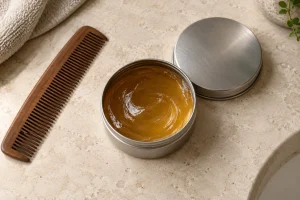
Formula variety: Whether your target market wants a matte-finish clay, a water-soluble pomade, a heavy-hold fiber paste, or a texturizing cream, established manufacturers maintain deep formula libraries. They understand how to balance hold, shine, and chemical stability for products that hold up through international heat and humidity testing.
Packaging customization: You aren’t limited to generic stock jars. Factories can produce custom aluminum tins, bespoke tooling, silk-screen printing, and premium soft-touch finishes that position a competitively priced product as a polished retail item.
Scalable production: A qualified manufacturer can support early-stage brands through low-MOQ ODM runs, then scale to high-volume automated production lines when demand grows—without requiring you to change suppliers.
When discussing product lines with overseas suppliers, matching formula types to your customer’s styling preferences early will reduce back-and-forth during sampling:
| Formula Type | Hold Level | Finish / Shine | Best For |
|---|---|---|---|
| Water-Based Pomade | Medium to Strong | High Shine | Classic slicked-back styles; washes out easily with water |
| Matte Clay / Mud | Strong | Zero Shine / Matte | Modern, textured looks with a natural, reworkable finish |
| Fiber Paste | Medium | Low to Medium | Pliable, messy styles; adds thickness and volume to fine hair |
What Types of Bulk Hair Wax Can Chinese Suppliers Produce?
Most people picture a single tin on a bathroom shelf when they think of hair wax—but experienced Chinese manufacturers have developed formulations to cover nearly every hair type, finish preference, and hold strength on the market. Knowing what’s available before approaching suppliers will sharpen your conversations and reduce early sampling time. Working with a dedicated hair wax manufacturer means having access to a broad product portfolio from the outset.
Water-Based Hair Wax
Water-based formulas are among the most requested products for private label development. They wash out easily, wear comfortably throughout the day, and appeal to customers who prefer low-maintenance styling. Chinese suppliers can typically produce these across a range of hold levels—light to ultra-strong—and they respond well to fragrance customization and natural ingredient additions such as aloe vera or panthenol.
Oil-Based Hair Wax
Oil-based wax delivers heavier, longer-lasting hold and remains a staple for classic or retro grooming lines. It performs well through long shifts and humid conditions, which accounts for much of its enduring appeal—though customers will need more effort to wash it out. If your target market leans toward barbershop-style or traditional men’s grooming, this formula belongs on your product shortlist.
Matte Clay Wax
Matte clay wax has posted consistent demand growth over recent years, driven largely by younger consumers seeking a natural, no-shine finish. Chinese manufacturers typically offer kaolin clay and bentonite clay-based variants, which can be positioned across a wide price range depending on formulation complexity. It’s one of the more competitive product categories right now—and one of the most marketable on platforms like Amazon and Etsy.
High-Shine Pomade Wax
High-shine pomade wax is built for polished, slicked-back styles and sells well in markets with a cultural tradition of glossy hairstyling. Chinese suppliers maintain well-established production lines for these formulas, available in both water-based and oil-based versions depending on the finish and washability your customers expect.
Hair Fiber Wax
Fiber wax is a hybrid product—part styling wax, part hair fiber—that builds texture and adds visual thickness. It’s particularly popular with customers managing fine or thinning hair. The fiber component is typically nylon or keratin-based, and most reputable factories can customize the fiber-to-wax ratio to hit the hold level and finish you’re targeting.
Natural and Beeswax-Based Formulas
If your brand positions itself in the clean beauty or organic space, natural wax formulas are widely available from Chinese manufacturers. Beeswax, carnauba wax, and shea butter blends are common base options. These products typically command a higher retail price point and photograph well for Shopify and Amazon listings—just make sure you verify ingredient sourcing and any relevant certifications directly with the supplier before finalizing the formula.
Color Hair Wax
Temporary color wax has carved out a strong niche, particularly with younger demographics and event or festival markets. Chinese suppliers produce these across an extensive shade range—from natural tones to vivid neons—and they’re generally straightforward to apply and easy to wash out. For boutique owners or Etsy sellers, color wax can be a high-margin addition to an existing product line.
Most experienced Chinese manufacturers can handle all of these product types—often within the same facility. The real challenge isn’t finding a supplier who can produce what you need; it’s finding one who will do it consistently, at the right quality level, every time.
Where to Find Bulk Hair Wax Suppliers in China
Knowing what you want is only half the equation. The harder part—especially for first-time importers—is knowing where to look and how to separate credible manufacturers from time-wasters. Each sourcing channel comes with its own strengths and limitations.
B2B Marketplaces for Hair Wax Wholesale
For most buyers, online B2B platforms are the natural starting point. The major directories give you access to a wide range of China hair wax wholesale suppliers in one place, but they also reward a more critical approach than many first-timers apply.
- Alibaba – The largest and most familiar directory. Look for suppliers with a “Verified Manufacturer” badge and a meaningful transaction history. A polished listing isn’t always a reliable signal; some of the better factories have plain profiles and let their response quality speak for itself.
- Made-in-China.com – More factory-oriented than Alibaba and frequently overlooked by Western buyers. Worth using as a cross-reference once you’ve identified promising leads elsewhere.
- Global Sources – Tends to attract mid-to-high-tier manufacturers and more established buyers. If you’re placing larger orders or working to tighter quality standards, leads here are often stronger.
- DHgate – Better suited for small test orders than serious OEM production runs. It can be a practical way to evaluate a formula before committing to a full bulk order, but it isn’t the primary channel for serious sourcing.
A few habits that make the process more efficient before sending your first inquiry:
- Check how long the supplier has been active on the platform—longevity tends to matter more than star ratings, which can be influenced
- Compare similar listings across two or three platforms; meaningful price gaps often indicate whether you’re dealing with a manufacturer or a trading company
- Send the same inquiry to five or six suppliers simultaneously, then shortlist based on the quality and specificity of their responses
For a more curated starting point, our guide to the top private label hair wax manufacturers in China covers the key players worth evaluating.
Major Hair Care Manufacturing Hubs in China
China’s cosmetics industry is geographically concentrated. Most serious production takes place in a handful of cities, and knowing where to focus makes a real difference when narrowing your search or planning factory visits.
- Guangzhou (Guangdong Province) – The undisputed center of China’s beauty and personal care manufacturing. Thousands of hair care factories operate here, many specializing in wax, pomade, and styling products. If you’re visiting China to source, this is the logical starting point.
- Shanghai – A growing base of premium and internationally compliant manufacturers, with stronger familiarity with Western documentation requirements including MSDS sheets and CPNP compliance files.
- Yiwu – Better known as a wholesale trading hub than a production center. More useful for meeting distributors and trading companies, particularly if you need smaller quantities or a broader product mix.
- Shenzhen – Particularly strong in packaging manufacturing. A practical base if you’re coordinating formula and packaging sourcing from the same region to reduce logistics complexity.
If a factory visit is on the table, grouping supplier meetings by city is far more efficient than traveling across provinces. Guangzhou alone can occupy a serious buyer for a full week.
Trade Shows and Beauty Exhibitions
Trade shows are an underrated sourcing channel. Nothing replaces meeting a factory representative in person, handling samples directly, and getting a feel for how a potential supplier conducts themselves in a professional setting.
The Canton Fair (China Import and Export Fair) is held twice a year in Guangzhou and ranks among the largest trade fairs in the world. The beauty and personal care section draws serious buyers from across the globe and puts hundreds of bulk hair wax suppliers under one roof—including many that don’t appear prominently on the major B2B platforms.
China Beauty Expo (CBE), based in Shanghai, is one of Asia’s largest dedicated beauty industry events. Manufacturers, brands, and distributors all exhibit here, making it particularly useful for comparing suppliers side by side and tracking product trends before they surface on sourcing platforms.
In-Cosmetics Asia is more ingredient and formulation focused—but a working knowledge of what goes into your hair wax makes you a sharper, harder-to-mislead client during supplier negotiations.
If attending in person isn’t feasible right now, these options are still worth pursuing:
- Most shows publish exhibitor directories online—download them and treat them as a working shortlist of vetted manufacturers
- Virtual attendee options have expanded significantly in recent years and often include full catalog access
- Many exhibitors will share samples and product information by request, even well after the show ends
Finding Hair Wax Suppliers Through Google Search
Google is an underused sourcing channel, mainly because most buyers stop after the first page of results. Factory websites tend to rank poorly—many are outdated, awkwardly translated, or buried beneath B2B marketplace listings—but reaching manufacturers directly often opens the door to better pricing and cleaner communication.
Search approaches that surface stronger leads:
- “hair wax OEM manufacturer China” – Adding OEM or private label filters for suppliers already structured to produce to your brand specifications
- “hair wax factory Guangzhou” – City-specific terms return more genuine manufacturers and fewer distributors
- “hair wax private label China minimum order” – Commercial-intent terms help surface suppliers oriented toward brand clients rather than retail buyers
When you land on a factory website directly, run a quick assessment before making contact:
- Does the site show real production photos rather than stock imagery?
- Is there a certifications page referencing ISO 22716 or GMP compliance?
- Does the physical address verify on Google Maps or Baidu Maps?
- Does the product catalog include actual formulation details, not just product names?
- Are there downloadable documents such as MSDS sheets or capability statements available?
A factory that checks most of these boxes is worth an inquiry—even if the website itself looks basic.
Using Social Media to Discover Manufacturers
Social media has grown into a useful preliminary sourcing channel, particularly for getting an initial read on a manufacturer before approaching them through formal channels.
LinkedIn is the most productive starting point. Searching “hair wax manufacturer China” or “cosmetics OEM Guangzhou” surfaces factory export managers, sourcing consultants, and trade representatives actively pursuing international clients. Posting your sourcing criteria directly and letting relevant contacts reach out can work better than many buyers expect.
YouTube has become a surprisingly useful resource. Some Chinese manufacturers have invested in English-language factory tours and product demonstrations, and a real facility walk-through tells you considerably more about operational scale and production quality than any listing page.
Facebook groups focused on Amazon FBA, private label beauty, or hair care product development often contain peer recommendations from buyers who’ve already worked through the vetting process. Supplier contacts shared in these communities are worth following up—treat them as leads, not endorsements.
One important caveat: anything sourced through social media deserves an additional layer of verification. A polished feed or active profile is straightforward to maintain regardless of what the actual operation looks like. Cross-reference every social media find with the documentation checks and direct communication steps covered throughout this guide.
Working with China Sourcing Agents
A sourcing agent is a China-based professional—typically fluent in both Mandarin and English—who acts as your on-the-ground representative throughout the supplier search, negotiation, and quality control process. For buyers new to importing from China, or those managing complex orders, a reliable agent can genuinely earn their fee.
What a good sourcing agent typically handles:
- Identifying vetted manufacturers beyond what appears on English-language platforms
- Translating communications and bridging expectations during pricing negotiations
- Visiting factories on your behalf and conducting pre-shipment quality inspections
- Coordinating samples, production timelines, and outbound logistics
What to assess before signing on:
- Ask for verifiable client references—preferably from buyers working in a similar product category
- Clarify upfront how the agent charges: flat fee, percentage of order value, or a combination of both
- Confirm they hold a clear conflict-of-interest policy; you want someone working in your interest, not collecting undisclosed referral fees from the suppliers they’re supposed to be evaluating
- Be cautious of agents who present a supplier shortlist quickly, without first asking substantive questions about your brand, target market, and formulation requirements
A practical rule of thumb on timing: if your first order value is modest and you’re comfortable managing communication and basic due diligence independently, you can likely handle the process without an agent at the outset. Once order values and product complexity grow, having a trusted local contact on the ground tends to pay for itself fairly quickly. For a broader overview of qualified partners, the guide to the best OEM hair products suppliers is a useful reference.
How to Verify a Hair Wax Factory Before Ordering
Before committing funds to a bulk order, verifying your supplier thoroughly protects both your brand and your business. Here’s what to check.
Confirm GMP and ISO 22716 certification. These internationally recognized standards govern manufacturing practices and production environments for cosmetics. A legitimate hair wax factory should be able to provide copies of their current certificates on request.
Request a live video tour. Ask the sales representative for an impromptu WeChat or Zoom walkthrough of the factory floor. This confirms they own and operate actual production equipment, rather than acting as a trading intermediary presenting a rented or third-party facility.
Review the company’s registered capital. Legitimate cosmetic manufacturers typically carry registered capital that reflects the scale of their operation. A quick review of their business license provides a useful baseline for comparison against smaller trading companies.
Request MSDS and COA documents. Material Safety Data Sheets and Certificates of Analysis confirm that the formulation ingredients are safe, chemically stable, and compliant with import requirements in your target market.
Assess export history. Ask for bill of lading records or photographs of completed custom orders for overseas brands. This confirms the supplier understands international shipping documentation and has executed similar orders successfully.
Test sample stability. Before placing any bulk order, stress-test the sample. Leave it in a warm environment for several days and assess whether the wax separates, softens excessively, or changes texture under heat. A stable formula holds up; one that doesn’t will cost far more in refunds and returns than the sample test ever would.
The True Cost of Importing Bulk Hair Wax from China
A low unit price can look compelling at first glance—but it rarely tells the complete story. When buying bulk hair styling products from China, your real cost includes duties, freight, packaging, inspection fees, customs charges, and sometimes temperature-control considerations.
Calculating landed cost before placing any order—including trial orders—is a discipline worth building early. Adjusting pricing, MOQ, or packaging before production starts is straightforward; discovering your margin disappeared at the port is not.
HS Code Classification and Import Duties for Hair Wax
Hair wax is typically treated as a hair preparation, but you shouldn’t rely on a supplier’s quoted HS code alone. The correct classification can depend on the product’s formula, intended use, ingredient list, packaging, and destination country.
For many markets, hair styling products fall under the broader HS category for preparations used on the hair—but exact import codes, duty rates, and documentation requirements should always be confirmed with a licensed customs broker or freight forwarder before shipment. If you’re importing into the United States, the FDA’s guidance on importing cosmetics is a practical reference for understanding compliance requirements.
Details to verify early:
- Product name and intended use
- Full ingredient list
- Jar size and retail packaging format
- Country of origin
- Destination country
- Whether the formula contains alcohol, aerosol propellant, or restricted ingredients
Some suppliers use a general HS code for convenience that may not accurately reflect your specific product. If customs reclassifies the shipment, your final cost and compliance burden may change accordingly.
Shipping Semi-Solid Cosmetics: Freight, Hazmat, and Temperature
Hair wax is a semi-solid cosmetic, which generally makes shipping more straightforward than aerosols or alcohol-based products—but the formulation still matters. Some styling products contain fragrance compounds or other ingredients that may require additional documentation, particularly for air freight.
Before booking shipment, confirm with your supplier and freight forwarder whether the product requires any of the following:
- MSDS or SDS
- Certificate of Analysis (COA)
- Ingredient list
- Non-dangerous goods declaration, if applicable
- Product photos and packing list
- Carton dimensions and gross weight
- Temperature or storage guidance
Sea freight is generally more cost-effective for bulk orders, though it carries longer transit times. Air freight is faster, but cosmetics may face more intensive inspection, higher costs, and stricter documentation requirements. For small trial orders, express shipping is convenient—though the cost per unit is significantly higher.
Temperature is a detail many first-time importers underestimate. Hair wax can soften, separate, or change texture if exposed to prolonged heat during transit or storage. If your product has a soft base formula, premium packaging, or a heat-sensitive fragrance, ask the supplier how it performs under elevated temperature conditions—and run your own stability test before placing a large order.
Calculating Your True Landed Cost per Unit
Your landed cost is the actual cost of getting one sellable unit into your warehouse or fulfillment center. It’s the number that should drive pricing decisions—not the unit price on the supplier’s quotation.
A straightforward formula:
Landed cost per unit = (total product cost + packaging + inspection + freight + insurance + customs duty + import fees + local delivery) ÷ total sellable units
Breaking it into three layers makes the calculation easier to manage.
1. Factory-side costs
These are costs paid before the goods leave China: unit price, private label fee, custom jar or mold cost, label and box printing, sample charges, inspection or testing, and inland delivery to port.
2. Import-side costs
These are costs tied to moving goods into your market: sea, air, or express freight; cargo insurance; customs duty; customs broker fee; import processing fees; port charges; and document handling.
3. After-arrival costs
These are easy to miss but still affect your margin: warehouse receiving, local trucking, Amazon FBA prep, relabeling or barcode fees, storage, damaged or unsellable units, and returns allowance.
By way of illustration: if you purchase 5,000 jars of hair wax at $1.20 each, the supplier invoice may look straightforward—but once you add packaging upgrades, freight, duty, customs fees, inspection, and local delivery, the real cost per unit may land closer to $1.65 or $1.80. That spread matters, especially when selling on Amazon (where referral fees, FBA fees, advertising, and returns all need to be absorbed) or selling wholesale (where your retail or distribution partner also requires margin).
Before confirming any bulk order, request a written cost breakdown from both your supplier and your freight forwarder. Then build in a buffer for unexpected charges. A conservative landed cost estimate will always serve you better than pricing built on the most optimistic scenario.
Conclusion
China’s hair styling wax production infrastructure gives brands and distributors an accessible combination of formula depth, packaging flexibility, and scalable output. The opportunity is real—but it rewards preparation. Targeting the right manufacturing hubs, verifying supplier credentials methodically, building a clear picture of your true import costs, and stress-testing products before committing to volume are the steps that separate brands that scale predictably from those that stall at the sourcing stage.
If you’re ready to move from research to production, Keronhair works with private label brands, distributors, and retail buyers to develop and manufacture hair wax products at scale—from initial formula development through to finished, export-ready product.
FAQs
How do I find reliable bulk hair wax suppliers in China?
You can find bulk hair wax suppliers through B2B marketplaces, factory websites, beauty trade shows, sourcing agents, and peer referrals. Always verify business licenses, request samples, review production capacity, confirm export experience, and check compliance documentation before placing an order.
What should I check before buying bulk hair wax from a Chinese factory?
Check the supplier’s business license, formula options, MOQ, sample quality, ingredient list, packaging capability, production lead time, payment terms, and export documentation. A reliable factory should be able to answer technical questions clearly and without hesitation.
Can Chinese suppliers produce private label hair wax?
Yes. Many Chinese hair wax manufacturers offer OEM and ODM services, including custom formulas, fragrances, jar sizes, labels, and branded packaging. Always request and evaluate samples before confirming a private label order.
What HS code is used for importing hair wax?
Hair wax is typically classified under HS heading 3305, which covers preparations used on the hair. The exact code and applicable duty rate depend on the formula, packaging, and destination country—always confirm with a licensed customs broker before shipment.
What is the minimum order quantity for bulk hair wax from China?
MOQ varies by supplier, formula complexity, and packaging type. Standard formulas generally carry lower MOQs, while custom formulas, proprietary jars, or bespoke labels typically require higher minimums. Ask suppliers for both a sample MOQ and a bulk production MOQ at the outset of your inquiry.