A supplier sends you a business license, several certificate images, a factory video, and a fast quotation. The documents look reassuring until you compare the details. One company name appears on the quote, another appears on the certificate, and the factory address is missing from both. The sales team says this is normal but gives no written explanation.
Verification works when the legal company, licensed production site, quality system, product records, contract, invoice, and payment account describe one clear production relationship. A thick folder of unrelated files proves very little.
This guide shows you how to test that relationship before you approve samples, pay a production deposit, or rely on a compliance claim.
What does a “qualified” hair care manufacturer need to prove?
“Qualified” is not a universal status. A company can be legally registered but lack permission to manufacture your product. A factory can hold a valid quality-system certificate while the certificate covers a different site. Even a well-run plant still needs to qualify your exact formula, packaging, tests, and market documents.
Treat manufacturer verification as six connected layers:
| Verification layer | Question to answer | Useful evidence | What the evidence does not prove by itself |
|---|---|---|---|
| Legal identity | Does the company exist and remain in good standing? | Government business record, legal name, registration number | That it operates the factory shown online |
| Production permission | May the site legally make the proposed type of product? | Current production license, site address, permitted activities | That it can consistently meet your specification |
| Quality system | Does the factory use documented cosmetics manufacturing controls? | GMP evidence, ISO 22716 certificate, procedures, audit report | That every finished batch will pass |
| Factory capability | Does the site have suitable people, areas, equipment, and controls? | Live or onsite audit, maintenance and production records | That your formula and package have been validated |
| Product evidence | Can the factory reproduce and release your approved product? | Controlled sample, specification, test reports, batch record, COA | That the product meets every destination-market requirement |
| Market readiness | Are the product and responsible parties prepared for the sales country? | Safety and product files, label review, required notification or listing support | Government approval unless the applicable law expressly grants it |
A hair care product manufacturer is verified only when these layers point to the same legal entity, site, activity, product, and contract structure.
Hair care manufacturer verification checklist
Use this checklist to screen a candidate before spending money on an onsite audit or a long custom-formulation program. Save the evidence and review date behind every answer.
| # | Check | Evidence to request | Cross-check | Initial decision |
| 1 | Legal company identity | Business license or registration extract | Government business registry | Stop if the supplier hides the legal entity |
| 2 | Contract and payment party | Quote, contract draft, invoice details, bank beneficiary | Compare the names and request an entity map | Conditional if related companies are disclosed and documented |
| 3 | Production site | Factory operator and physical address | Production license and live or onsite audit | Stop if the actual producer remains hidden |
| 4 | Production permission | Current cosmetics production license | Holder, site, permitted scope, issuing authority, dates | Stop if the product falls outside the scope |
| 5 | ISO or GMP evidence | Complete certificate or current audit evidence | Certification body, scope, site, accreditation, status | Conditional if a system exists but evidence is out of scope |
| 6 | Product capability | Equipment, process flow, relevant records, sample | Audit the path for the proposed format | Conditional until the sample and process are qualified |
| 7 | Testing system | Test plan, methods, laboratory, reports | Match the sample, formula, and package codes | Stop if critical tests cannot be explained |
| 8 | Traceability | Batch numbering, material and production records | Trace one batch backward and forward | Stop if the records do not connect |
| 9 | Change control | Procedure and contract clause | Ask how changes receive approval | Stop if unilateral substitutions are allowed |
| 10 | Market documents | Product and country-specific deliverables list | Identify the responsible party and authority | Conditional until duties are assigned in writing |
| 11 | Approved standard | Signed specification and approved sample code | Compare with tests, quotation, and batch-release criteria | Do not produce without a controlled version |
| 12 | Audit follow-up | Findings, corrective actions, closure evidence | Confirm who accepted closure and when | Stop for unresolved critical findings |
Use this as an evidence screen. Do not turn it into a supplier score. A missing production license cannot be offset by a good price or friendly communication.
Step 1: Confirm the manufacturer’s legal identity
English trading names are convenient for marketing, but they are poor identifiers. Begin with the legal name and registration number used by the government in the manufacturer’s home country.
Ask the supplier for:
- Its full legal company name in the local language
- An English name, if one is officially used
- The company registration number
- Registered address
- Legal representative or authorized signatory
- Current business status and stated business scope
- Factory operator and production address
- Names used by the website, sales company, and export company
- Contract, invoice, and bank-beneficiary names
A company stamp, email signature, quotation header, or marketplace badge cannot replace an official record.

Search the government business registry
For a manufacturer in China, search the Chinese legal name or unified social credit code in the National Enterprise Credit Information Publicity System. The system publishes market-entity information and lets users search by company name or code.
Record the company’s status, registered address, legal representative, business scope, annual-report information where available, abnormal-operation listings, serious-illegality information, and public administrative penalties shown in the record. Save a copy with the date of your search.
A clean company record is useful but limited. It confirms legal identity. It does not prove that the company owns a factory, holds the required production permission, or performs well.
Map every entity in the transaction
Many legitimate projects involve more than one company. A sales or export company may sign the commercial documents while a related licensed factory makes the goods. A brand owner may also outsource production to an independent contract manufacturer.
Put each role in one table:
| Project role | Legal entity | Address | Evidence | Question to resolve |
| Website and sales contact | Website terms, email, quotation | Who employs the sales team? | ||
| Contract party | Contract draft | Why is this company accepting the obligations? | ||
| Factory operator | Production license, audit | Which site makes each SKU? | ||
| Product responsible party | Market-specific records | Who carries the legal market role? | ||
| Invoice issuer | Pro forma and commercial invoice | Does it fit the contract structure? | ||
| Bank beneficiary | Bank details | Is any third-party payment justified? |
Do not reject a supplier merely because the names differ. Ask for a written explanation and documents connecting the companies. Stop if the producer remains hidden, the payment account belongs to an unexplained party, or the supplier keeps changing its story.
Step 2: Verify the production license and manufacturing scope
A business registration allows a company to conduct stated business activities. A cosmetics production license addresses permission to manufacture. The name and structure of this authorization vary by country, so check the source jurisdiction and the exact factory site.
China’s Measures for the Supervision and Administration of Cosmetics Production and Operation state that cosmetics production requires a production license. The rules also specify information that appears on the license and divide permission into production units based on process, finished form, and use.
Check every field on the license
For a Chinese cosmetics production license, compare:
- License number
- Production company name
- Unified social credit code
- Company residence or registered address
- Production address
- Legal representative or responsible person
- Permitted production units
- Issuing authority
- Issue date
- Expiry date
- Amendments recorded on the license copy
The Chinese rules state that the license is valid for five years. Do not rely on an old image saved by a salesperson. Check its current status and any changes through the relevant authority.
Match the licensed unit to the product
The Chinese licensing framework includes units for general liquids, creams and emulsions, powders, aerosols and organic-solvent products, wax-based products, and other specified categories. A broad website catalog does not mean one site has permission or equipment for every format.
Ask the manufacturer to map each proposed SKU to its licensed unit and production process. A shampoo, hair mask, pomade, oxidation color, developer, straightening product, and aerosol spray create different questions. Technical products such as hair color, bleach, perm, and straightening systems also need product-specific regulatory and safety review.
Do not make this classification yourself from a product photo. Get the proposed formula and process reviewed by people who understand the current rules in the source country and target market.
Check outsourced production
Contract manufacturing can be legitimate. Under the Chinese rules, an entrusted producer must hold the relevant cosmetics production permission, and the parties have defined duties for production and oversight.
If another company will make the product, request:
- The licensed producer’s legal name and factory address
- The relevant production license and scope
- A written explanation of the relationship
- Responsibility for raw materials and packaging
- Responsibility for production, testing, release, deviations, and recalls
- Access to factory and quality records
- The entities that appear in the contract, invoice, label, and market files
Focus on whether you know who makes the goods and who answers when something goes wrong. A trading or brand company may be part of a legitimate arrangement when its role is disclosed.
Step 3: Authenticate ISO 22716, GMP, and other certificates
Certificate images are easy to place on a website. Verification requires the complete document, the correct site, a relevant scope, a current status, and an identifiable issuing body.
Understand ISO 22716
ISO 22716 provides cosmetics GMP guidelines for production, control, storage, and shipment. It addresses the manufacturing system. It is not a product approval, an export license, or proof that a particular batch passed its specification.
There is another point buyers often miss: ISO does not perform certification or issue certificates. An external certification body conducts the certification. If a supplier says it is “certified by ISO,” ask who actually issued the certificate.
Check the certificate line by line
Request a complete and readable copy, then review:
- Certified legal entity
- Manufacturing address and covered sites
- Standard and edition
- Certification scope
- Certificate number
- Certification body
- Issue, surveillance, and expiry dates
- Current status, including suspension or withdrawal
- Accreditation information where applicable
A certificate for a parent company, sales office, or different factory should not be applied automatically to the site making your product.

Verify the issuing body and status
Search the certificate number in the certification body’s official directory. Check its accreditation information and use a recognized certificate database, such as IAF CertSearch, where the certificate and scheme fall within its coverage.
If you cannot find a record, contact the certification body. Absence from one database is a reason to investigate, not automatic proof of fraud. Save the verification result, status, and date.
Also ask what happens next. A certificate nearing expiry may require surveillance or renewal evidence before your production begins.
Keep different documents in their proper roles
| Evidence | What it may indicate | What to verify | What it cannot replace |
| ISO 22716 certificate | Cosmetics GMP system certification | Holder, site, scope, body, status, dates | Product testing and batch acceptance |
| ISO 9001 certificate | General quality-management system | Relevance and site scope | Cosmetics-specific GMP review |
| Government production license | Legal permission for listed activities | Holder, site, unit, status, dates | Product performance or reliable delivery |
| Social or ethical audit | Conditions reviewed under one program | Program, site, date, findings, closure | Cosmetics quality or market compliance |
| Halal or vegan evidence | Conformity with a defined scheme | Issuer, site, ingredients, products, validity | General safety, GMP, or approval everywhere |
| Laboratory report | A result for an identified sample | Laboratory, method, sample code, date, scope | Future batch consistency |
A valid certificate should lead to operating records. Ask to see current procedures, training, maintenance and calibration, material controls, cleaning, production records, deviation handling, corrective actions, traceability, and batch release. The certificate supports the review; it does not finish it.
Step 4: Check the factory’s real operating capability
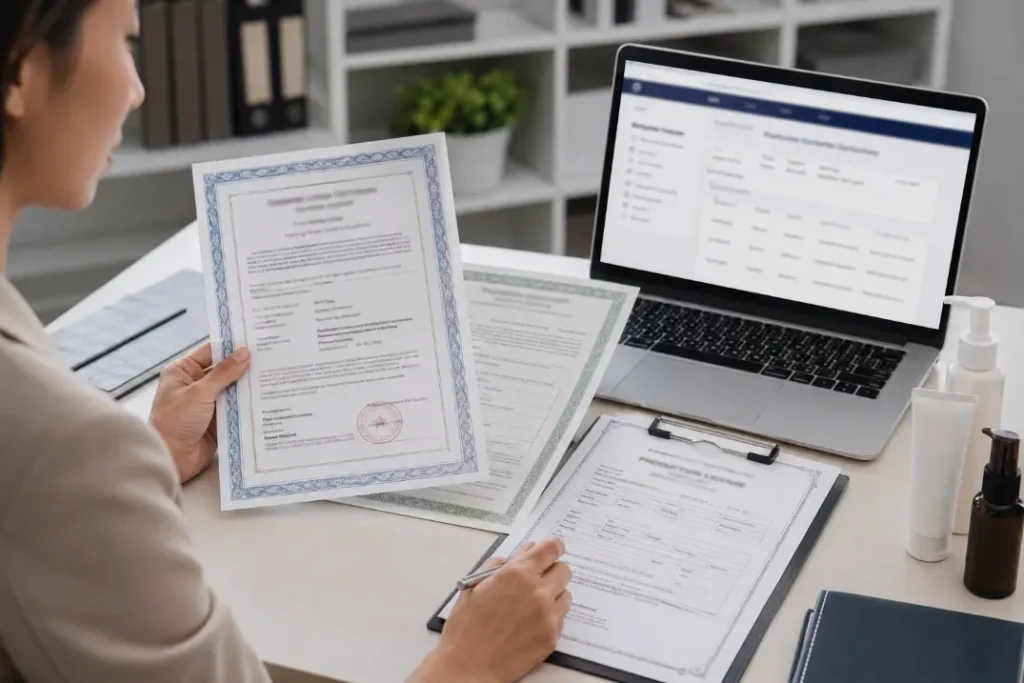
A factory audit tests whether documents and sales claims match daily work. For higher-risk products, an onsite audit gives the clearest view. A structured live video review can screen a supplier before travel or an independent audit.
Start with a controlled live walkthrough
Ask for a live tour through the product path:
- Exterior, entrance, and site identification
- Receiving and quarantine area
- Raw-material and packaging storage
- Weighing and dispensing
- Water-treatment system where relevant
- Mixing, heating, cooling, or emulsification equipment
- Bulk holding and transfer
- Filling, sealing, coding, and packing
- Laboratory and sample-retention area
- Rejected or nonconforming material area
- Finished-goods quarantine and release
The host can protect other customers’ confidential information while still showing the areas, status controls, equipment, and records that matter. Edited promotional footage is useful for orientation, not verification.
Follow one proposed product
General factory tours tend to show the cleanest corridor and newest machine. A useful audit follows one proposed SKU through material receipt, storage, weighing, compounding, in-process checks, filling, coding, finished-product testing, release, retention, and traceability.
Ask the team to explain how it controls:
- Material identity and approval
- Quarantine and released status
- Formula and process versions
- Weighing and line clearance
- Mixing time, temperature, speed, or other parameters
- In-process pH, viscosity, appearance, or fill checks where relevant
- Packaging-component issuance and reconciliation
- Coding and artwork versions
- Finished-product release
- Retained samples
Choose one batch code and ask the team to trace it backward to materials and forward to finished goods. A system that cannot do this during a planned review will be hard to rely on during a complaint.
Inspect people, equipment, and quality authority
Look beyond stainless steel. Check who has authority to reject materials, stop production, investigate a failure, and release a finished batch. Review staff training, hygiene, controlled movement, cleaning, pest control, maintenance, calibration, utilities, laboratory capability, warehouse segregation, complaint handling, and recall procedures.
Ask how outsourced laboratories are qualified. If a factory cannot run a specialized test internally, that is not automatically a problem. It should know which laboratory does the work, how samples are identified, what methods are used, and who reviews the result.
Add format-specific checks
| Product format | Additional evidence to review |
| Shampoo and conditioner | Water controls, mixing, pH and viscosity checks, microbial controls, filling compatibility |
| Oils and anhydrous serums | Raw-material identity, oxidation controls, fill accuracy, closure and light or air protection |
| Masks and styling creams | Heating and cooling control, homogenization, viscosity, hot-fill or pump compatibility |
| Wax and pomade | Heating, melt control, fill temperature, cooling, jar or tin compatibility |
| Hair color and developer | Ingredient restrictions, shade standards, component matching, warnings, specialized testing |
| Perm and straightening products | Ingredient restrictions, process controls, directions, warnings, performance and safety review |
| Aerosol spray, mousse, or dry shampoo | Aerosol permission, propellant handling, pressure filling, leakage and pressure tests, transport requirements |
The equipment should match the product and batch size. A plant that can fill ordinary shampoo is not automatically qualified for aerosols or oxidation color.
Ask how the factory handles failure
A factory that says it has never had a deviation or complaint is not necessarily safer. More often, it means the team has not shown you how problems are recorded.
Ask for a sanitized example involving a rejected raw material, out-of-specification result, packaging defect, or customer complaint. Follow the record through containment, root-cause investigation, corrective action, preventive action, and an effectiveness check.
The goal is to see whether the system detects problems, investigates them, and prevents repeat failures.
Step 5: Verify product testing and batch-control evidence
Facility qualifications do not qualify your product. The exact formula, package, claims, specification, and destination market still need their own evidence.
Control the approved sample and specification
Do not authorize production against the phrase “same as sample.” Identify the reference.
Your approval pack should include:
- Unique sample and formula code
- Formula or specification version
- Appearance, odor, color, pH, viscosity, and other relevant limits
- Performance and sensory criteria
- Fill weight or volume
- Packaging components and drawings
- Artwork version
- Storage and shelf-life assumptions
- Agreed test plan
- Authorized approvals and dates
Subjective characteristics still need language the parties understand. A curl cream may need agreed targets for spread, hold, flaking, residue, and next-day feel. A shampoo may need targets for viscosity, lather, rinse feel, and scalp comfort. The laboratory and buyer should use the same approved reference.
Review stability, microbiological, and compatibility testing

There is no universal test pack for every hair product. A qualified technical and regulatory team should build a risk-based plan around the formula, packaging, use conditions, claims, and market.
Ask:
- Which stability conditions and checkpoints apply?
- How is microbiological quality evaluated?
- Does the preservative system require additional evaluation?
- Is the formula tested in the intended bottle, jar, pump, cap, liner, label, and decoration?
- Are leakage, dispensing, discoloration, clogging, panel collapse, or label adhesion relevant?
- Are light, heat, cold, or freeze-thaw exposures appropriate?
- Does the product need pressure, transit, or dangerous-goods testing?
- Who performs each test?
- What is the laboratory’s competence or accreditation scope?
- What sample code and packaging version appear on the report?
- What are the acceptance criteria?
- What happens after a failure?
Testing needs time. A short schedule may be realistic for a known formula in qualified stock packaging, but the schedule still has to include the tests required for a new formula or component. For a closer look at the production timeline, see our guide to private label hair care MOQ, sampling, packaging, and lead time.
Match claims to evidence
An ingredient story is not a claim substantiation file. Neither is an unlabelled before-and-after photograph.
For each proposed claim, record the wording, formula, use instructions, target population, test method, protocol, report, and intended use on the label or website. Ask a qualified market specialist to review therapeutic, hair-growth, hair-loss, dandruff-treatment, structural-treatment, or strong safety claims.
Claims can change product classification or the evidence required in some markets. Set the claim direction before artwork approval, not after printed cartons arrive.
Connect the COA to the batch
A Certificate of Analysis or batch-release record should identify:
- Manufacturer and site
- Product and batch code
- Manufacture and test dates
- Specification version
- Test items and methods
- Limits and results
- Release status
- Authorized reviewer
Check that the COA points to the same product, formula version, and batch named on the shipping documents. A generic template or a report for another formula is not batch evidence.
Step 6: Confirm destination-market responsibilities
A production license and ISO certificate in the source country do not make a finished product ready for every market. The brand, importer, responsible person, manufacturer, safety assessor, and regulatory provider may hold different duties.
United States
For ordinary cosmetics, do not ask a supplier for an “FDA approval certificate.” The FDA states that cosmetic facility registration and product listing are neither a cosmetic approval program nor a promotional tool.
Under the applicable US framework, the responsible person is generally the manufacturer, packer, or distributor whose name appears on the label. Determine which facility, product, safety, adverse-event, labeling, and record obligations apply to your product, including any exemption. Put each task against an owner and due date.
Claims matter. A product sold to cleanse or condition hair may be a cosmetic, while a claim to treat disease can bring drug rules into the discussion. Dandruff and hair-loss claims deserve careful US classification review before formula and label approval.
European Union
For the EU, map the Responsible Person, good manufacturing practice, Cosmetic Product Safety Report, Product Information File, label, and product notification. Regulation (EC) No 1223/2009 sets obligations for the Responsible Person and product safety file, while the Cosmetic Product Notification Portal is used to submit required product information before the cosmetic is placed on the EU market.
CPNP is a notification system. It is not a product approval or manufacturer certificate.
The factory may provide formula, manufacturing, test, and packaging documents. That does not transfer all responsibility from the brand, importer, Responsible Person, or safety assessor. Agree on the document format, owner, review sequence, and update process early.
Other markets
Do not assume that a US or EU document pack covers the UK, Canada, Australia, GCC countries, ASEAN markets, or individual African countries. Use the current authority and a qualified local adviser.
Create a deliverables table:
| Requirement | Manufacturer | Brand or importer | External expert | Approval owner | Due date |
| Ingredient and formula data | |||||
| Product testing | |||||
| Safety assessment | |||||
| Label and claims review | |||||
| Notification, registration, or listing | |||||
| Import and customs documents | |||||
| Adverse-event and complaint process |
This table prevents a common late-stage problem: every party assumed someone else was preparing the file.
Step 7: Verify formula rights and commercial controls
A technically capable factory can still be a poor commercial fit if formula rights, changes, records, and inspections are unclear.
Define the formula route
Before development begins, compare the available custom hair care formulation options and write down whether the product uses:
- A shared stock formula
- A stock base with selected adjustments
- A supplier-developed ODM formula
- A fully custom development
- A buyer-supplied formula or specification
Then define who owns the composition and manufacturing know-how, whether the formula or fragrance is exclusive, whether the buyer receives the quantitative formula, how improvements are owned, whether the formula can be transferred, and what happens after termination.
An NDA helps protect confidential information. It does not replace a development agreement, manufacturing agreement, quality agreement, or controlled specification. Get legal advice where the intellectual property or commercial exposure warrants it.
Control every material change
Require prior approval for changes to:
- Formula or ingredient grade
- Raw-material supplier
- Fragrance, color, or preservative
- Bottle, jar, closure, liner, or decoration
- Manufacturing site
- Production process or equipment
- Testing laboratory or method
- Specification
- Subcontractor
Define how an emergency substitution is handled and which tests a change triggers. Without change control, the product approved during sampling may not be the product filled six months later.
Protect audit and record access
The agreement should address access to current licenses and certificates, buyer or independent audits, record retention, batch documentation, complaints, pre-shipment inspection, notification of material regulatory changes, corrective actions, recalls, and cooperation after a quality incident.
If the supplier says these rights are “standard,” ask to see them in the draft contract.
Build a manufacturer evidence matrix
Create one row for each important claim. The matrix shows which statements have evidence, which still need confirmation, and when each item must be checked again.
| Manufacturer claim | Evidence supplied | Entity and site matched? | Independent cross-check | Product-specific? | Status | Recheck date |
| “We are the factory” | Production license and factory audit | Government record and site review | Not applicable | Pass / Conditional / Stop | ||
| “ISO 22716 certified” | Complete certificate | Certification body or recognized database | No | Pass / Conditional / Stop | ||
| “We make this format” | License scope, equipment, records, sample | Audit and technical review | Yes | Pass / Conditional / Stop | ||
| “The formula is custom and exclusive” | Development and IP terms | Legal review | Yes | Pass / Conditional / Stop | ||
| “Testing is included” | Test plan, laboratory, methods, reports | Technical review | Yes | Pass / Conditional / Stop | ||
| “Ready for the target market” | Deliverables matrix | Regulatory review | Yes | Pass / Conditional / Stop |
Use three decisions:
- Pass: the evidence is current, consistent, relevant to the correct entity and site, and sufficient for the current sourcing stage.
- Conditional: the gap can be closed through a document, clarification, corrective action, sample, test, or audit closure before the next payment milestone.
- Stop: the supplier hides the producer, uses altered records, lacks relevant production permission, requests unexplained third-party payment, refuses critical testing or audit access, or leaves a critical finding open.
Avoid star ratings that create false precision. A critical identity, license, falsification, or safety failure should stop the approval no matter how attractive the price is.
Red flags during verification
One spelling mismatch may have a simple explanation. A cluster of contradictions usually needs deeper investigation.
Identity and payment
- The supplier provides only an English trading name.
- The contract, invoice, certificate, and bank beneficiary use unexplained companies.
- The actual producer is not identified.
- Payment is requested to a personal or unrelated account without a legitimate documented reason.
Licenses and certificates
- A document is cropped, blurred, altered, expired, or missing pages.
- The holder or address does not match the proposed factory.
- The scope does not cover cosmetics manufacturing or the relevant activity.
- A logo replaces the full certificate.
- Registration or notification is described as product approval.
Factory and quality controls
- The supplier offers only edited promotional footage.
- The team cannot explain quarantine, batch records, release, retention, deviations, or change control.
- Critical measuring or test equipment lacks current calibration or maintenance evidence.
- Product and batch codes conflict across records.
- The factory claims it has never had a complaint or deviation but cannot show an investigation process.
Product and contract
- The supplier requests bulk production before formula, packaging, artwork, specification, and testing are approved.
- Testing is “included,” but no method, laboratory, sample code, limits, or report is defined.
- The factory may substitute ingredients or packaging without approval.
- Formula exclusivity is promised verbally but absent from the contract.
- Target-market responsibilities remain unanswered.
Any suspected falsification deserves a pause. Do not argue the point through a long sales chat. Ask for original records and independent confirmation, then decide whether the project should continue.
Documents to request before a production deposit
The exact file depends on product and market risk, but most private label buyers should organize three folders before releasing a bulk-production payment.
Company and factory
- Current government business record
- Factory legal name and address
- Current production license or local equivalent
- Entity-relationship explanation
- Authorized signatory evidence where appropriate
- Current certificate copies
- Factory audit report and corrective-action closure, where required
Product and quality
- Approved sample code and specification
- Ingredient or INCI information appropriate to the stage
- Formula ownership and confidentiality terms
- Packaging specification and artwork approval
- Agreed stability, microbiological, compatibility, performance, and transport plan
- Reports required before production
- Batch-record and COA format
- Change-control procedure
- Nonconformance and complaint process
Commercial and market
- Final itemized quotation and exclusions
- Manufacturing and quality terms
- Payment milestones linked to approvals
- Incoterm and shipping responsibilities
- Destination-market deliverables matrix
- Label and claims approval responsibility
- Inspection and acceptance process
- Recall, remedy, and dispute provisions reviewed by appropriate counsel
A good sample supports the decision, but it does not release the product for manufacturing. Pay the bulk deposit after the agreed identity, license, technical, commercial, and market gates are satisfied.
A five-step manufacturer approval workflow
Verification should progress in stages. There is little value in paying for a full audit when a supplier cannot pass a basic identity check.
Step 1: Request the evidence pack
Collect legal identity, production license, site, certificates, product scope, and entity relationships before paying for custom development.
Step 2: Complete the desk review
Check government records, license fields, certificate status, entity consistency, and open questions. Remove candidates with critical identity or permission failures.
Step 3: Review the factory
Conduct a structured live walkthrough or onsite audit. Follow the proposed product path, review records, test traceability, and record findings. For a higher-risk or larger project, use an independent auditor with the right cosmetics and product-format experience.
Step 4: Qualify the product and package
Control the approved sample and specification. Complete the agreed testing and verify that the formula, packaging, artwork, and claims still describe the same product.
Step 5: Approve with conditions and recheck dates
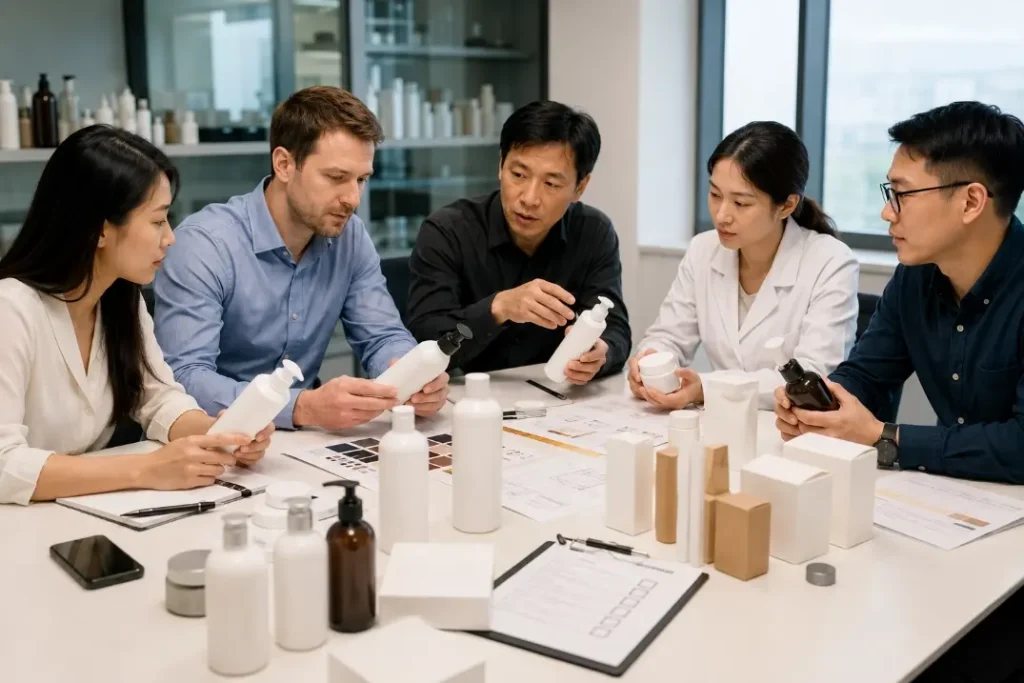
Close critical findings, document any remaining conditions, sign the required agreements, and link payment milestones to approval gates. Record recheck dates for licenses, certificates, audits, tests, and material changes.
How Keronhair supports buyer verification
Keronhair should be checked with the same method used for any other candidate. A buyer’s questions should lead to project-specific evidence rather than a broad website claim.
For a proposed project, the review can include:
- Identification of the relevant contracting and production entities
- Applicable factory and quality documents for buyer review
- Discussion of certificate holder, site, scope, issuing body, and validity
- Confirmation of hair product format and development-route feasibility
- Identifiable sample versions and written feedback
- Formula, packaging, artwork, testing, and production approvals
- An appropriate factory discussion, visit, live review, or independent inspection
- A clear division between manufacturer support and the duties of the brand, importer, Responsible Person, or external adviser
If you are still comparing candidates, start with our guide to reliable hair product manufacturers. Buyers focused on China can also review the current list of custom hair care manufacturers in China before applying this verification process.
To discuss a project with Keronhair, send the target market, product category, formula route, packaging direction, quantity range, required standards, audit expectations, and launch timing. Our OEM/ODM hair product manufacturing team can then confirm what information and next steps apply to the brief.
Verify the evidence chain before approving the factory
Licenses, certificates, factory videos, and samples have value only when they refer to the same legal company, production site, activity, product, and transaction.
Identify the parties first. Check government and production records. Authenticate certificate scope and status. Audit the operating process. Qualify the formula and packaging. Assign destination-market responsibilities. Then place the approved specification, testing, change rules, and inspection rights into controlled project documents.
The result should be a short, traceable evidence file rather than a large folder of unrelated claims. If you want Keronhair to review a hair care brief against this process, contact our team with your product, market, packaging, quantity, and verification requirements.
Frequently asked questions
How can I tell whether a hair care manufacturer is legitimate?
Match the supplier’s legal identity to a government business record, then identify the actual factory and check its production permission. Compare the names and addresses on the license, certificate, quotation, contract, invoice, and bank account. Review the factory and product evidence before approval. A polished website, fast sample, or marketplace badge cannot replace that chain.
Is a business license enough to verify a cosmetics factory?
No. A business license or registration proves that the company legally exists and may state its business scope. It does not prove that the company operates the factory, has cosmetics production permission, or can make your product. Check the production license or local equivalent for the actual site, then review its quality system and technical capability.
How do I verify an ISO 22716 certificate?
Check the legal entity, factory address, certification scope, standard and edition, certificate number, certification body, issue and expiry dates, and current status. Search the certification body’s directory and a recognized database where applicable. Contact the issuer if the result is unclear. ISO develops the standard but does not issue the certificate.
Does ISO 22716 mean every product is safe or approved?
No. ISO 22716 addresses cosmetics GMP for production, control, storage, and shipment. A valid certificate can support confidence in the management system, but it does not approve a product or guarantee every batch. Your formula, packaging, claims, tests, specification, batch records, and destination-market responsibilities still require review.
Does FDA registration prove that a hair care manufacturer is approved?
No. FDA cosmetic facility registration and product listing are not a cosmetic approval program. Do not describe a registered facility as an “FDA-approved cosmetics factory.” Determine the current MoCRA responsibilities for the facility, product, and responsible person, and review the product’s claims and classification separately.
What should I check during a hair care factory audit?
Confirm the site’s identity, license scope, people, material controls, equipment, cleaning, production flow, laboratory, batch records, release, retained samples, traceability, deviations, change control, complaints, and recall procedures. Follow the process for your proposed product. Aerosols, hair color, straightening products, waxes, and ordinary shampoos need different technical checks.
Can I verify a factory without visiting China?
You can complete much of the early screening remotely. Check government records and certificates, run a controlled live video tour, review documents, test samples, and appoint an independent local auditor when needed. Remote work has limits, especially when the project uses higher-risk formats or large order values. The verification depth should match the product and commercial risk.
What test reports should a hair care manufacturer provide?
The test plan depends on the formula, package, use, claims, and market. It may include stability, microbiological, preservative-system, packaging-compatibility, performance, pressure, leakage, or transport evidence. Check the laboratory, method, sample code, packaging version, dates, acceptance criteria, and result. Do not accept a report for a different formula as evidence for your product.
How often should manufacturer qualifications be rechecked?
Check them before initial approval, at document expiry, after a factory or entity change, after a significant formula or process change, and after a serious quality issue. Add a periodic review based on supplier and product risk. A current record can become outdated, so save both the evidence and the date you checked it.
What if the manufacturer’s company names do not match?
Ask for an entity map. Related sales, export, contract, and manufacturing companies can form a legitimate structure, but their roles should be documented. Connect the website, sales contact, factory, production license, contract, invoice, bank beneficiary, and market-responsibility parties. Stop if the supplier refuses to identify the producer or explain the payment structure.
Should I use a third-party factory audit company?
An independent audit is useful when your team cannot visit, when the product carries higher technical risk, or when the order value justifies outside review. Define the audit scope and choose an auditor with cosmetics and relevant format experience. An audit is one piece of evidence. It does not replace product testing, packaging qualification, specifications, or contract controls.
Which verification failures should stop the project?
Stop for hidden production, false or altered records, missing permission for the relevant manufacturing activity, unexplained third-party payments, inability to trace a batch, refusal of critical testing, or unresolved critical audit findings. A small clerical discrepancy may be correctable. A false document or concealed producer changes the risk entirely.