Yes. A Chinese hair care manufacturer for Saudi Arabia and UAE brands can develop and produce private-label products when the formula, claims, packaging, technical documents and manufacturing controls are aligned with the destination market. However, the factory’s ability to manufacture does not complete local product notification, registration, import or shipment-clearance responsibilities.
The practical question is not simply, “Can the factory make it?” It is whether the brand, Chinese manufacturer and local importer or responsible party can connect product development with the correct Saudi or UAE route. This guide explains that division of work, the evidence to request and the controls to complete before bulk production. If you are still weighing a Chinese factory against other sourcing routes, compare the private label manufacturing options for Middle East brands before deciding which suppliers to assess against these requirements.

Yes—But Manufacturing and Market Access Are Not the Same Thing
An overseas manufacturing project has several approval points. The factory may approve technical feasibility, the brand may approve the product and artwork, and a local party may manage market-facing requirements. A government authority or authorised assessment body may then review information or a shipment according to the applicable process.
These are connected decisions, but they are not interchangeable.
What a Chinese Hair Care Manufacturer Can Usually Support
A capable manufacturer can review a product brief, recommend an appropriate development route, prepare samples, source or assess packaging, manufacture the approved formula and perform agreed quality controls. It can also organise product and shipment information required from the manufacturing side.
The exact scope should be stated in the quotation or project agreement. “Turnkey” can mean different things. One supplier may include formula development and packaging sourcing, while another may also coordinate third-party testing or prepare a broader technical package. Ask for named deliverables rather than relying on a service label.
Keronhair’s public pages describe a Guangzhou-based operation offering OEM and ODM hair care manufacturing routes across several hair care categories. Saudi and UAE buyers should treat that as a starting point for a project-specific feasibility review, not proof that every formula, document or pack format is available.
What the Manufacturer Cannot Decide or Guarantee
A Chinese factory should not decide which Saudi or UAE entity will hold local accounts, act as importer or accept local responsibilities. It should not make final legal decisions about product classification, claims or local label content unless appropriately qualified and authorised for that role.
It also cannot guarantee a government submission, registration or clearance result. Even a well-controlled factory does not know the final outcome before the authority or relevant body reviews the submitted product and shipment information.
Be cautious when a supplier uses phrases such as “SFDA approved,” “Montaji approved” or “fully GCC compliant” without explaining the product, company, evidence and activity covered. Ask instead:
- What will the manufacturer provide?
- What must the brand approve?
- What must the local importer or responsible party complete?
- Which point still depends on an authority, laboratory or third party?
Use a Four-Layer Readiness Test Before You Request Samples
| Readiness layer | Question to answer | Evidence or decision needed |
|---|---|---|
| Factory capability | Can the actual site make and fill this product category? | Legal factory identity, equipment, category experience and quality process |
| Product readiness | Is the formula, intended use, claim and pack suitable for the destination brief? | Product specification, ingredient review, claim review and packaging plan |
| Document readiness | Can the manufacturer supply the agreed information at the required stage? | Factory, formula, test, batch, packaging and shipment records |
| Local market readiness | Is an authorised local party ready to manage the applicable submission and import route? | Named owner, account status, local approvals and importer plan |
Do not progress simply because one layer looks strong. A good sample cannot compensate for an unidentified production site. A complete factory dossier cannot compensate for missing local ownership. All four layers should have a named owner and an evidence trail.
Define the Product and Destination Before the Factory Starts Development
The manufacturer cannot prepare a destination-ready project if the brief says only “Middle East.” Saudi Arabia and the UAE must be treated as named markets, and a Dubai route should not automatically be presented as the answer for every emirate or channel.
Name the Exact Launch Market and Sales Channel
State whether Saudi Arabia, Dubai or another UAE market will launch first. If both countries are planned, decide whether the brand expects one common formula and pack or is prepared to use different versions after local review.
The sales channel matters too. Salon, e-commerce, pharmacy, beauty retail and mass-market programmes can create different commercial, packaging and claim decisions. A professional hair colour system, for example, needs a different brief from a consumer shampoo.
Include the proposed importer, distributor, local responsible party and fulfilment route. If those roles are still open, label them as unassigned. That is safer than silently assuming the Chinese manufacturer will cover them later.
Confirm That the Intended Use and Claims Stay Within Cosmetic Scope
The Saudi Food and Drug Authority’s cosmetics overview explains that cosmetics are intended for purposes such as cleaning, perfuming, protection, keeping external body parts in good condition or changing appearance. It also states that medical claims can affect classification.
This distinction should influence the brief before formulation begins. “Helps hair feel smoother” and “treats a scalp disease” are not equivalent claims. Hair-loss, dandruff, infection or therapeutic language can raise classification and evidence questions that should not be resolved by marketing copy alone.
The Gulf Standardization Organization’s GSO 2528:2024 page provides the official reference point for cosmetic-claims criteria. Have the applicable claims and safety framework reviewed for the specific destination rather than copying claims from another market.
Match the Brief to the Actual Hair Product Category
Product category changes the manufacturing and evidence questions:
- Shampoo, conditioner and masks: Define cleansing, conditioning, viscosity, fragrance, rinse feel, stability and bottle or jar function.
- Oils, serums and leave-on products: Consider dispensing, leakage, compatibility, feel and the intended claim set.
- Hair dye and developer: Treat the shade system, mixing ratio, instructions, pack combination and category-specific safety work as a coordinated project.
- Straightening or smoothing products: Review the formula, application protocol, ingredient restrictions and claims carefully before sampling.
- Wax, pomade, clay or gel: Match viscosity, filling equipment, heat response, closure and washout expectations.
Keronhair’s verified product pages cover general hair care manufacturing, shampoo, hair colour, straightening and styling directions. Ask for evidence relating to the exact category and production site, especially for specialised systems.
Do not define the consumer as a single “Middle Eastern hair type.” Specify the actual user, hair characteristics, salon practices, climate-related concerns, test panel and performance benchmark relevant to the brand.
Identify the Importer or Local Responsible Party Early
The local party affects the information that must appear in the product file, artwork and import workflow. Appointing that company late can trigger label changes, document rework or a second product review.
Before approving the first sample, establish:
- Who will confirm the applicable Saudi or UAE process?
- Who controls the local account and product record?
- Who reviews ingredients, intended use and claims?
- Who approves Arabic and English label content?
- Who manages authority questions and shipment clearance?
If no one can answer these questions, keep the project in development rather than moving to printed packaging or bulk production.
Plan the Saudi Arabia Route Around Ghad, FASEH and the Local Importer

Saudi planning should begin while the formula and artwork are still editable. The SFDA’s published cosmetic product notification guidance is the appropriate current starting point for the product-notification framework and reflects the transition to the unified Ghad system.
Because systems and detailed requirements may change, the Saudi importer or responsible project team should confirm the live process for the actual product.
Confirm the Saudi Importer and Ghad Responsibilities
SFDA information on FASEH cosmetic consignment clearance describes an importer process that first involves product and relevant licence steps through Ghad, followed by the FASEH route for cosmetic shipment clearance.
That sequence shows why the importer cannot be an afterthought. The brand and Saudi party should confirm:
- Which company is authorised to perform the relevant actions
- Which establishment, product and manufacturer information is needed
- Who uploads or maintains information
- Who responds if SFDA requests clarification
- Which approval point is required before production or shipment
The Chinese manufacturer can supply agreed source information. It should not be described as the Saudi account owner unless that role has been independently verified.
Prepare Manufacturer Inputs Before Product Notification
Ask the Saudi project owner to create a manufacturer-input list before the formula is approved. Depending on the product and current process, this may cover the legal manufacturer, production address, product identity, ingredient information, intended use, claims, specifications, pack information and supporting evidence.
Do not send unversioned documents. Every file should identify the SKU, formula or product version, language, status and date. If the ingredient list changes during sampling, notify the Saudi reviewer before artwork and product records are finalised.
For a private-label shampoo manufacturing project, for example, the brand should connect the final ingredient list, product name, intended claims, bottle size, label text and approved sample. For hair dye, the documentation and instructions may require a more category-specific plan.
Plan FASEH Shipment Clearance Before the Goods Leave China
Product preparation and shipment clearance are separate checkpoints. The importer should identify the current FASEH steps, conformity-assessment arrangements and shipment records before the factory books freight.
Create a pre-shipment list covering the agreed commercial invoice, packing list, transport documents, batch information, product identification and any origin or conformity records applicable to the shipment. The final list should come from the Saudi importer or its qualified customs and regulatory support—not from a generic export-document template.
If a required product or establishment step remains incomplete, do not assume the shipment can be corrected easily after arrival. Build clearance readiness into the production-release meeting.
Treat UAE and Dubai Requirements as a Separate Project Route
Dubai Municipality’s current services page lists separate consumer-product services for Montaji registration, import and re-export permission, advertising permission and testing. This is a useful reminder that product registration, shipment release and advertising are related but distinct activities.
Confirm the Establishment That Will Use Montaji
Dubai Municipality states that consumer-products establishments can assess and register products through Montaji. The brand should therefore identify the appropriate UAE establishment, confirm its account and define who owns the product record and future updates.
Ask practical continuity questions:
- What happens to the record if the distributor changes?
- Who retains the approved artwork and technical package?
- Who receives renewal or authority notices?
- Can the brand obtain copies of relevant records?
The Chinese manufacturer generally supports the establishment with source information. It does not become a UAE local entity merely because it supplies the product.
Align Formula, Artwork and Product Records Before Registration
The formula, INCI-style ingredient information, product name, intended use, claims, pack size, manufacturer details and artwork should describe the same commercial product. A mismatch between the sample, formula file and printed pack can create rework.
Plan Arabic and English content before printing. Do not assume that a label used for Saudi Arabia will automatically fit the Dubai project. Have the local party verify required fields, translations, responsible-party information and claim wording.
If one design will serve several markets, create a country-by-country artwork approval sheet. A shared pack is a business decision made after review, not the default.
Separate Product Registration From Import and Re-Export Permission
Dubai Municipality lists Montaji registration and the consumer-products import/re-export permit as separate services. The project plan should therefore show which product milestone must be completed before the importer requests shipment release.
The manufacturer should receive the final shipping instructions early enough to prepare cartons, codes and documents accurately. The importer should confirm port, consignee, record references and other current requirements before dispatch.
Avoid treating a registration record as proof that any shipment, advertisement or future formula change is automatically accepted. Each activity has its own owner and evidence.
Review Advertising Claims Before Launch Campaigns
Dubai Municipality also lists a consumer-product advertising permit service. The marketing team should not treat registered artwork as permission to publish any new performance, therapeutic, influencer or promotional claim.
Connect marketing review to product development. If a campaign needs a claim not included in the original brief, assess the classification and evidence impact before publishing it. The same discipline applies to marketplace listings, salon training, social media and distributor catalogues.
Verify the Chinese Factory and Assign Every Responsibility
Cross-border risk falls when the buyer can connect every company, document and decision to a named owner. Build that connection before paying for packaging or bulk materials.
For the supplier-side review, use the Saudi-brand manufacturer verification checklist to connect legal-entity checks with sample approval, packaging, document consistency and reorder controls. This keeps the factory audit tied to the actual launch brief.
Use One Responsibility Matrix for Each Destination Market
Use a separate matrix for Saudi Arabia and the UAE, even if many people and documents are shared.
| Task | Chinese manufacturer | Brand owner | Local importer/responsible party |
|---|---|---|---|
| Product and formula inputs | Supplies agreed manufacturing information | Approves commercial brief and formula | Confirms local review needs |
| Claims and artwork | Provides product and pack inputs | Owns final claim and design decisions | Reviews local content and responsible-party details |
| Local product process | Responds with agreed documents | Funds and coordinates decisions | Manages applicable accounts and submissions |
| Production and release | Manufactures to approved specifications | Approves release conditions | Confirms market and import readiness |
| Shipment | Prepares agreed batch and commercial records | Approves shipping plan | Manages applicable import and clearance tasks |
| Changes or complaints | Investigates manufacturing evidence | Coordinates brand response | Manages local market and authority obligations |
Manufacturer Deliverables
Name the factory information, formula and product records, packaging inputs, batch documents and shipment records the manufacturer must provide. Add format, language, due date and version status.
Brand Decisions and Approvals
The brand should approve the intended consumer, product positioning, formula route, sample, claims, packaging, artwork and commercial terms. Dated approvals reduce disputes about which version entered production.
Importer or Local Responsible-Party Tasks
The local party should confirm classification, local accounts, product process, label requirements, import plan and post-market responsibilities. The precise role can vary by country and arrangement.
Authority, Laboratory and Third-Party Inputs
Record which questions require an authority, qualified regulatory professional, testing laboratory, certification body, auditor or inspection company. A factory sales representative should not be the sole source for those decisions.
Define Ownership of Accounts, Records and Future Changes
Document who owns or controls local product accounts and who can access records. If the importer changes, the brand should know whether information can transfer, whether a new submission is needed and how future shipments will be affected.
Also agree on formula and packaging change control. The manufacturer should notify the brand before changing a significant raw material, supplier, fragrance, colour, process, component or production site. The local party should assess whether the change affects its product record or artwork.
Treat Missing Owners, Unexplained Entities or Incomplete Evidence as Stop Conditions
Pause if the contracting party, bank beneficiary, certificate holder and production site cannot be reconciled. Legitimate group structures exist, but the relationship should be written and verifiable.
Other stop conditions include:
- No named owner for local product or import tasks
- A certificate supplied only as a cropped logo
- Product documents that do not identify the correct SKU or version
- Pressure to print labels before local review
- A promise of guaranteed government approval
- Refusal to allow reasonable factory verification
Verify the Legal Manufacturer and Actual Production Site
Request the legal company name, registered address, production address, business scope and export or contracting entity. Compare these details across the quotation, invoice, bank account, certificates and intended product records.
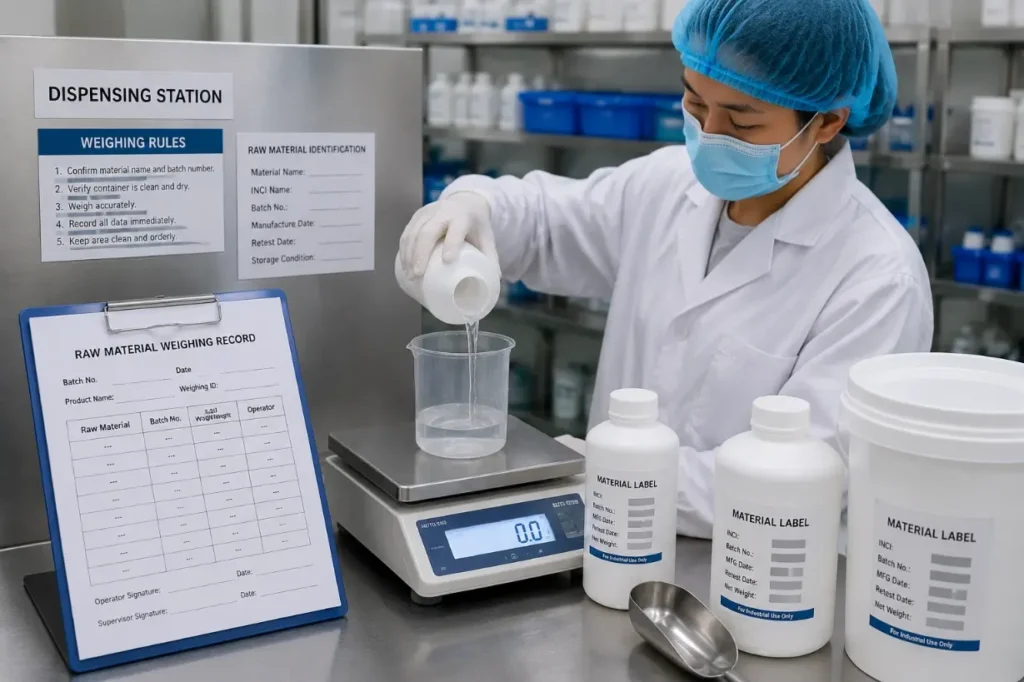
Use a live video tour, third-party audit or site visit in proportion to risk. Look for category-relevant equipment, material identification, weighing controls, batch records, line clearance, laboratory activities, finished-product release and retained samples.
Keronhair’s public website gives a Guangzhou address and describes hair care manufacturing. Before publication or contracting, buyers should still confirm the precise legal entity, production site and document scope for their project.
Read ISO 22716 or GMP Evidence Beyond the Logo
The official ISO 22716 page states that the standard provides guidelines for the production, control, storage and shipment of cosmetic products. It does not function as Saudi or Dubai product approval.
When a supplier presents an ISO or GMP-related certificate, check:
- Certificate holder
- Factory address
- Standard and scope
- Issuing body
- Issue and expiry dates
- Verification route
Apply the same standard to Keronhair. Its current certificates and scopes should be manually confirmed before the article or sales team cites them.
Organize Formula, Product, Packaging, Batch and Shipment Records by Stage
| Project stage | Evidence group | Buyer purpose |
|---|---|---|
| Supplier qualification | Business, factory and certificate records | Confirm who will manufacture |
| Product development | Formula, ingredient, product, claim and packaging information | Support local review and sample decisions |
| Pre-production | Approved sample code, specification, artwork and test plan | Lock the commercial version |
| Batch release | Batch record, agreed quality results and retained-sample reference | Connect production to the approved standard |
| Shipment | Packing, invoice, transport and destination-specific records as applicable | Support dispatch and importer workflow |
The local Saudi or UAE party should define the final list. The manufacturer should confirm which documents it can issue, when they become available and whether a change in formula or packaging requires a revised file.
Control Samples, Production and the Final Go/No-Go Decision
Sampling is both product development and a test of the supplier’s working discipline. A manufacturer that controls versions and explains changes during sampling is easier to manage during production.
Approve Samples Against Written Product and Market Criteria
Give each sample a code and evaluate it against the product brief. Shampoo criteria might cover cleansing, foam, wet feel, rinse, fragrance and viscosity. A mask may focus on spread, detangling, rinse and residue. Styling products need category-specific hold, finish, application and washout criteria.
Record requested changes, who approved them and the resulting formula version. Do not approve “the sample in the last parcel” without a traceable code.
Link the Approved Formula to Packaging and Testing
Use the intended commercial component for compatibility work. A visually similar bottle may use a different resin, closure, pump or liner. Thick creams, low-viscosity serums and reactive systems create different filling and pack risks.
The appropriate stability, microbiological, compatibility, transport or specialised testing depends on the product, claims and market. Define the responsible laboratory, protocol, timing, acceptance criteria and response to a failed result. Do not describe a generic visual check as proof of safety or market compliance.
For a custom project, the Keronhair formulation and sampling discussion can begin with the product brief. The exact test package and evidence still require project confirmation.
Lock the Master Sample, Batch Release and Change-Control Process
Before production, connect the final formula version, approved sample, product specification, packaging specification and artwork. Agree on in-process checks, finished-product release, retained samples and pre-shipment review.
Set change-control rules for repeat orders. If a material or packaging component is discontinued, the parties should know who assesses the alternative, approves a new sample, repeats testing and updates local records.
Check the Non-Negotiable Go/No-Go Conditions
Move to bulk production only when:
- The destination market and local party are confirmed
- Formula, claims and artwork have completed the planned review
- The legal factory and relevant evidence match
- The document list and owners are written
- The coded sample and commercial packaging are approved
- Testing and release responsibilities are agreed
- Shipment readiness has a named owner
Stop if the factory is unidentified, required documents are missing, the label is unreviewed, the payment structure is unexplained or anyone guarantees an authority result. A high supplier score should not override a critical stop condition.
Send Keronhair a Saudi- or UAE-Ready Manufacturing Brief
A useful enquiry should include:
- Saudi Arabia, UAE/Dubai or another confirmed destination
- Buyer and sales-channel type
- Product category and number of SKUs
- Private label, ODM or custom formula route
- Estimated quantity per SKU
- Packaging status
- Claims or ingredient restrictions
- Target launch timing
- Local importer or responsible-party status
- Required samples and manufacturer documents
Keronhair can review manufacturing feasibility from the China side and discuss project-specific formula, sample, packaging, production and document availability. The Saudi or UAE party must still confirm its applicable local process.
To begin, discuss a Saudi or UAE hair care manufacturing brief with the product-development team rather than requesting only a catalogue and “best price.”
A Chinese hair care manufacturer for Saudi Arabia and UAE brands can be a workable route when each party understands its role. The most reliable project is not built on a broad compliance promise; it is built on a destination-specific brief, verifiable factory evidence, controlled product versions and a local partner ready to manage market access and import responsibilities.
A first conversation is easier to use when it begins with the product and destination brief. Our Beautyworld Dubai 2026 project information provides a concrete example of the OEM/ODM topics prepared for an international supplier meeting.
Frequently Asked Questions
Can a Chinese manufacturer legally make private-label hair care for a Saudi brand?
Yes. The factory can manufacture and export, but the Saudi product, local-party, notification, import and document requirements must be confirmed for the specific project.
Can a Chinese hair care factory register my product in Ghad?
Do not assume so. The Chinese factory normally supplies agreed source information, while the authorised Saudi importer or responsible party confirms and manages the applicable Ghad activities.
Can the same product and label be used in Saudi Arabia and the UAE?
Possibly, but never by default. Review the formula, claims, Arabic content, responsible-party details and submission requirements separately before approving a shared version.
What documents should a Chinese hair care manufacturer provide for GCC import?
Request legal factory, certificate, formula, product, packaging, test, batch, commercial and shipment records by project stage. The local importer should confirm the final list.
Does ISO 22716 mean the product is approved in Saudi Arabia or Dubai?
No. ISO 22716 provides cosmetic GMP guidelines for production, control, storage and shipment. It does not represent Saudi or Dubai product approval.
Who should handle Montaji registration for a Dubai hair care product?
The appropriately authorised local consumer-products establishment should confirm and manage the Montaji process. The manufacturer supports it with agreed product and factory information.
Do Saudi or UAE hair care labels need Arabic?
Plan for Arabic content, often alongside English, but have the local responsible party verify the applicable language and label requirements before printing.
Can a manufacturer guarantee SFDA, Ghad, FASEH or Montaji approval?
No responsible manufacturer should guarantee the outcome. It can provide supporting information, while the result depends on the product, local party, submission and official review.