A crowded shelf does not guarantee a better natural hair routine. Two bottles with different names may do nearly the same job, while a popular “essential” may add nothing but residue to your particular hair. The smarter approach is to choose products by function: what needs cleaning, where you need slip, how much conditioning your strands tolerate, and what finish your style requires. This guide explains 15 useful product categories, where each fits, and when it is sensible to leave one out.
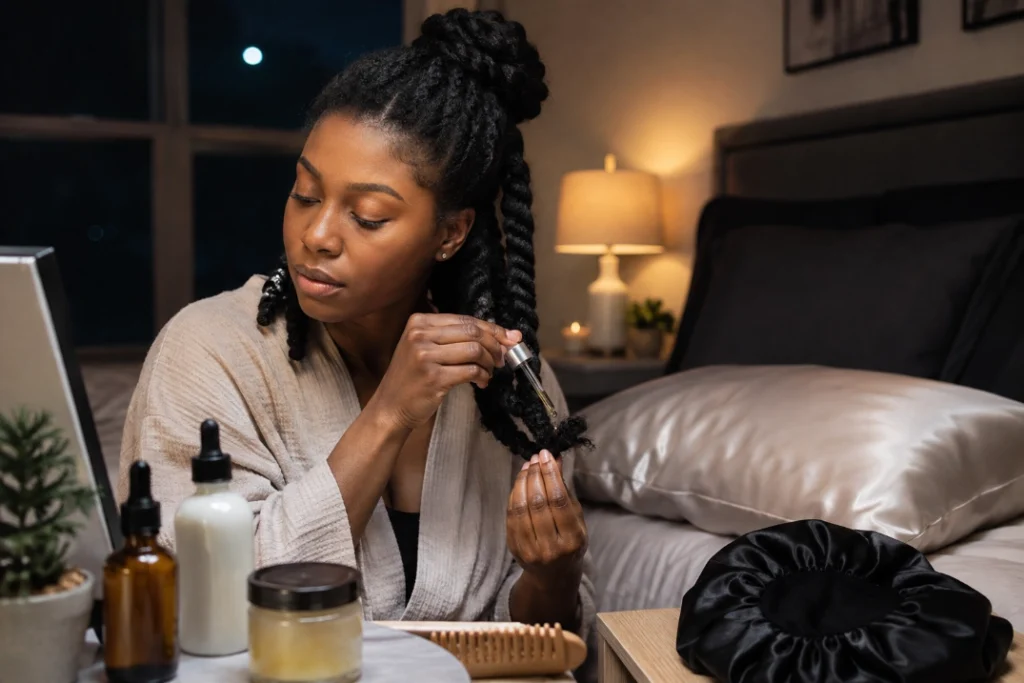
What Does Natural Hair Actually Need From Its Products?
Natural hair does not need a complicated ritual. A useful routine cleans the scalp, reduces friction during detangling, helps the hair remain flexible and manageable, and supports the intended style without leaving excessive buildup. The right products depend on how your hair and scalp behave, not on the size of somebody else’s wash-day collection.
Natural texture is only one part of the decision
In this guide, natural hair means hair worn in its natural texture without chemical relaxing or permanent straightening. The term often includes curly, coily, kinky, and Afro-textured hair, but those descriptions are not interchangeable with race, strand thickness, density, or porosity. It also does not mean that every suitable formula must contain only natural or organic ingredients.
Two people with a similar curl pattern can need very different products. Fine, low-density hair may lose volume under a rich cream, while dense or coarse hair may need more product simply to achieve even coverage. Scalp oiliness, coloring, heat use, protective styles, local humidity, and the hardness of the water can all change what works. For more help separating these factors, see Keronhair’s guide to hair type, texture, and porosity.
Build around product roles, not product hype
Start by assigning each product a job. A cleanser removes sweat, oil, and residue. A conditioner provides slip. A treatment addresses an occasional need. A leave-in supports manageability, while a styler creates the desired definition, volume, or hold. An oil or serum may smooth the surface, but it cannot replace cleansing or water-based conditioning.
Some formulas perform more than one role. A moisturizing shampoo may leave the hair manageable enough that you do not need a pre-shampoo treatment. A conditioning curl cream may serve as both leave-in and styler. The 15 categories below are therefore arranged in common routine order, not ranked from universally best to worst.
15 Best Hair Care Products for Natural Hair
Use this list as a menu, not a required shopping list. Many people can build a dependable routine with a cleanser, a rinse-out conditioner, an optional leave-in, and one styler. Alternate cleansers, intensive treatments, oils, and scalp products make sense only when they address a specific problem.
| No. | Product category | Main job | When used | Often useful for | Main caution |
|---|---|---|---|---|---|
| 1 | Pre-shampoo treatment | Reduce friction before washing | Before shampoo | Tangle-prone or manipulation-sensitive hair | Heavy oils can add buildup |
| 2 | Moisturizing shampoo | Clean with a comfortable after-feel | Regular wash day | Routine scalp and hair cleansing | “Sulfate-free” does not prove mildness |
| 3 | Clarifying shampoo | Remove stubborn residue | Occasionally | Heavy product use or hard-water exposure | Frequent use may feel drying |
| 4 | Co-wash | Provide light cleansing and conditioning | Selected wash days | Some dry-feeling curl routines | May not remove dense buildup |
| 5 | Rinse-out conditioner | Add slip and reduce combing friction | After cleansing | Most wash routines | More product is not always better |
| 6 | Deep conditioner or mask | Provide richer conditioning | Periodically | Dry-feeling or highly manipulated hair | Can weigh down fine hair |
| 7 | Detangling spray or cream | Improve slip during knot removal | On wet or damp hair | Dense, long, or tangle-prone hair | Product cannot compensate for rough technique |
| 8 | Protein or bond-support treatment | Temporarily support weakened fibers | As needed | Processed or heat-stressed hair | Overuse may leave hair stiff |
| 9 | Leave-in conditioner | Support softness and manageability | After washing | Dry, tangled, curly, or coily hair | Match the weight to the hair |
| 10 | Curl cream | Add softness and flexible definition | During styling | Twist-outs, braid-outs, and wash-and-go styles | Too much can flatten the hair |
| 11 | Styling gel or custard | Create hold and longer-lasting definition | Final styling layer | Defined or sleek styles | Check for flaking between layers |
| 12 | Styling mousse or foam | Add light hold and volume | During styling | Fine hair, sets, braids, and quicker drying | Hold varies widely by formula |
| 13 | Lightweight oil or serum | Reduce friction and add shine | Before washing or as a finish | Dry ends and surface smoothing | Oil does not hydrate hair |
| 14 | Heat protectant | Reduce heat-related damage | Before thermal styling | Blow-drying, pressing, or ironing | It cannot make excessive heat harmless |
| 15 | Scalp-care product | Address a defined cosmetic scalp need | As labeled | Residue, oiliness, or dry-feeling scalp | Persistent symptoms need medical care |
1. Pre-shampoo treatment
A pre-shampoo treatment, often called a pre-poo, is applied before cleansing to lubricate the strands and make sectioning or detangling easier. It can be an oil, conditioner, or formula made specifically for this step. One laboratory study found that coconut oil reduced protein loss under the tested pre-wash and post-wash conditions, but the result does not apply to every oil and does not mean that damaged hair has been permanently repaired.
- Best for: knot-prone hair, dry-feeling ends, or wash days that involve considerable detangling.
- What to look for: a formula that spreads easily and rinses out with your usual shampoo.
- How to use it: apply a modest amount to sections before washing and follow the labeled contact time.
- Skip it when: the hair already feels coated or conditioner alone provides enough slip. Excess oil can leave the finished style dull and heavy.
2. Moisturizing shampoo
A moisturizing shampoo removes sweat, oil, skin cells, and everyday product residue while aiming to leave the hair manageable after rinsing. The word “moisturizing” describes the intended after-feel; it does not mean that the shampoo should leave a film or fail to clean the scalp. Mildness depends on the complete surfactant system, concentration, pH, conditioning agents, amount used, and washing technique rather than a sulfate-free label alone.
- Best for: regular wash days when heavy buildup is not present.
- What to look for: a clean scalp, easy rinsing, and hair that responds well to conditioner afterward.
- How to use it: massage mainly over the scalp with fingertips, then let the rinse pass through the lengths.
- Common mistake: scrubbing fragile ends or choosing such a mild cleanser that residue remains after repeated washing.
3. Clarifying shampoo
Clarifying shampoo provides stronger or more targeted cleansing than a regular moisturizing shampoo. It can remove accumulated oils, butters, styling polymers, dry shampoo, and other residue. A chelating cleanser is a related but more specific option for mineral deposits from hard water. Hair that remains coated after washing, looks unusually limp, or starts flaking when familiar products are layered may need a deeper cleanse, although those signs can have other causes.
- Best for: frequent use of heavy stylers, oils, dry shampoo, or exposure to mineral-rich water.
- What to look for: clarification or chelation that matches the type of residue you experience.
- How to use it: cleanse when buildup appears, then restore slip with a suitable rinse-out conditioner.
- Common mistake: following a fixed weekly schedule. Overuse may leave the lengths rough or dry, while light-product routines may need clarification only rarely.
4. Co-wash
A co-wash is a conditioning cleanser designed to provide light cleansing with a softer after-feel. It is different from using an ordinary rinse-out conditioner as shampoo unless that conditioner is specifically labeled to cleanse. Some natural hair routines use co-wash between shampoo days or when the hair needs resetting but has little residue. Scalp condition and product use should determine whether this option is appropriate.
- Best for: selected low-buildup wash days when the scalp remains comfortable.
- What to look for: a product labeled as a cleansing conditioner or co-wash, with clear rinse directions.
- How to use it: work it over the scalp and hair as directed, then rinse thoroughly.
- Skip it when: heavy oil, wax, gel, or scalp residue is present. Itching, coating, or poor styling performance usually signals that a proper shampoo is needed.
5. Rinse-out conditioner
Rinse-out conditioner is the main source of slip after shampoo. It helps wet strands move past one another, so fingers or a wide-tooth tool can separate tangles with less pulling. The American Academy of Dermatology recommends conditioning after every shampoo for Black hair. Conditioner can smooth rough areas and improve manageability, but it cannot permanently reconnect split ends.
- Best for: almost every wash routine, especially hair that tangles readily.
- What to look for: even spread, useful wet slip, manageable rinsing, and no stubborn coating.
- How to use it: apply through the lengths and ends, divide into sections, and detangle from the ends upward.
- Choose the weight carefully: fine hair may prefer a lighter formula, while dense or coarse hair may need richer coverage. Using extra product is unnecessary once comfortable slip has been reached.
6. Deep conditioner or hair mask
A deep conditioner or hair mask usually has a richer texture, longer contact time, or more intensive conditioning effect than a regular rinse-out conditioner. Product names are not standardized, so “mask” does not automatically mean that the formula is stronger or better. Judge it by softness, detangling, residue, and how the hair behaves after styling.
- Best for: hair that feels rough after cleansing or receives frequent color, heat, or high-manipulation styling.
- What to look for: enough conditioning to improve flexibility without leaving a heavy coating.
- How to use it: follow the labeled dose and contact time; add heat only when the directions recommend it.
- Skip or reduce it when: regular conditioner already performs well, or fine and low-density hair loses volume. Leaving a mask on for hours does not guarantee a better result.
7. Detangling spray or cream
A detangling spray or cream adds lubrication when rinse-out conditioner or leave-in does not provide enough slip. It can also re-wet a section that starts drying before detangling is complete. Dermatologists advise detangling curly hair while it is wet and conditioned, since aggressive dry brushing may increase breakage or disrupt the curl pattern.
- Best for: dense, long, tightly coiled, or knot-prone hair.
- What to look for: a light spray for fine hair or a richer cream for strands that need more lubrication.
- How to use it: hold the section above a knot and work from the ends upward with fingers or a wide-tooth tool.
- Skip it when: your regular conditioner already provides enough slip. No detangler can compensate for pulling quickly through tight knots or working with oversized sections.
8. Protein or bond-support treatment
Protein treatments and bond-support products are intended for hair weakened by bleaching, coloring, repeated heat, or mechanical stress. Depending on the formula, they may temporarily improve strength, smoothness, or manageability. They cannot biologically heal dead hair fiber or return processed hair to its original condition, so permanent-repair language should be treated cautiously.
- Best for: processed, heat-stressed, or fragile-feeling hair that responds well to the treatment.
- What to look for: clear directions, a suitable intensity, and a result you can assess after washing and styling.
- How to use it: follow the product schedule rather than applying it automatically based on porosity.
- Reduce or skip it when: hair feels stiff, rough, or difficult to detangle. First rule out buildup, poor conditioning, tight styling, and rough handling, since a treatment cannot correct those habits.
9. Leave-in conditioner
Leave-in conditioner remains on the hair after washing to support softness, detangling, and preparation for styling. The American Academy of Dermatology notes that it may benefit curly, dry, tangled, long, chemically treated, or heat-styled hair. It may also reduce the amount of manipulation needed when styling damp hair.
- Best for: hair that still feels difficult to manage after rinse-out conditioner.
- What to look for: sprays or milks for fine and low-density hair; lotions or creams when more conditioning is needed.
- How to use it: begin with a small amount on damp lengths and ends unless the label permits scalp application.
- Skip or reduce it when: conditioner and styler already provide enough softness. Heavy application near the roots may flatten the hair, while repeated layers can create coating rather than useful conditioning.
10. Curl cream
Curl cream helps strands group together while adding softness and flexible definition. It generally provides more conditioning but less hold than a styling gel. That balance works well for twist-outs, braid-outs, finger coils, and soft wash-and-go styles. A curl cream can sometimes replace a separate leave-in, depending on its directions and how much conditioning the hair needs.
- Best for: styles that need curl grouping and softness rather than firm hold.
- What to look for: a lighter lotion for fine hair or a richer cream for coarse, dense, or dry-feeling hair.
- How to use it: apply in sections to damp or wet hair, using less than you think at first.
- Common mistake: layering an incompatible gel over the cream. Test the pair on one section; excess cream can cause flakes, slow drying, flatten volume, or weaken hold.
11. Styling gel or custard
Styling gel or custard forms a film around grouped strands, creating definition and helping the finished style last. Flexible formulas leave more movement, while stronger-hold gels may form a firm cast during drying. That cast can often be gently scrunched once the hair is completely dry. Hold needs vary with the style, desired volume, weather, and refresh routine.
- Best for: wash-and-go styles, defined twists, braids, slicked sections, or humidity-sensitive looks.
- What to look for: suitable hold, reasonable drying time, clean washout, and compatibility with your leave-in.
- How to use it: distribute in sections and avoid disturbing the curl groups before they dry.
- Common mistake: adding too much or layering fresh gel over old residue. Incompatible layers may pill or flake; mousse may suit readers who prefer lighter definition and more volume.
12. Styling mousse or foam
Styling mousse or foam gives natural hair a lighter route to definition, volume, and hold. It spreads quickly and often dries faster than a cream-and-gel combination. Some formulas feel soft and conditioning; others create a crisp set. Results depend on the polymers, application amount, products underneath, and the way the hair is dried.
- Best for: fine hair, roller sets, flexi-rod sets, braids, twist-outs, or styles where movement matters.
- What to look for: the right balance of hold, drying time, flaking, humidity response, and ease of restyling.
- How to use it: apply in sections to damp hair, with a compatible light leave-in if extra conditioning is needed.
- Skip it when: stronger hold is the priority and gel already works. Applying more foam does not always improve hold and may leave some formulas sticky or crisp.
13. Lightweight oil or serum
A lightweight oil or serum can reduce surface friction, smooth rough-feeling ends, add shine, or slow water loss after a water-based product has been applied. Oil does not supply water, so it cannot hydrate dry hair by itself. Silicone serums can also provide slip and humidity control; silicones are not universally harmful, although residue still needs appropriate cleansing.
- Best for: finishing a dry style, smoothing selected ends, or supporting a suitable pre-wash routine.
- What to look for: easy spreading and a finish that does not leave your hair greasy or flat.
- How to use it: start with a few drops and apply only where the surface needs smoothing.
- Skip it when: the leave-in or styler already produces the desired finish. Do not use castor, rosemary, or another oil as a substitute for medical evaluation of sudden shedding or thinning.
14. Heat protectant
A heat protectant is made for use before blow-drying, pressing, curling, or flat-ironing. It may improve lubrication and reduce heat-related damage under the labeled conditions, but it cannot make excessive temperatures or repeated passes harmless. The AAD also advises using heat protection before thermal styling.
- Best for: anyone using a blow-dryer or direct-heat tool.
- What to look for: explicit heat-protection directions and a format that can be distributed evenly.
- How to use it: detangle first, apply as labeled, use the lowest practical temperature, and limit passes over each section.
- Skip it when: no heat tools are used. Ordinary oil is not a substitute unless labeled for this purpose. Smoke, scorching odor, or lasting curl-pattern change means the temperature or technique needs immediate adjustment.
15. Scalp-care product
A scalp-care product should match a defined concern. Lightweight serums, rinses, exfoliating pre-washes, and regulated anti-dandruff products perform different jobs, so residue, oiliness, dry feel, and flaking should not be treated as the same problem. Follow the label closely, especially when deciding whether a formula should stay on the scalp or be rinsed away.
- Best for: a specific cosmetic scalp need or a diagnosed condition with appropriate product guidance.
- What to look for: a delivery format that reaches the scalp and does not leave unwanted residue.
- How to use it: keep applicators clean and follow the labeled placement, amount, and frequency.
- Use caution when: wearing protective styles, since heavy oiling may worsen buildup or discomfort. Persistent itching, pain, sores, scaling, shedding, thinning, or a receding hairline requires assessment by a board-certified dermatologist.
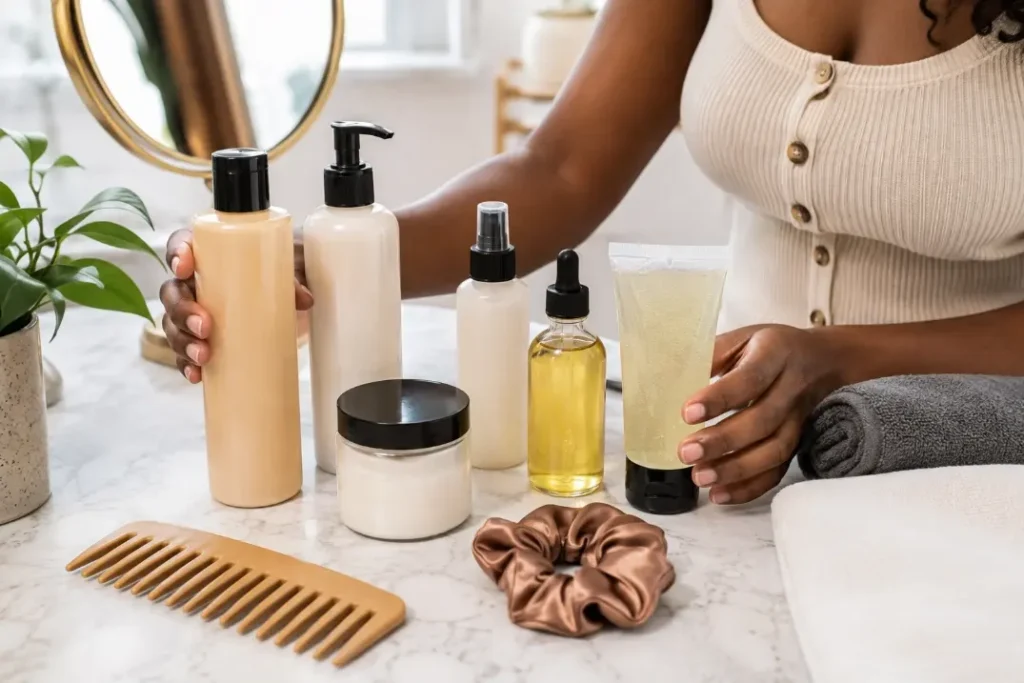
How Do You Build a Complete Natural Hair Routine With These Products?
A complete routine is a sequence of jobs, not a challenge to layer all 15 products. Several steps are alternatives, so one wash day may use only four or five categories.
Step 1: Assess the scalp, hair, and current style
Note scalp comfort, buildup, tangling, strand width, density, processing history, and today’s styling plan. Choose for the current need instead of applying the entire shelf automatically.
Step 2: Use a pre-shampoo product only when it solves a problem
Add pre-poo when it improves sectioning, protects dry-feeling ends, or reduces tangling. Use a scalp pre-wash only when formulated for that concern. Leave it out if residue increases without an easier wash.
Step 3: Cleanse with the appropriate strength
Use moisturizing shampoo routinely, a clarifying or chelating shampoo for stubborn residue, and co-wash only when light cleansing is enough. Massage gently, rinse well, and judge the result by scalp comfort and manageable hair, not foam volume.
Step 4: Condition and detangle in sections
Condition after cleansing and detangle in sections. Add a detangler if slip is insufficient. Use a mask, protein treatment, or bond-support product only when the hair calls for it and the directions explain where it belongs.
Step 5: Apply leave-in and choose one styling route
Use a leave-in if the hair needs more manageability after rinsing. Then select a route based on the finish you want:
- For light definition and volume, try leave-in plus mousse.
- For stronger definition and hold, try leave-in plus gel.
- For a softer twist-out or braid-out, try leave-in plus curl cream, with a compatible gel only if more hold is needed.
Avoid stacking butter, oil, cream, mousse, custard, and gel simply because each product is popular. Every added layer should have a purpose.
Step 6: Dry fully and protect the finished style
Apply heat protectant with thermal tools. Otherwise, air-dry or diffuse with limited handling, and let a defined style dry before separation. At night, use a bonnet, scarf, smooth pillowcase, loose pineapple, or another low-friction method suited to the style.
Step 7: Refresh selectively between washes
Refresh only the sections that need attention with water, light leave-in, foam, or a little styler. If the hair feels sticky, coated, or hard to restyle, adding product will not remove buildup. Cleanse when cleansing is the missing job.
Routine flow: Assess → optional pre-poo → cleanse → condition and detangle → optional treatment → leave-in → choose one styling route → dry and protect → refresh or wash when needed.
How Should You Choose Products for Your Hair Type and Porosity?
Curl pattern describes shape, but it cannot prescribe a complete routine. Product weight and frequency should respond to several observable factors, including strand width, density, processing history, scalp condition, styling habits, climate, and how readily residue accumulates.
| Hair or routine factor | What you may notice | Product direction to test | Watch for |
|---|---|---|---|
| Fine strands or low density | Hair is easily flattened or coated | Light leave-in, foam, small amounts of serum | Heavy butter and repeated layering |
| Coarse strands or high density | More sectioning is needed for coverage | Richer conditioner, cream, or mask as needed | Assuming more product always means more moisture |
| Low-porosity tendency | Slow wetting or products sitting on the surface | Lightweight layers, smaller amounts, thorough cleansing | Oil and butter accumulating over time |
| High-porosity or processed hair | Fast wetting, rough feel, or rapid loss of softness | Conditioner, leave-in, occasional protein or bond support | Overloading with protein or heavy coatings |
| Frequent protective styles | Limited scalp access or residue near roots | Rinse-clean cleanser and lightweight scalp products | Tight tension and oil buildup |
| Heat styling | Dry feel, weaker strands, or pattern changes | Labeled heat protectant and lower tool temperature | Repeated passes and “damage-proof” promises |
| Humid climate | Swelling, frizz, or short style life | Compatible film-forming styler with suitable hold | Incompatible layers that flake |
Porosity is best treated as a practical observation, not a perfect home diagnosis. The popular floating-hair glass test is affected by residue, surface tension, and how the strand is handled, so it should not decide your entire routine. Notice instead how quickly clean hair becomes wet, how products spread, and whether the hair feels coated or loses softness soon after styling.
Change one variable at a time and observe it across several wash days. If you switch the shampoo, conditioner, leave-in, and gel together, you will not know which change helped or caused a problem.
Which Ingredients and Formula Features Matter Most?
Long lists of “good” and “bad” ingredients are rarely useful. Performance comes from the complete formula, how much you apply, whether it is rinsed thoroughly, how it interacts with the next layer, and how your own hair and scalp respond.
Cleansing systems
Routine shampoos often combine surfactants to balance cleansing, foam, mildness, and rinse feel. Clarifying products may use a stronger system or ingredients that target minerals and stubborn films. Sulfate-free is one label clue, not proof that a shampoo will be mild, moisturizing, or strong enough for your buildup. Judge the result after several uses.
Conditioning and slip
Conditioning agents, fatty alcohols, polymers, and emollients can improve spread, wet combability, softness, and surface feel. Their names matter less to most shoppers than the practical result: Can you detangle with less force? Does the product rinse as expected? Does it leave useful softness or a persistent coating?
Humectants, creams, butters, and oils
Humectants help attract and retain water within a balanced formula. Creams and butters can add softness and lubrication, while oils can reduce friction or slow water loss from an already conditioned strand. Climate, dose, and the surrounding formula affect the result. A humectant-rich gel that performs well in one climate may give a different finish in high humidity.
Protein and bond-support ingredients
Hydrolyzed proteins and bond-support systems vary widely in size, concentration, and intended use. They may temporarily improve the feel or performance of weakened hair, but they do not provide permanent repair. Follow the directions and stop if the result is persistent stiffness, roughness, or difficult detangling.
Film formers and hold ingredients
Gels, custards, and mousses rely on film-forming ingredients to group strands and hold a style. Compare flexibility, cast, flaking, drying time, washout, and humidity response. A styler that performs well alone can still flake when layered over an incompatible leave-in, so formula compatibility matters as much as the reputation of either product.
What Natural Hair Product Mistakes Should You Avoid?
When hair feels dry, coated, limp, stiff, tangled, or unusually fragile, another purchase is not always the answer. Troubleshooting is easier when you return to product roles and remove unnecessary variables.
- Buying every item marketed for natural hair without giving each one a clear job.
- Avoiding shampoo so long that residue and scalp discomfort increase.
- Applying heavy butter and oil while skipping water-based conditioning.
- Detangling dry hair aggressively or pulling from the roots through knots.
- Using protein on a fixed schedule even when the hair feels stiff or rough.
- Layering leave-ins, creams, oils, mousses, and gels that pill or flake together.
- Applying products to the scalp when the directions intend them for the lengths.
- Wearing tight styles or using high heat, then expecting a product to cancel the mechanical or thermal stress.
- Treating persistent scalp symptoms, shedding, or thinning only with cosmetics.
When a routine stops working, remove one variable, cleanse appropriately, return to a basic conditioner and styler, then add optional products back one at a time. That process usually tells you more than adding a new mask to an already crowded routine.
What Should Brands Consider When Developing Products for Natural Hair?
For brand founders, the same function-first logic applies to product development. A useful natural hair line begins with a defined user, routine step, and performance target, not a vague “for all curls” label. A focused collection is also easier for customers to understand and for a development team to test.
- Define the target user and use case. Document expected wash habits, styling methods, climate, strand characteristics, scalp needs, price position, and sales channel. A lightweight wash-and-go line and a rich braid-out line should not begin with the same brief.
- Start with a focused routine. A cleanser, conditioner, leave-in, and styler can form a coherent launch. Add clarifiers, masks, oils, or scalp products only when consumer research identifies a distinct need.
- Set practical performance criteria. Specify cleansing strength, foam, slip, wet combability, rinse feel, residue, curl grouping, hold, flaking, drying time, and humidity response. Terms such as “moisturizing” need an observable product target behind them.
- Test the products as a system. A good leave-in and a good gel can still create flakes when layered. Test realistic quantities, application orders, drying methods, refresh cycles, and washout across the intended hair profiles.
- Match the packaging to the formula. Pumps, tubes, jars, caps, and dispensing openings must suit the product’s viscosity and the way customers use it with wet hands or in sections.
- Use claims that can be supported. Avoid unverified hair-growth, scalp-treatment, permanent-repair, damage-proof, and universal curl claims. Claims should reflect the formula, testing, market, and local regulatory requirements.
Keronhair’s hair care product manufacturing services support private label and custom product development, while brands building a cleanser can review its custom shampoo manufacturing capabilities. Before requesting a quote, it also helps to plan MOQ, sampling, packaging, and lead time. When the product brief is ready, you can discuss the project with Keronhair.
Conclusion: Build a Smaller Routine That Solves the Right Problems
The best hair care products for natural hair are the ones that perform a clear job in your routine. Start with effective cleansing, a rinse-out conditioner, an optional leave-in, and one styler suited to the finish you want. Add clarification, deep conditioning, protein, oil, heat protection, or scalp care only when you can name the problem each addition is meant to solve.
Change one variable at a time and watch how clean hair responds over several wash days. A smaller routine makes buildup, stiffness, flaking, and product incompatibility much easier to identify. If scalp discomfort persists, or you notice pain, sores, sudden shedding, thinning, or a receding hairline, consult a board-certified dermatologist rather than relying on another cosmetic product.
Frequently Asked Questions About Hair Care Products for Natural Hair
Use these answers as starting points, then adjust for your scalp, strands, styling habits, and product directions.
What products are essential for a basic natural hair routine?
A practical minimum is an effective shampoo, a rinse-out conditioner with enough slip, and a suitable styler. Add leave-in when the hair needs more softness or manageability. Masks, co-washes, protein treatments, oils, detanglers, and scalp products are optional solutions for needs the basic routine does not meet.
In what order should I apply natural hair products?
Cleanse, then condition and detangle. Use any rinse-out treatment according to its label. After rinsing, apply leave-in if needed, followed by cream, mousse, gel, or a tested combination. Oil or serum is an optional finish, not a conditioner substitute. Apply labeled heat protectant before thermal styling.
How often should natural hair be washed?
There is no universal schedule. Activity, protective styles, scalp condition, product load, and cleanser strength all affect timing. The AAD advises people with curly hair to wash according to how oily or dirty the scalp becomes. Cleanse often enough to maintain comfort and remove residue.
Does natural hair always need sulfate-free shampoo?
No. Sulfate-free does not automatically mean mild, and one surfactant does not predict the full formula’s performance. Many people use a gentler routine shampoo and a stronger clarifier when needed. Choose by cleansing, scalp comfort, conditioned after-feel, and compatibility with your styling products.
Is leave-in conditioner necessary for natural hair?
Not for everyone. Dry-feeling, tangled, long, processed, heat-styled, curly, or coily hair may benefit from added manageability. Fine hair may prefer a light spray; coarse or dense hair may prefer cream. Skip leave-in when conditioner and styler already provide enough softness.
Should low-porosity hair avoid oils and protein?
No. Low-porosity hair may become coated by heavy layers, so test smaller amounts, lighter textures, and adequate cleansing. That does not make every oil or protein unsuitable. Follow the directions and judge flexibility, residue, softness, and detangling instead of relying on the porosity label alone.
How do I know if I have product buildup?
Possible signs include a coated feel after washing, limpness, root residue, new flaking between layers, or poor response to water and usual stylers. Try an appropriate clarifying wash followed by conditioner. Persistent itching, scaling, or soreness may have another cause and needs professional evaluation.
Can oils moisturize natural hair?
Oils do not add water. They can lubricate the surface, reduce friction, add shine, support a pre-wash step, or slow water loss after water-based conditioning. Use oil for one of those jobs, not as a substitute for cleanser, conditioner, or leave-in.
When should I see a dermatologist about my hair or scalp?
Consult a board-certified dermatologist for persistent itching, scaling, inflammation, sores, or pain. Sudden shedding, visible thinning, bald areas, and a receding hairline also need assessment. Cosmetics cannot diagnose or treat every cause of scalp discomfort or hair loss.