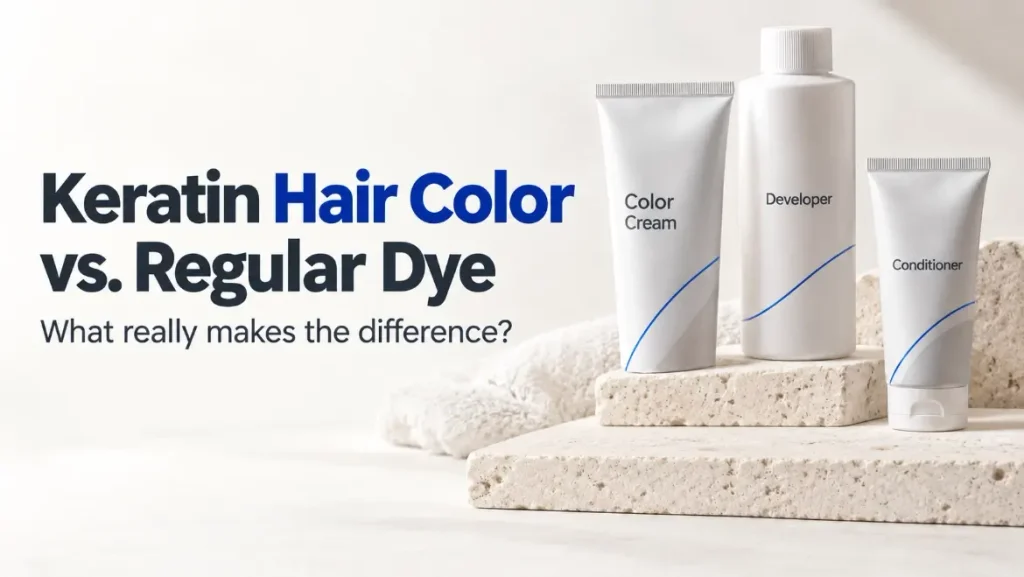
Keratin hair color generally means a hair-color product or kit marketed with keratin-based conditioning ingredients. Those ingredients may be in the color cream, a separate treatment, or both. The dye system creates the color; the keratin ingredient is intended to support the condition and feel of your hair.
A keratin label doesn’t automatically mean less damage, no ammonia, or better gray coverage. Compare the type of color first, then look at the conditioning formula and its supporting evidence.
What Does “Keratin Hair Color” Actually Mean?
When you’re comparing hair dyes, “keratin” points to the conditioning side of the product—not a separate type of hair color. You still need to check whether the dye is permanent, demi-permanent, or semi-permanent to understand what kind of color result to expect.
For example, Schwarzkopf’s Keratin Color range is a permanent hair dye. The two descriptions can apply to the same product: one identifies the range’s care focus, while the other tells you its coloring category. Check each component’s ingredient list to see whether keratin is included in the dye itself, the accompanying conditioner, or both.
How Does Keratin Hair Color Work?
The goal is to change your shade while leaving your hair softer and easier to comb. Coloring and conditioning involve different ingredients, and both need to work in the finished formula.
What Creates the Color?
In a typical permanent oxidative formula, an alkaline environment helps the hair swell so small dye precursors can enter. Hydrogen peroxide helps develop the color and can lighten natural pigment. The shade depends on the formula, your starting hair color, and how the product is used.
The hair color developer is part of that system. Keratin doesn’t replace it, and a conditioning claim isn’t a reason to change its strength or mixing ratio.
What Does the Keratin Ingredient Do?
Hydrolyzed keratin is keratin broken down into smaller protein fragments. These are used as conditioning ingredients, with performance depending on the ingredient’s properties, the surrounding formula, and the hair being treated.
Research on protein treatments supports evaluating keratin as a conditioning ingredient. Whether those benefits carry over to a particular dye still needs testing; an ingredient list can’t tell you how that product performs.
How Is Keratin Hair Color Manufactured?
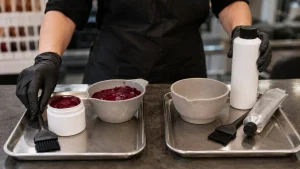
For an oxidative cream hair color kit, manufacturers develop the color cream and compatible developer, evaluate performance, and fill the components separately. The steps below describe a general process. Mixing order and processing conditions depend on the formula.
1. Define the Formula and Select the Ingredients
Development starts with the target shade, the hair it will be used on, and the coverage required. Formulators select coloring and conditioning ingredients to suit that goal. The chosen keratin ingredient also needs to work in its intended component, whether that’s the color cream or a separate conditioner.
Adding more protein isn’t a reliable shortcut. Its compatibility and performance in the finished system matter more than the ingredient name alone.
2. Make the Color Cream and Control the Batch
Production typically includes checking and weighing raw materials, preparing the cream base, and mixing ingredients through a defined sequence. Depending on the formulation, this can involve dissolving, dispersing, and emulsifying different components.
Appearance, uniformity, pH, and viscosity provide useful process checks. Our guide to how hair dye is manufactured explains the broader production workflow. There isn’t one universal temperature or addition stage for every keratin ingredient.
3. Evaluate Color Results, Conditioning, and Stability
Development checks should cover the mixed product on suitable test hair, not just the unmixed cream. Color and coverage need assessment alongside conditioning performance. Storage stability and packaging compatibility answer separate questions.
At Keronhair, we’ve tested encapsulated keratin ingredients to investigate whether protecting the ingredient could help maintain conditioning performance during oxidative coloring. Testing that approach alone doesn’t establish timed release or repair benefits. Retained ingredient, easier combing, and stronger fibers are different outcomes, so each claim needs evidence from the finished formula.
4. Fill, Pack, and Release the Product
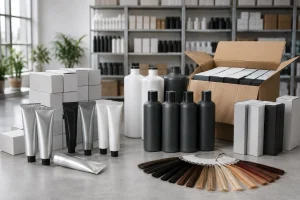
Color cream and peroxide developer are filled separately, so the intended coloring reaction begins when they’re mixed for use. Components may be manufactured or sourced separately before assembly into a kit.
Release checks should cover product specifications, seals, labels, and batch identification. Keronhair’s private label hair dye development connects shade and formula work with developer pairing and packaging coordination, so brands can assess the proposed product as a complete system. Conditioning claims still need product-specific support.
Keratin Hair Color vs. Regular Dye: What Actually Changes?
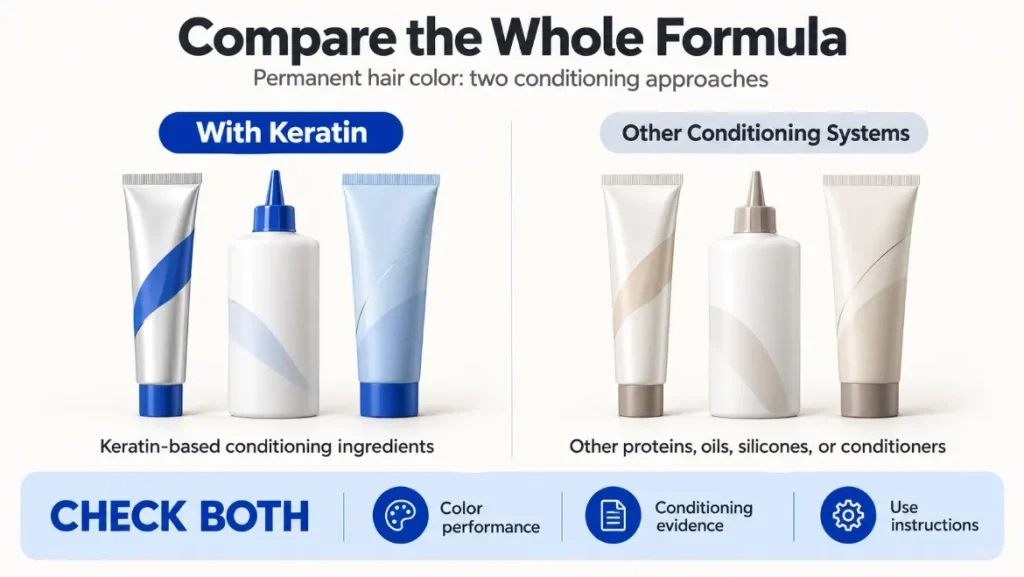
Compare products intended for the same job. Permanent hair dye with keratin belongs alongside other permanent dyes in a comparison, rather than a temporary color mask that works differently.
| What you’re comparing | Permanent color kit with keratin | Other permanent color kit |
|---|---|---|
| Coloring mechanism | Uses its oxidative dye system | Also uses an oxidative dye system |
| Conditioning | May include keratin ingredients in one or more kit components | May use other proteins, silicones, oils, or conditioning agents |
| Ammonia | Check the specific formula | Check the specific formula |
| Developer | Requires the specified compatible developer | Requires the specified compatible developer |
| Gray coverage and lift | Depend on the formula, shade, and application | Depend on the formula, shade, and application |
| Color longevity | Needs product-specific evidence | Needs product-specific evidence |
| Damage and allergy risk | Conditioning claims don’t remove these considerations | The same considerations apply |
A dye without keratin can still have a well-designed conditioning system. You can’t rank two products fairly by checking for one ingredient while ignoring their color goals, application conditions, and aftercare.
Is Keratin Hair Dye Less Damaging?
Not necessarily. A product may provide useful conditioning, but “less damaging” needs a defined comparison. The formula, developer, processing conditions, and your existing hair condition all matter. A softer finish alone doesn’t tell you how much structural change occurred during coloring or how another dye would have performed.
Softer Hair and Stronger Hair Are Different Outcomes
Hair that slips through a comb more easily can be more comfortable to handle. A strength test asks a different question: how the fiber responds to an applied force. Neither measurement automatically explains the other.
In their study of protein treatments on damaged hair, Daniels and colleagues tested bleached, permed, and heat-damaged hair. Hydrolyzed keratin improved wet tensile strength under those conditions. A different protein treatment performed best in certain dry tests. These were tests of conditioning treatments, not a comparison showing that keratin dyes outperform conventional dyes.
Read the Comparison Behind the Claim
A breakage claim is easier to judge when you know the comparison. Schwarzkopf’s Keratin Color claim concerns combing breakage on damaged hair compared with untreated hair. It doesn’t establish superiority over every competing dye.
When you read a claim, check:
- Was the color cream tested alone or with the complete care system?
- Was the comparison against untreated hair, an earlier formula, or another dye?
- Did the test measure combing breakage, tensile strength, or consumer perception?
- Were the starting hair and application conditions comparable?
Those details help you judge whether the claim answers your question.
Will Keratin Hair Color Straighten Your Hair?
Keratin in a dye isn’t, by itself, a straightening treatment. A coloring kit and a professional smoothing service have different purposes and instructions. If you like your curls, the word “keratin” on a dye box doesn’t automatically mean the product is designed to straighten them.
That also doesn’t guarantee that coloring will leave fragile curls unchanged. Discuss previous bleaching, coloring, and smoothing services with your stylist. If you’re planning two services, follow the specific systems’ guidance rather than assuming one waiting period works for every combination.
Who Might Consider It—and When Should You Be Cautious?
A keratin-containing color is worth considering when you already need that type of dye and want to compare its conditioning performance. It isn’t a reason to color hair that only needs help with dryness or tangling.
Before choosing, consider your situation:
- You need gray coverage or a shade change: assess those requirements first, then compare conditioning claims.
- You only want softer lengths: review your care routine before adding a coloring service.
- Your hair breaks easily or has undergone substantial chemical processing: get its condition assessed before another treatment.
- You’ve reacted to hair dye or currently have an irritated scalp: don’t assume a keratin-labeled alternative resolves the problem; seek medical advice.
Your hair and your scalp are separate considerations. A product can leave the lengths feeling smooth without being suitable for your skin.
How to Choose a Keratin Hair Color Beyond the Front Label
Start with the result you want, then examine the kit that promises it.
Check the Color Cream, Developer, and Conditioner Separately
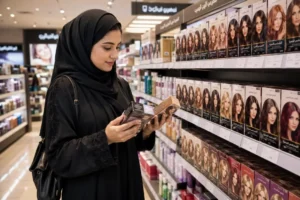
Look for the ingredient list belonging to each component. “Hydrolyzed Keratin” is one name you may encounter, but don’t assume every keratin-related product uses an identical ingredient or puts it in the same place.
Use this short label check:
- Identify the coloring category and intended starting shades.
- Locate the keratin ingredient in the relevant component’s list.
- Read the developer pairing and application instructions.
- Check the product’s specific claims and warnings.
Suppose a kit contains keratin only in its after-color conditioner. That may be useful aftercare, but it doesn’t show that keratin acts throughout the dye reaction. Check your actual package; online ingredient lists can differ.
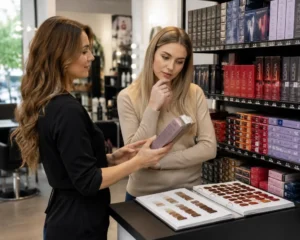
Match the Formula to Your Color Goal
If you’re choosing keratin hair dye for gray coverage, check the recommended shades and coverage instructions against your starting hair color. A protein claim doesn’t answer those questions.
If you like your color but dislike the rough ends, another dye application may be unnecessary. Our guide to conditioning dry hair without making it greasy can help you review your routine instead.
Choose the necessary color service first; treat keratin as one formulation feature to evaluate.
Developing a keratin hair color for your brand? Send Keronhair your product brief for a project quote. Include your target market, reference shades, desired conditioning benefits, quantity per shade, and packaging format. We can discuss formulation and sampling options, then review the project scope and proposed product claims with you.
What Should You Check Before Coloring?
Follow the product’s instructions even if it emphasizes conditioning. The FDA’s hair dye safety guidance advises testing before every use and notes that a reaction remains possible despite a negative skin test.
- Perform the allergy alert test exactly as directed. A strand test checks color and hair response; it doesn’t replace the skin test.
- Don’t color an irritated or damaged scalp. A previous dye reaction warrants medical advice before another attempt.
- Use the specified developer, ratio, and processing time. Don’t add keratin serum, conditioner, or another dye unless the manufacturer explicitly permits it.
- Wear gloves and rinse as directed. Stop using a product that causes a reaction and seek appropriate medical help.
Our explanation of mixing semi-permanent and permanent hair dye covers why different coloring systems aren’t interchangeable. Factory formulation trials are controlled development work, not instructions for modifying a retail kit.
Frequently Asked Questions
These quick answers address details a keratin claim alone won’t settle. Your specific product’s label and instructions take priority.
Is Keratin Hair Color Always Permanent?
No. Keratin describes an ingredient or product positioning, not a universal coloring category. Check whether your product is labeled permanent, demi-permanent, semi-permanent, or another format.
Is Keratin Hair Dye Ammonia-Free?
Not automatically. Check the specific formula and ammonia-free claim. Keratin and ammonia describe different aspects of the product, and ammonia-free doesn’t mean risk-free.
Does Keratin Hair Color Cover Gray Hair?
Some products are designed for gray coverage, but keratin itself doesn’t provide the color. Coverage depends on the dye system, shade, starting hair, and correct application.
Does Keratin Hair Color Last Longer?
Not necessarily. You need a product-specific comparison to support longer-lasting color. The keratin label alone doesn’t establish better fade resistance.
Can You Use It on Bleached Hair?
Only if the specific product suits your hair and color goal. Bleached hair needs careful assessment and strand testing, especially when fragile or unevenly porous. Ask a colorist if you’re unsure.
Can You Add Keratin to Regular Hair Dye?
Don’t add keratin treatments or serums unless the dye manufacturer explicitly allows that combination. Extra ingredients can change the mixture and its performance. Use separate care products as directed.
Is Keratin Hair Color Vegan?
Not necessarily. Keratin ingredients can be animal-derived. Verify the source and the finished product’s vegan claim rather than relying on the product name or a cruelty-free label.
References & Sources
The sources below serve different purposes: product information establishes a brand’s claims, laboratory research examines particular treatments, and FDA guidance addresses safety. None establishes that all keratin hair colors perform alike.
- Schwarzkopf Keratin Color: Product Information and Claim Conditions.
- Daniels et al.: An Ex Vivo Comparison of the Tensile Strengthening Properties of Protein Derivatives on Damaged Hair, 2016.
- U.S. FDA: Hair Dye Safety, Allergic Reactions, and Precautions.
The Keronhair development example is a company-reported account of internal trial work, not an independently verified product-performance study.