Peptides in shampoo now appear in products marketed for damage repair, scalp care, and fuller-looking hair. The promises can sound impressive, but “peptide” is not one ingredient—and a formula that is rinsed off does not behave like a leave-on treatment.
So how do you know whether a peptide shampoo is useful or simply well marketed? The answer lies in the exact peptide, the finished formula, the evidence behind the claim, and whether the shampoo suits your hair and scalp. This guide walks through each point so you can read the label with clearer expectations and avoid paying for benefits the product cannot support.
What Are Peptides, and Why Are They Added to Shampoo?
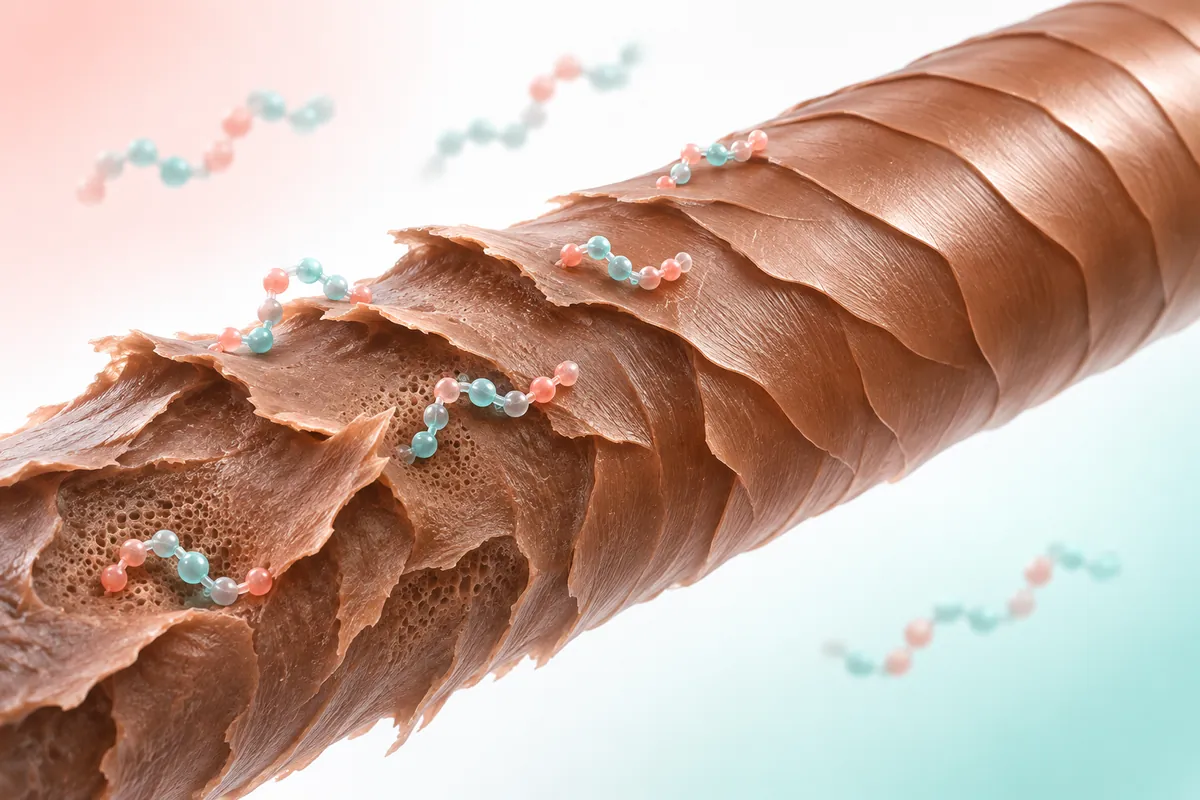
Peptides are chains of amino acids, the building blocks of proteins. Their size, sequence, charge, stability, and concentration help determine how they behave within a shampoo. Some are included for hair-fiber conditioning; others are marketed for scalp care. Those purposes require different kinds of evidence.
Peptides vs. Proteins and Hydrolyzed Proteins
These terms are related, but they are not interchangeable:
- Amino acids are individual building blocks.
- Peptides are shorter chains of amino acids.
- Proteins are longer, more complex amino-acid chains.
- Hydrolyzed proteins are proteins broken into smaller fragments. The resulting material may contain peptides of different sizes rather than one precisely defined sequence.
Copper Tripeptide-1 is a specific peptide, while hydrolyzed keratin is a mixture of keratin-derived fragments. Research on one does not prove the other.
Why Rinse-Off Contact Time Changes Expectations
Shampoo is diluted during washing and then rinsed away. An ingredient may interact with the hair surface during that time, but its contact conditions differ from those of a leave-on scalp serum. Findings from cell studies, isolated follicles, supplements, or other delivery formats cannot automatically be transferred to shampoo.
For anyone developing a peptide shampoo, the useful questions extend beyond the ingredient name: Is the material compatible with the surfactant system? Is it stable at the formula’s pH and during storage? What, if anything, remains on the hair or scalp after rinsing? Finished-product testing under normal use is more relevant than a supplier’s ingredient mechanism alone.
What Do Peptides in Shampoo Actually Do?
The most useful way to understand peptide shampoo is to ask where the claimed effect occurs. Existing hair, the scalp surface, and the living follicle are different targets.
| Intended area | Realistic cosmetic goal | What you should not assume |
|---|---|---|
| Hair fiber | Better slip, softness, manageability, or temporary support for damaged areas | Permanent biological repair of a non-living fiber |
| Scalp surface | A comfortable, conditioned scalp when the complete formula is suitable | Treatment of dandruff, dermatitis, or another scalp disease |
| Hair follicle | A specific ingredient may have preliminary or format-specific research | Proven regrowth from any shampoo that mentions peptides |
Effects on the Hair Fiber
Some hydrolyzed protein fractions and peptides can interact with the hair surface or with damaged fibers. Depending on the treatment, this may improve slip, combing behavior, or mechanical properties.
A published study of wool-derived hydrolyzed keratins examined chemically relaxed textured hair and found that molecular size influenced penetration and deposition. Certain fractions improved breakage-related measurements. Importantly, the penetration experiments included three-hour soaking in peptide solutions. The study was not a clinical trial of a finished shampoo used briefly and rinsed off, so it cannot establish the same result for everyday peptide-shampoo use.
In this context, “repair” means improving measurable properties of an existing, non-living hair fiber—not restoring it permanently to its undamaged state.
Scalp and Hair-Growth Claims
Scalp comfort, fuller-looking hair, and new growth are different outcomes. A comfortable scalp does not demonstrate altered follicle activity, and added volume does not demonstrate a higher hair count. A follicle-related claim needs evidence that identifies the peptide, delivery format, study population, and actual measured outcome.
Common Types of Peptides Found in Shampoo
“Peptide shampoo” is not a standardized product category. Two bottles carrying the same front-label phrase may contain very different ingredients and make different claims.
Hydrolyzed Protein Peptides
Hydrolyzed keratin, wheat, rice, soy, silk, and pea proteins can supply mixtures of smaller protein fragments for conditioning formulas. The degree of hydrolysis, molecular-weight distribution, and finished shampoo affect how they interact with hair. The presence of a hydrolyzed protein does not guarantee a particular strength or breakage result.
Copper Peptides
Copper Tripeptide-1 (GHK-Cu) is discussed in scalp-care research for its possible signaling effects. It is also marketed in connection with hair growth, but the available research does not establish that a rinse-off copper-peptide shampoo regrows hair.
A 2026 review of short peptides for hair loss covers laboratory, animal, ex vivo, and limited clinical work. It identifies gaps in methods, dosing, and comparisons with established treatments. Evidence for a peptide in another delivery format should not be presented as clinical proof for a shampoo.
Biomimetic and Signal-Peptide Complexes
Synthetic or biomimetic peptides may be marketed around cell signaling, anchoring, density, or follicle support. Names you may encounter include Acetyl Tetrapeptide-3, Biotinoyl Tripeptide-1, Copper Tripeptide-1, and various sh-Oligopeptide or sh-Polypeptide ingredients.
Some appear in proprietary blends. When a blend has been studied, the results may not reveal how much of the effect—if any—came from the peptide alone.
How Peptides May Appear on an Ingredient List
| Label example | What the name tells you | What it does not prove |
|---|---|---|
| Copper Tripeptide-1 | A defined copper-binding tripeptide is present | The amount delivered to follicles or a regrowth result |
| Acetyl Tetrapeptide-3 | A specific modified four-amino-acid peptide is present | That a study of a proprietary blend applies to this shampoo |
| Biotinoyl Tripeptide-1 | A biotin-linked tripeptide is present | That “biotin” in the name guarantees stronger or faster-growing hair |
| Hydrolyzed Keratin | Keratin has been broken into smaller fragments | One fixed molecular size, concentration, or performance level |
| Hydrolyzed Wheat/Rice/Pea Protein | A plant protein hydrolysate is included | That all plant-derived peptides behave alike |
sh-Oligopeptide or sh-Polypeptide name | A specifically named oligopeptide or polypeptide material is declared | Effective scalp delivery or a clinically proven shampoo outcome |
The table is a reading aid, not a ranking. More peptide names do not automatically produce a better shampoo.
What Are the Realistic Benefits of Peptide Shampoo?
Depending on its full formula, a peptide shampoo may offer softer feel, easier detangling, reduced roughness, or temporary fullness. A well-tolerated shampoo may also leave the scalp comfortable. These are cosmetic outcomes—not proof of new growth or permanent fiber repair.
Choose the required cleansing and conditioning performance first. Our guide to the different types of shampoo explains why that primary job matters more than a featured ingredient.
Can Peptide Shampoo Make Hair Grow?
There is not enough direct clinical evidence to say that peptide shampoos, as a category, regrow hair. Early results for individual peptides may warrant further study, but the critical missing link is proof that a finished, rinse-off formula improves human hair-growth outcomes when used as directed.
In the United States, claims to treat or prevent hair loss may change a product’s regulatory status from cosmetic to drug, depending on its intended use. Hair that looks fuller after washing should not be described as new growth. If hair loss is sudden, patchy, painful, or worsening, seek an appropriate medical assessment rather than relying on a cosmetic shampoo.
Peptide Shampoo vs. Peptide Serum: Which Makes More Sense?
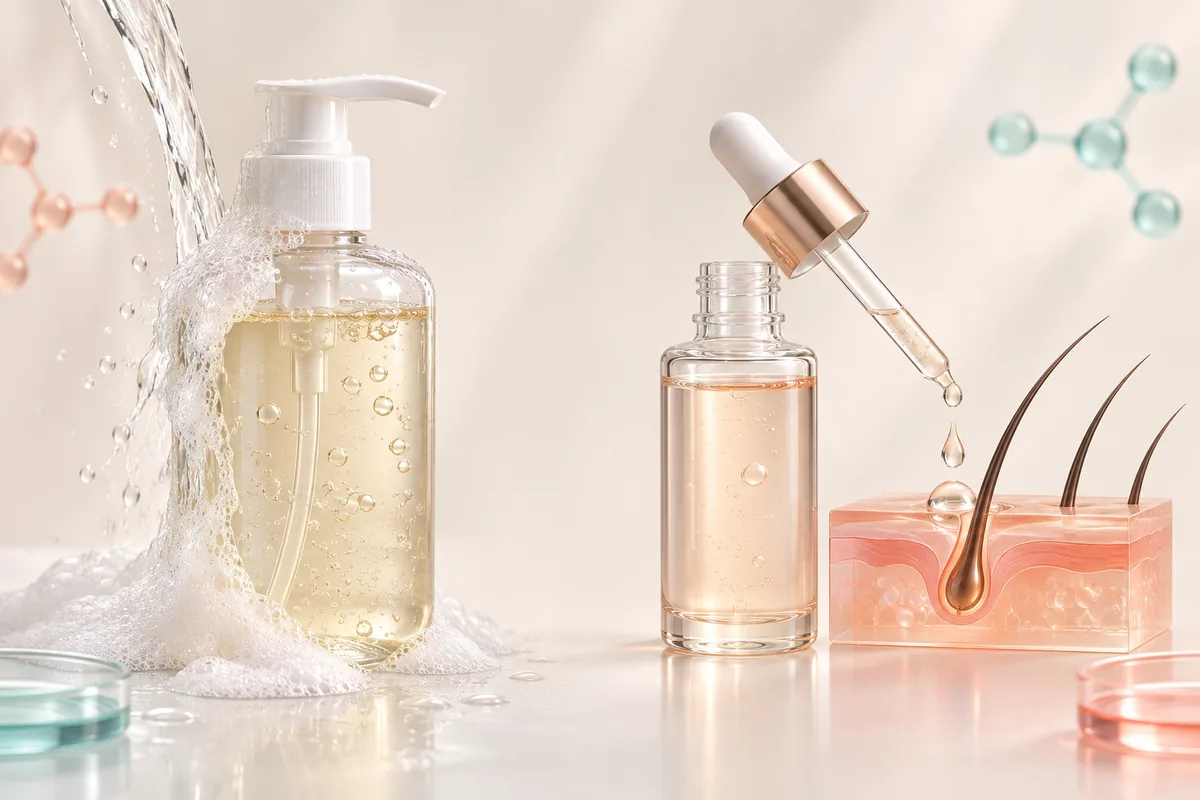
The better format depends on the job. Shampoo is necessary for cleansing; serum is an optional leave-on step. Neither format becomes effective merely because it contains peptides.
| Factor | Peptide shampoo | Peptide scalp serum |
|---|---|---|
| Main role | Cleansing with possible supporting cosmetic benefits | Leave-on delivery to a targeted scalp area |
| Contact time | Short and followed by rinsing | Longer, according to the directions |
| Practical advantage | Fits into a normal wash routine | Has stronger delivery logic for a scalp-focused ingredient |
| Main limitation | Limited contact and dilution during use | May leave residue or irritate; efficacy still needs evidence |
| Best evidence | Testing of the finished rinse-off shampoo used as directed | Testing of the finished leave-on serum used as directed |
A leave-on format allows more contact time, but only product-specific evidence can show whether that advantage produces a meaningful result.
How to Use Peptide Shampoo Correctly
Follow the individual product instructions rather than assuming every peptide shampoo needs a special contact time.
- Read the directions first. Check whether the product is intended mainly for the scalp, the lengths, or both.
- Wet the hair and scalp thoroughly. This helps distribute the shampoo without excessive rubbing.
- Apply it to the intended area. Massage gently with your fingertips rather than scratching with your nails.
- Follow the stated contact time. Do not copy another brand’s two-minute or five-minute instruction.
- Rinse thoroughly. Condition the lengths if your hair needs additional slip or detangling.
- Stop if your skin reacts. Rinse promptly if you experience burning, swelling, hives, or marked irritation.
Longer contact is not automatically better. Daily suitability depends on the surfactants, fragrance, conditioning level, directions, and your scalp response.
How to Read a Peptide Shampoo Ingredient List
Start with the complete ingredient declaration, then check whether the company names the peptide and explains the finished product’s intended job.
Use this five-point check:
- Find the exact ingredient name. “Peptide technology” is less informative than a full ingredient list.
- Separate peptides from supporting ingredients. Caffeine, niacinamide, panthenol, botanical extracts, and surfactants may contribute to the product story but are not all peptides.
- Do not calculate concentration from list position. Under U.S. cosmetic labeling rules, ingredients are generally listed in descending order, but ingredients at 1% or less may be listed in any order after those above 1%. See the FDA labeling summary.
- Check whether the shampoo’s primary job fits your needs. A peptide claim does not establish cleansing strength, color safety, or sensitivity suitability.
- Ask for product-specific support when the claim is measurable. “Reduces breakage” and “increases hair count” require different tests.
How Strong Is the Evidence Behind the Claim?
Match the evidence to the benefit being claimed:
- Mechanistic or cell research can explain why an ingredient deserves study, but not how a finished shampoo performs.
- Hair-tress or single-fiber testing can support specific fiber-related observations under the tested conditions.
- Studies of a different product format cannot automatically be transferred to a rinse-off shampoo.
- Controlled testing of the finished shampoo used as directed provides more relevant support for the measured cosmetic claim. Biological regrowth claims require suitable human evidence, not just smoother hair fibers.
No single evidence hierarchy fits every outcome: a breakage claim and a hair-count claim need different study designs.
Marketing Claims That Need a Closer Look
Be cautious of “clinically proven” claims that omit the tested product, participants, comparison, outcome, or study duration. Before-and-after photos are also difficult to interpret when lighting and styling differ. Neither tingling nor the number of peptide names on a label establishes efficacy.
How to Choose a Peptide Shampoo for Your Hair
Choose the shampoo for its main job, then decide whether its peptide system adds value. Cleansing needs, hair condition, fragrance tolerance, color treatment, and after-feel matter more than a trend ingredient.

| Your main concern | How to judge the fit |
|---|---|
| Damaged, bleached, or rough lengths | Look for conditioning and easier detangling in the complete formula |
| Fine or thinning-looking hair | Prioritize a clean rinse and avoid confusing temporary fullness with growth |
| Scalp-focused care | Check the exact peptide, directions, complete formula, and claim-specific evidence |
| Diagnosed or rapidly progressing hair loss | Treat shampoo as cosmetic support, not a substitute for assessment or treatment |
| Comfortable hair and scalp | Peptide shampoo is optional; you do not need to replace a routine that already works |
If your hair is dyed, use the same whole-formula approach described in our guide to choosing shampoo for color-treated hair. A peptide claim does not prove that a product is color-safe.
Likewise, peptides do not determine how strongly a product removes oil or styling residue. If buildup is your main problem, compare the intended roles of clarifying shampoo and regular shampoo before choosing based on a peptide claim.
How Can You Tell Whether Peptide Shampoo Is Working?
Match what you track to what the shampoo promises. Cleansing, scalp comfort, slip, tangles, and roughness are practical user observations. Breakage is harder to compare because combing, chemical treatments, heat, and hairstyles also affect it.
Hair collected in the drain mixes shed hairs and broken fragments; a single wash cannot establish a change in hair loss. Photos that show more volume may reflect styling or less clumping rather than new growth.
A Practical At-Home Product Comparison
Keep wash frequency, conditioner, styling, heat use, and photo conditions reasonably consistent. Record scalp comfort, cleaning, tangling, and visible breakage over several uses. This can help you decide whether you prefer a shampoo, but it is not a clinical test and cannot attribute changes to the peptide itself.
Are Peptide Shampoos Safe for Everyone?
Assess safety at the level of the complete shampoo. Fragrance, preservatives, surfactants, botanicals, or another component may irritate even when the featured peptide is tolerated.
Stop using the product if it causes burning, hives, swelling, blistering, or worsening irritation. Seek medical advice when a reaction is significant or persists after you stop.
“Protein-sensitive hair” is not a standardized medical diagnosis. Stiff, coated, dry, or rough hair suggests the formula or routine may not suit you, but it does not identify the responsible ingredient.
Frequently Asked Questions
Can I Use Peptide Shampoo Every Day?
Possibly, if the product directions allow it and the shampoo cleans without causing dryness or irritation. Peptide content alone does not determine frequency. Base your routine on the complete formula, scalp needs, hair condition, and response.
Is Peptide Shampoo Good for Damaged or Bleached Hair?
It can be useful when the formula improves conditioning, slip, or manageability. It cannot reverse structural damage or replace careful detangling, conditioning, and heat protection. Look for evidence tied to damaged hair rather than a general peptide claim.
Is Peptide Shampoo Safe for Colored Hair?
Peptides do not automatically make a shampoo color-safe. Check the product’s stated purpose and directions, then observe how your color and hair feel respond over repeated washes.
How Long Does Peptide Shampoo Take to Work?
Cleaning and hair-feel changes may be noticeable within early uses. There is no universal timeline for breakage, scalp, or growth claims because peptides, formulas, and tested outcomes differ. Treat a fixed generic timeline as marketing unless the finished product has relevant evidence.
Can I Use Peptide Shampoo With a Peptide Serum?
You often can if both labels permit it and your scalp remains comfortable. Using more peptide products does not guarantee a better result. Introduce products separately when possible so that irritation or unwanted buildup is easier to trace.
The Bottom Line
Choose peptide shampoo first for its cleansing and overall hair feel. A peptide may add conditioning value, but the finished product—not an ingredient trend—determines whether the shampoo meets its stated purpose. Look for research that actually matches the formula, use conditions, and claim.
For hair-care brands exploring a peptide-focused shampoo, development should start with the exact peptide material, intended cosmetic benefit, surfactant system, pH and stability requirements, packaging, and evidence for the finished product. Keronhair’s published manufacturing approach includes approving formula and packaging specifications and checking production attributes such as pH and viscosity; those routine controls do not by themselves prove peptide-specific efficacy. Learn more about Keronhair’s shampoo manufacturing services and discuss which formulation and claim-support work your project would need.