Most of the world’s hair color is made in China — including plenty of it that reaches shelves under European and American labels. For a brand owner, that raises a practical question rather than a patriotic one: if you’re going to source from Chinese factories for OEM hair dye, how do you pick a good one, what will it cost, and what can go wrong?
The strongest Chinese hair color factories sit inside Guangdong’s cosmetic manufacturing cluster, hold GMPC and ISO 22716 certification, run in-house formulation labs, and can take you from brief to bulk in roughly three to five months. The weak ones look almost identical on a website. This guide covers what these factories actually produce, what you should budget, how to vet a supplier before you wire a deposit, and where the compliance traps sit for the US, EU, and Chinese markets.
China’s Core Competitive Advantages for Hair Color Production
If you’re launching or expanding a professional hair color line, the manufacturing partner you choose shapes your cost base, your speed, and how much product IP you end up owning. Here’s what keeps global brands sourcing from China.
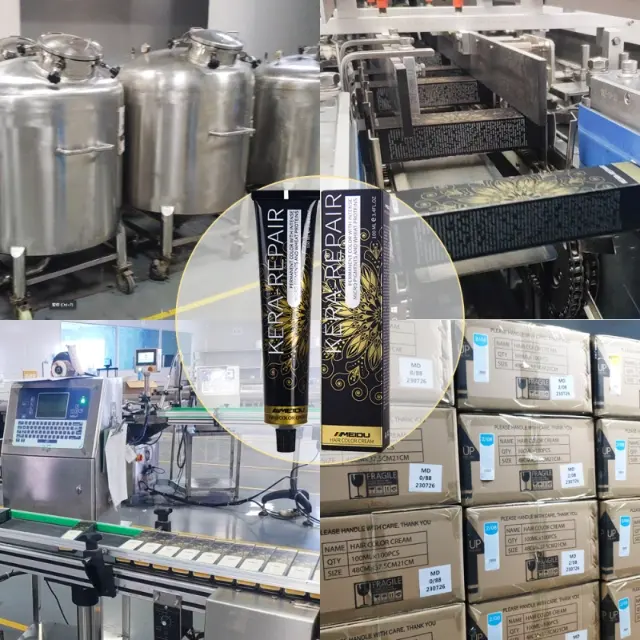
The World’s Most Integrated Cosmetic Supply Chain
In Guangdong, the people who blend your color, the plant that extrudes your aluminum tubes, the developer bottle supplier, and the carton printer are often within an hour’s drive of each other. That proximity removes a layer of coordination — and a layer of margin — that Western brands otherwise absorb through trading companies. When a shade needs reworking two weeks before shipment, this is the difference between a delay of days and a delay of months.
Raw Material Depth: Global Giants Sourced Locally
Oxidative color depends on a specific set of dye intermediates, couplers, alkalizers, and conditioning agents. Chinese factories buy these domestically, at scale, without import duty. That applies at both ends of the spectrum: commodity chemical colorants and the botanical extracts that clean-label lines are built on.
Logistics Proximity to Major Export Ports
Guangzhou and Shenzhen are two of the busiest container ports on earth. Finished goods move from the filling line to a container with minimal inland freight — which matters more than people expect, because inland trucking is where lead times quietly inflate.
Cost Efficiency Without a Quality Trade-Off
Automated filling and precision packaging lines let a mid-sized brand access unit economics once reserved for multinationals. That margin isn’t just profit; it’s the budget that funds product photography, influencer seeding, customer acquisition, and a booth at Cosmoprof or China Beauty Expo.
One trade-off is worth naming, though: low price and low MOQ rarely travel together with strong R&D. Factories that quote aggressively on a standard formula are often the ones least equipped to develop a custom one.
Advanced R&D Capabilities and Rapid Innovation Cycles
Hair color is trend-driven, and viral shade cycles don’t wait for a twelve-month development calendar. Established factories keep formulation chemists on staff who can turn a reference swatch into a stable benchmark sample quickly. That capability shows up most clearly in three places:
- Fast turnarounds on viable, stable benchmark samples.
- Deposit-only color masks and glosses, where the market has moved fastest.
- Clean-label gray-blending systems.
Deep Experience in Export and International Regulatory Compliance
Oxidative hair dyes carry heavier safety testing obligations than most cosmetic categories. Established Chinese manufacturers operate under Good Manufacturing Practices and ISO 22716, and the experienced ones will already have export documentation packages built for your target market — safety assessment data, ingredient traceability records, and the certificates your importer will ask for.
Worth being clear about where responsibility sits: a factory can prepare documentation, but legal responsibility for market compliance stays with the brand. Any supplier who implies otherwise is overselling.
The Full Spectrum: Types of Products Chinese Factories Produce
Chinese hair color factories cover a wider range of formats than most first-time buyers expect. Permanent salon cream, demi-permanent gloss, deposit-only mask, bubble dye, and temporary spray each involve different equipment, filling methods, and stability work. A factory that runs one format well is not automatically capable in another, so map the formats your range actually needs before building a shortlist. The sections below outline the main categories, and our hair color manufacturing service page lists the formats we run in-house.
Permanent Hair Color Systems
Permanent color remains the bedrock of the global market. Leading facilities leverage advanced China hair color contract manufacturing networks to produce:
- Cream-based oxidative color: The most widely sourced professional format.
- Powder-to-liquid mixing systems: Highly stable and popular for specific regional markets.
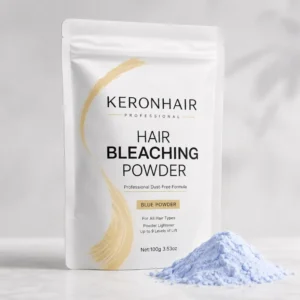
- High-lift and lightening formulations: Precision-engineered bleaches and lighteners that protect hair integrity.
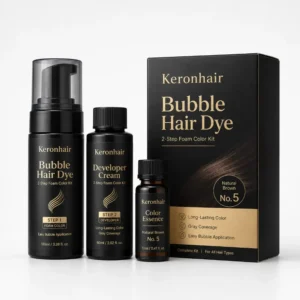
- At-home box kits: Complete turnkey setups configured with developers, safety gloves, and post-color conditioners.
When partnering with established Chinese Factories for OEM Hair Dye, standard product line configurations can easily be adjusted for ammonia levels, conditioning agents, and developer volumes to hit specific target price points and quality tiers.
Semi-Permanent & Demi-Permanent Hair Color
These two categories serve distinct market segments, and modern Chinese Factories for OEM Hair Dye produce both with exceptional color accuracy:
- Semi-permanent formulas: Deposit pure pigment without requiring a developer, typically fading over 6–12 washes. Perfect for vivid, trend-driven fashion shades and creative color lines.
- Demi-permanent formulas: Utilize a low-volume developer to achieve deeper penetration. Lasting 20–28 washes, these are the industry standard for blending grays and refreshing faded salon tones without structural damage.
Temporary Hair Color Products
Driven by low-commitment consumer trends, temporary formats are experiencing massive growth. Top wholesale hair dye suppliers offer highly stable formulations across multiple form factors:
- Color-depositing shampoos and toning rinses.
- Aerosol hair color sprays and styling mousses.
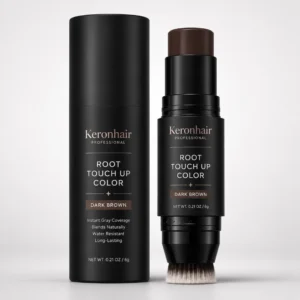
- Mascara-style root touch-up wands for quick coverage.
- Color-deposit conditioners and temporary hair chalks.
All wash out fully in one to two shampoos, making them ideal for seasonal launches, festival collections, or entry-level product lines carrying lower inventory risk.
Herbal, Plant-Based & “Clean” Hair Dye Formulations
Demand for ingredient transparency has changed what factories invest in. Several Chinese manufacturers now run dedicated clean-label development, typically covering:
- Herbal-infused oxidative bases with reduced chemical load
- Ammonia-free and PPD-free alternatives for sensitive scalps
- Certified organic botanical extracts
Claims in this category need more scrutiny than most, not less. Our guide to finding and vetting a hair care factory covers the documents to request before accepting a clean-label claim at face value.
An Industry Note on Clean Beauty: “Plant-based” doesn’t automatically mean 100% organic in oxidative color systems. A trustworthy manufacturer will always be completely transparent about the chemistry required to achieve specific performance levels versus clean-label marketing claims.
Professional Salon Lines vs. Retail Consumer Lines
Salon and retail hair color are different products built for different users, and the split affects formula, packaging, and instructions:
- Professional salon lines: Higher pigment load, developer strengths across 10–40 vol, shade systems a trained colorist can intermix, and bulk or aluminum tube packaging for backbar use.
- Retail consumer lines: Simpler application, wider safety margin for untrained users, kit components such as gloves and post-color conditioner, and shelf-ready boxes carrying allergy-alert and patch-test instructions.
Ask a prospective factory which of the two it actually ships in volume. Capability in one does not transfer to the other, and the packaging, instruction, and warning work differs more than the formula does. If salon distribution is your channel, our guide to choosing a professional hair color supplier covers what to test before committing.
Navigating Global Regulations: EU vs. US vs. China
Entering the international hair dye space means complying with distinct regulatory frameworks. Because hair dyes rely on chemically active ingredients, regulatory bodies scrutinize this category intensely. Partnering with elite Chinese Factories for OEM Hair Dye ensures your portfolio remains compliant across major global regions.
United States: MoCRA, Facility Registration and the Responsible Person
The Modernization of Cosmetics Regulation Act (MoCRA) is the largest expansion of FDA authority over cosmetics since 1938. For a brand importing hair color into the US, the operative requirements are facility registration and product listing, safety substantiation, adverse-event reporting, and record retention.
One distinction is worth getting right before you sign anything. Your overseas factory registers as a facility. The responsible person named on the product label is the party accountable for safety substantiation and adverse-event reporting — and in most import arrangements, that is you, not the factory. A factory’s FDA facility registration is not product approval and does not transfer to your brand.
European Union: CPNP Notification and Who Can Submit It
Before a cosmetic product is placed on the EU market, it must be notified through the Cosmetic Products Notification Portal (CPNP) under Article 13 of Regulation (EC) No 1223/2009, supported by a Product Information File and a safety assessment.
The notification can only be submitted by a Responsible Person established in the EU. A Chinese manufacturer cannot perform this step on your behalf, because it is not an EU legal entity. What a capable factory can do is supply the formula composition, test results, and documentation your Responsible Person needs to build and maintain the PIF. Treat any supplier who offers to “handle CPNP for you” as a reason to ask more questions, not fewer.
China: CSAR and the Special Cosmetics Classification
China’s Cosmetic Supervision and Administration Regulation (CSAR) took effect on 1 January 2021 and splits products into two tracks. Ordinary cosmetics are filed with the provincial authority. Special cosmetics must be registered with the NMPA following a review of safety and efficacy. Hair dye sits in the special category, alongside perming, anti-hair-loss, whitening, and sunscreen products. The NMPA’s provisions for the registration and filing of cosmetics set out the dossier requirements.
This matters in two different ways depending on your plan. If you intend to sell in China, registration is a pre-market obligation with its own testing and data requirements, and it is not a formality. If you only intend to export, CSAR does not apply to your product — but a factory that operates inside a registration-and-testing regime day to day is a reasonable proxy for documentation discipline.
The same structure appears in other markets under different names, and the differences matter more than the similarities. Saudi Arabia, for instance, runs a notification system rather than an approval system, which means the notifier keeps full compliance liability rather than transferring it to a regulator. We cover the mechanics in our guide to registering hair care products with the SFDA Ghad system.
5 Best Chinese Factories for OEM Hair Dye
Finding a reliable manufacturing partner requires balancing advanced formulation chemistry with a secure, scalable supply chain. To streamline your sourcing process, we have highlighted five of the most capable, internationally compliant Chinese Factories for OEM Hair Dye operating today.
1. Keronhair
Based in the cosmetic manufacturing hub of Guangzhou, Keronhair is a highly specialized, 8,000-square-meter facility renowned for its premium hair care and color formulations. Established in 2010, the company brings over 16 years of direct factory operation experience to the table. They excel at producing professional-grade hair dyes, advanced straightening treatments, and salon-quality hair care systems.
- Certifications: Fully compliant with strict GMPC and ISO manufacturing standards.
- R&D Edge: Features an advanced, in-house laboratory dedicated to custom color matching and clean-label innovation.
Their deep technical expertise makes them a standout partner for global brands requiring tailored formulations and a reliable, quality-first production approach.
2. Colornow Cosmetic
Operating a massive footprint in Guangzhou, Colornow Cosmetic is a major player among international suppliers. They boast a massive formulation library featuring over 30,000 developed shades, giving brands incredible flexibility to target niche market trends.
- Export Focus: Fully compliant with US FDA and EU CPNP frameworks for seamless international shipping.
- Innovation: Operates a dedicated hair cosmetic research institute focusing on ammonia-free permanent color developments.
3. Jiangsu Meiaisi (Cremer Oleo)
Located in Suzhou, Jiangsu Meiaisi is one of the most established names in the contract manufacturing landscape, having produced hair color products since 1997.
- Regulatory Strength: Holds over 100 special state licenses specifically for hair dye production, heavily accelerating brand launch timelines.
- Scale: Operates massive automated filling lines under strict CGMP and ISO 22716 standards, making them an ideal match for high-volume retail brands.
4. Dexe Group
Dexe Group is a globally recognized manufacturing brand operating out of Guangzhou, specializing in consumer-focused, fast-turnaround hair color innovations.
- Product Specialty: Highly famous for hair dye shampoos, quick root touch-ups, and user-friendly temporary colors.
- Global Reach: With an export footprint crossing 100 countries, their seasoned team understands the nuances of international retail logistics and turnkey ODM solutions.
5. Guangzhou Yicai Cosmetics
Established in 2007, Guangzhou Yicai Cosmetics runs a highly automated 10,000-square-meter production facility with a deep focus on professional, salon-grade hair color.
- Core Offerings: Renowned for high-stability permanent oxidation creams and cost-competitive manufacturing pricing.
- Support: Fully ISO 9001 and MSDS certified, offering excellent R&D support for precise, custom color matching.
How to Vet a Chinese Hair Dye Factory Before You Order
Every factory website shows a clean laboratory and a wall of certificates. Here’s how to find out what’s behind them.
1. Verify certificates, don’t just collect them
Ask for the certificate number and issuing body, then check with that body directly. A GMPC or ISO 22716 certificate names a specific site and a specific scope — confirm the scope covers hair colorants and that the address matches the factory you’re talking to.
2. Establish whether they manufacture or broker
A meaningful share of “factories” are trading companies. Ask for the business licence, then ask for a live video walk of the blending room, filling line, and QC lab — unedited, on a weekday, with your name on a whiteboard in shot. Genuine manufacturers agree without hesitation. If you can travel, go: Guangzhou allows four factory visits in a day, and the difference becomes obvious within ten minutes.
3. Test the samples properly
Approve on performance, not a swatch photo. Run each shade on standardized swatches for lift, tone accuracy, and gray coverage; check tonal drift after ten washes; confirm the developer mixes cleanly without separating. Request stability and compatibility data on your final packaging — a formula that behaves in a lab jar can behave differently in your tube.
4. Settle formula ownership in writing before sampling
This is where brands lose the most and notice the latest. If the factory develops your formula, decide upfront whether you own it, whether you can transfer it elsewhere, and whether they may sell it to a competitor. Get it in the contract, not the WeChat thread.
5. Ask for the documentation your market requires
Request the specific document set for your destination market: safety assessment data, INCI-compliant labelling, MSDS, heavy-metal and microbiological test reports. A factory that routinely exports to your region sends these within a day. One that asks what you mean is telling you something useful.
Red flags worth walking away from
- A firm price quoted before anyone asked about shade count, packaging, or market.
- Reluctance to name the certifying body or share a certificate number.
- “FDA certified,” “EU approved,” or any government endorsement that doesn’t exist.
- No written MOQ or lead time — only verbal assurances.
- A sample arriving unlabelled, with no batch number or formula code.
Selecting Your Manufacturing Model: OEM vs. ODM
These two terms are used inconsistently across the industry, and the difference changes your development cost, timeline, and formula ownership. OEM usually means the factory produces to your specification or formula. ODM usually means the factory contributes the formula or product design. Neither definition is universal, which is why the agreed role belongs in the contract rather than in a quotation email. Our comparison of OEM and ODM hair care manufacturing sets out the questions to ask before committing to a route.
| OEM | ODM | |
|---|---|---|
| Formula | Developed to your specification | Selected from factory catalogue |
| Sample lead time | Roughly 15–25 business days | Roughly 7–14 business days |
| Development cost | Higher | Minimal or none |
| Differentiation | Genuine product IP | Packaging and positioning only |
| Formula ownership | Negotiable — settle in writing | Stays with the factory |
| Right for | Brands with a technical point of view | Speed-to-market and demand testing |
If you’re testing a market or building a first SKU on limited capital, start ODM. Prove sell-through, then move your hero product to OEM once you know which shade family actually sells. Going custom on day one is how brands spend their development budget on shades nobody buys.
Our OEM and ODM service sets out how each route works in practice.
Starting a Hair Color Project With a Chinese Manufacturer
Country is one decision. Factory, formula route, and regulatory responsibility are separate ones, and they are worth settling in that order. If you already have a product brief — target market, shade range, format, quantity per SKU, and launch date — that is enough to start a useful conversation about feasibility, cost, and timeline.
Keronhair manufactures hair color at an 8,000-square-meter facility in Guangzhou. Send us your product brief and we will come back on formula route, sampling timeline, and the documents you will need for your destination market.
Frequently Asked Questions
What is the minimum order quantity for OEM hair dye from China?
MOQs commonly start around 1,000 units per SKU for standard or lightly modified formulas, and rise for custom formulations and bespoke packaging. Your packaging supplier’s minimum is usually the binding constraint rather than the blending batch, so confirm both figures before assuming a floor.
How long does it take to produce a custom hair dye line in China?
Plan on three to five months from signed brief to delivered goods. That covers roughly 2–4 weeks of sampling and revision, 3–5 weeks for packaging tooling and print proofs, 4–6 weeks of bulk production, and 4–6 weeks of sea freight to the US or EU.
Can a Chinese factory be “FDA approved” for hair dye?
No. The FDA does not approve or certify cosmetics or cosmetic manufacturing facilities. Under MoCRA, facilities register with the FDA and products are listed — both obligations, not endorsements. Any supplier advertising “FDA certified” hair dye is misrepresenting US regulation.
Who owns the formula the factory develops for me?
That depends entirely on your contract, and the default in most cases favours the factory. If exclusivity or the ability to move production later matters to you, negotiate formula ownership and non-compete terms in writing before sampling starts — not after you’ve approved a shade.
Is Chinese hair dye lower quality than European manufacturing?
Quality tracks the individual factory, not the country. Guangdong’s leading cosmetic plants operate to the same ISO 22716 GMP standard as European contract manufacturers, and many produce for brands sold in the EU and US. The variance between Chinese factories is far wider than the variance between the best Chinese and European ones.