Choosing between a custom formula vs stock formula for hair products is one of the first strategic decisions a beauty brand makes before sampling, packaging, testing, and production. The choice affects more than the formula itself. It can influence launch timing, product differentiation, budget planning, claim review, packaging compatibility, sample feedback, and how smoothly the project moves into manufacturing.
For private label hair care brands, the question is not simply “Which option is better?” A stock formula may be practical for a fast, focused launch. A modified formula may give your brand enough differentiation without starting from zero. A fully custom hair care formulation may be the right route when your product concept, sensory goals, target channel, or professional positioning need more control.
This guide explains how each route works, what to ask a manufacturer, and how to decide which path fits your brand.
What Stock Formula and Custom Formula Mean in Hair Care Manufacturing
Before comparing formula routes, it helps to separate three ideas that are often mixed together: formula route, business model, and manufacturing service.
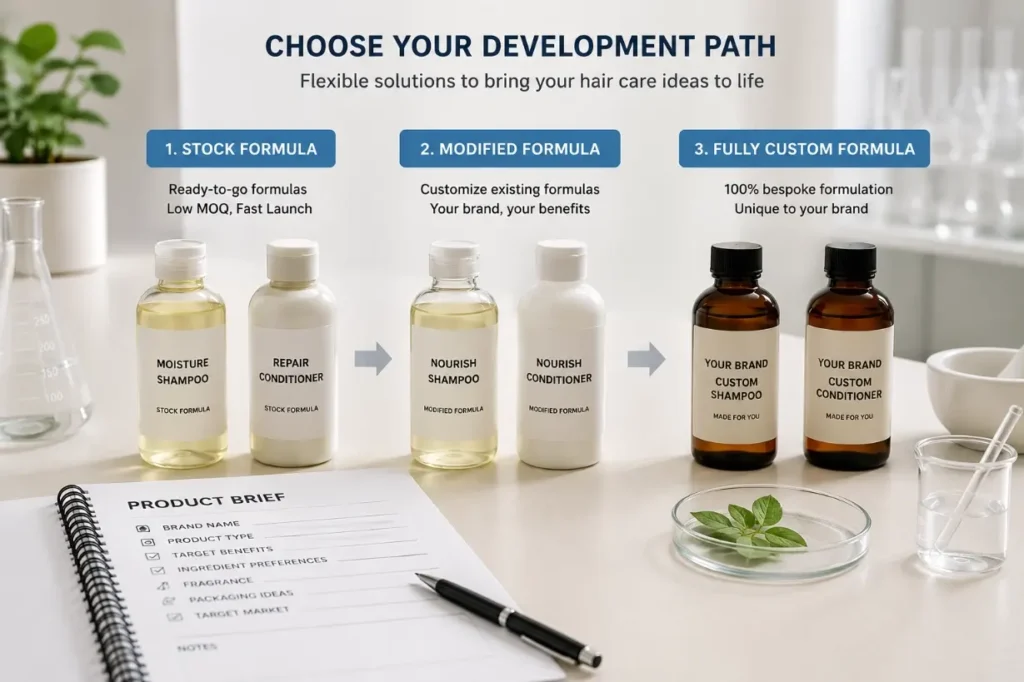
Stock formula, modified formula, and fully custom formula
A stock formula is an existing base formula that a manufacturer already has available. In private label hair care, this can help a brand start sampling without developing every technical detail from the beginning. The formula may still need review for target market, packaging, fragrance, claims, and label wording.
A modified formula starts with an existing base but adjusts selected elements. These may include fragrance, viscosity, color, sensory feel, hero ingredient direction, product positioning, or packaging fit. The actual modification range depends on the manufacturer, formula system, ingredient compatibility, and testing needs.
A fully custom formula starts from a product brief. The brand defines the product concept, target customer, desired sensory profile, ingredient preferences, claims direction, packaging idea, and launch requirements. The manufacturer then evaluates feasibility and develops samples around that brief.
None of these routes is automatically superior. The right choice depends on your brand stage, product category, target market, differentiation needs, and tolerance for development work.
How formula route differs from OEM, ODM, and private label
OEM, ODM, and private label describe business and manufacturing models. Stock, modified, and custom describe how the formula is developed.
For example, a private label shampoo line may use a stock formula, a modified base formula, or a fully custom formula. An OEM/ODM hair care project may also involve different formula routes depending on how much development support the brand needs.
Keronhair’s service pages cover areas such as custom hair care formulation, OEM/ODM hair product manufacturing, and private label hair care products. Before assuming a specific formula route is available for your project, confirm the current service scope, sample process, and product category fit directly with the manufacturer.
A buyer-supplied formula also needs a defined manufacturing handoff, not just a stock-versus-custom label. The OEM hair products guide connects formulation choices with specifications, packaging, quality records and target-market responsibilities.
Why hair care products need category-specific decisions
Hair care is not one formula category. A shampoo, conditioner, hair mask, serum, scalp care product, styling wax, straightening cream, and hair color product can have very different texture, packaging, usage, and testing considerations.
A formula route that works for a basic rinse-off shampoo may not be enough for a salon treatment line or a technical hair color system. That is why the decision should start with the product category and business goal, not only with the words “stock” or “custom.”
Custom Formula vs. Stock Formula for Hair Care Products: Quick Comparison
The fastest way to compare formula routes is to look at the tradeoffs side by side. Use the table below as a planning tool, then ask your manufacturer to confirm what applies to your specific product.
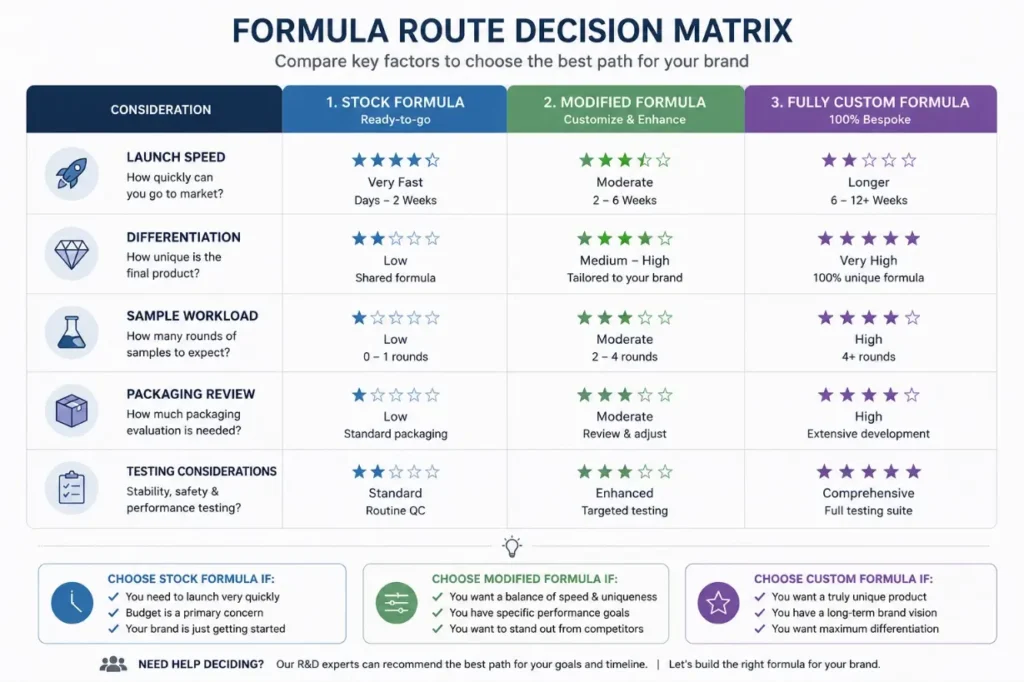
How to read the comparison before choosing a route
The table is not a price list, timeline promise, or quality ranking. It is a decision framework for beauty brands that need to understand how formula route affects development work.
Exact cost, lead time, sample rounds, MOQ, packaging options, and testing requirements depend on the manufacturer, formula complexity, product category, packaging, market, and order plan.
Formula route comparison for brand decision-makers
| Formula route | Best for | Advantages | Watchouts | What to ask the manufacturer | Typical next step |
|---|---|---|---|---|---|
| Stock formula | Brands testing a product line, launching quickly, or entering a common category | Lower development complexity; easier first sample discussion; useful for market testing | May offer limited differentiation; still needs label, packaging, claims, and market review | What can be adjusted? What documentation is available? Has the formula been tested with my intended packaging? | Request samples and review fit against your brief |
| Modified formula | Brands that like an existing base but need a clearer brand direction | Balances speed and differentiation; can support sensory or positioning adjustments | Changes can affect stability, texture, claims, label wording, and production behavior | Which attributes can be modified? What changes require retesting? How are versions controlled? | Submit a modification brief and approve revised samples |
| Fully custom formula | Brands with unique positioning, technical goals, or specific sensory requirements | Stronger development control; better fit for differentiated concepts | Requires clearer brief, more review, more testing discussion, and stronger project management | What brief information is needed? Who owns the formula? What testing and packaging checks are recommended? | Start feasibility review and sample development |
Launch speed and development workload
A stock formula can reduce early development work because the base already exists. A modified formula adds more review because the change must be technically checked. A fully custom formula usually requires the most detailed brief and sample feedback.
Differentiation and formula flexibility
Stock formulas can still support brand differentiation through positioning, fragrance, packaging, label design, product bundles, and channel strategy. Modified and custom routes usually offer more formula-level flexibility, but they also require more disciplined decisions.
Testing, packaging, and production handoff
Any route can require testing or compatibility checks, especially when packaging, claims, ingredient direction, color, fragrance, or target market changes. Do not treat an existing base formula as automatically production-ready for your exact brand launch.
Why the fastest route is not always the right route
A fast launch only helps if the product is right for the audience, channel, and market. If the stock formula does not match your brand promise, sensory target, or packaging format, a rushed decision can create rework later.
For example, a brand may sample a ready shampoo base but later decide it needs a more premium texture, different fragrance direction, or a claim that requires careful review. In that case, the project may move into modified or custom development after all.
Why the most custom route is not always necessary
Fully custom formulation sounds attractive, but it is not always the smartest starting point. If your main goal is to test a market, validate a channel, or build a simple first product line, a stock or modified formula may be more practical.
Custom development is most valuable when the product concept truly requires it. Otherwise, the extra development work can slow decisions without adding enough commercial value.
When a Stock Formula Is the Practical Choice
A stock formula can be a good route when your brand needs a practical starting point, not a blank-page development project.
Best-fit situations for stock formulas
Stock formulas often fit brands that want to test a product category, build a first private label line, or launch a familiar product type with clear positioning. This may include brands that already know their target customer but do not need a highly technical or proprietary formula at the start.
This route can also help when the team has limited product development experience. Instead of trying to describe every technical parameter, the brand can evaluate real samples and decide whether the base direction is close enough.
Product categories where stock formulas may work
Common hair care categories may be better suited to stock formula exploration, depending on the manufacturer’s available base formulas. Examples can include everyday shampoo, conditioner, hair mask, hair oil, simple scalp care, or certain styling products.
Technical categories may require more caution. Hair dye, straightening systems, professional treatments, and products with more sensitive claims or performance expectations may need deeper feasibility review before a stock route is chosen.
How brands can still differentiate a stock formula
Stock formula does not have to mean a generic product. Differentiation can come from the complete product strategy:
- Target customer and positioning
- Fragrance direction and sensory story
- Packaging format and label design
- Product bundle strategy
- Hero ingredient communication, if supportable
- Channel fit, such as salon retail, ecommerce, travel size, or professional backbar
- Brand education, usage guidance, and product-line architecture
The key is to avoid overpromising. If the formula is based on an existing base, the brand should be honest internally about which parts are differentiated and which parts are shared with the manufacturer’s existing options.
When several products share one repair positioning, assess the route at collection level as well as SKU level. Our U.S. clean-positioned repair range case illustrates the coordination of formulas, packaging and sample feedback across three products.
When a stock formula may not be enough
A stock formula may not be enough if your brand requires a very specific texture, fragrance profile, ingredient system, packaging behavior, professional performance expectation, or market claim direction.
It may also be limiting if your brand wants stronger formula ownership or exclusivity. These are business and contract questions, not assumptions. Ask the manufacturer what rights, if any, are available for the formula route being proposed.
Questions to ask before choosing a stock formula
Before selecting a stock formula, ask:
- What elements can be adjusted without changing the formula route?
- What product categories are available for sampling?
- What ingredient list and label information can be provided?
- Has the formula been reviewed for the target market?
- What packaging formats have been used or checked?
- What changes would move this from stock to modified development?
- What documentation is available before production?
For brands comparing private label hair care products, these questions can prevent misunderstandings before sampling begins.
When a Modified Formula Gives Your Brand the Better Balance
Many brands sit between two extremes. They do not want a completely generic product, but they also do not need full custom formulation from zero. This is where a modified formula can be useful.
Common reasons brands choose a modified formula
A modified route may work when a base formula is close to the desired product, but the brand wants to adjust the sensory experience or market fit.
For example, a brand may like a conditioner base but want a richer feel, a different fragrance direction, a silicone-free positioning, a different color appearance, or a packaging format that needs viscosity review. The manufacturer must confirm whether these changes are technically feasible.
What can often be adjusted, subject to feasibility
Possible adjustment areas may include:
- Fragrance direction
- Texture or viscosity
- Color or appearance
- Sensory feel
- Hero ingredient direction
- Target hair concern
- Packaging fit
- Product line consistency
- Label positioning, subject to claims review
The phrase “subject to feasibility” matters. A small change in fragrance, color, ingredient direction, or packaging can affect stability, compatibility, preservative system, production behavior, and label language.
Where modification can create hidden risks
Modification can look simple from a marketing perspective, but it may create technical questions.
If the formula becomes thicker, will it still work with the selected pump or bottle? If a new fragrance is added, does it affect color, scent stability, or packaging compatibility? If a hero ingredient is highlighted on the label, does the claim language need review?
These questions do not mean modification is risky by default. They mean the brand should treat modification as a controlled development step, not a casual edit.
How to brief a manufacturer for formula modification
A useful modification brief should include:
- Product type
- Existing base formula direction
- Attributes that must stay the same
- Desired changes
- Target customer
- Target market
- Packaging idea
- Claims direction
- Sample feedback priorities
- Launch timing and order planning expectations
If you are discussing modified hair care formula development with Keronhair, use the brief to ask whether the project should stay within a modified route or move into custom hair care formulation services.
When Fully Custom Hair Care Formulation Makes Sense
Fully custom hair care formulation is most useful when your brand needs a product that cannot be achieved by selecting or lightly modifying an existing base.
Strong signals that your brand needs a custom formula
You may need a fully custom route if:
- Your product concept is highly specific.
- You have a defined sensory target that existing bases do not match.
- Your brand needs a distinctive texture, fragrance, or product experience.
- Your ingredient direction is central to the brand story.
- Your packaging format creates formula constraints.
- You are building a professional or salon-positioned line.
- Your product requires more controlled sample development and scale-up review.
Custom formulation is not just about being different. It is about having a clear reason for development work.
Product categories where custom development can matter more
Custom development may matter more for salon treatments, scalp care, serums, oils, hair masks, hair dye systems, straightening creams, styling waxes, or products where texture and performance expectations are central to the buying decision.
A coordinated curl-care range may need different levels of customization across the SKUs. Our South Africa moisture and curl-care example provides a brief for discussing cleansing mildness, conditioning, styling feel and residue together.
For example, a salon brand may care about how a mask spreads, rinses, layers with other products, and feels after blow-drying. An ecommerce scalp care brand may care about texture, residue, fragrance intensity, and label language. A styling product may need a specific balance of hold, shine, spread, and washability.
What brands should prepare before custom formulation starts
Custom development works best when the brand prepares a clear product brief. At minimum, include:
- Product category
- Target customer
- Hair concern or product role
- Desired texture and sensory profile
- Fragrance direction
- Ingredient preferences and restrictions
- Packaging idea
- Target market
- Claims direction
- Benchmark products
- Launch timeline
- Expected product line structure
The brief does not need to be a technical formula. It should translate your brand strategy into practical development requirements.
Risks to confirm before custom development starts
Before starting a fully custom route, confirm the commercial and technical boundaries. Ask about sample steps, formula version control, ownership terms, exclusivity, testing responsibility, packaging compatibility, label support, and production handoff.
Do not assume that “custom” means exclusive ownership, guaranteed claims, or fixed market approval. These depend on supplier policy, contract terms, evidence, market regulations, and product details.
What custom formulation cannot solve by itself
Custom formulation cannot replace a clear brand strategy, realistic positioning, regulatory review, packaging planning, or disciplined sample feedback.
It also cannot guarantee market success. A custom formula can support differentiation, but the brand still needs the right price point, channel strategy, education, packaging, claims discipline, and customer fit.
How Formula Route Affects Sampling, Testing, Packaging, and Claims
The formula route affects the work that happens after the first sample. This is where many sourcing problems begin. A brand may think it has chosen a formula, but the project is not ready for production until sampling, packaging, claims, and approval details are aligned.
Sampling and sample feedback
With a stock formula, the first sampling task is usually fit evaluation. Does the product match the target customer, channel, texture preference, fragrance expectation, and packaging plan?
With a modified formula, the sample process should track what changed and why. Feedback should be specific: “increase viscosity slightly,” “reduce fragrance intensity,” “make rinse-off feel lighter,” or “adjust color to match the product line.”
With a fully custom formula, sampling is more connected to the product brief. Every round should move the formula closer to the approved target, not open a new direction each time.
Testing and safety substantiation
Testing needs depend on formula, product category, market, packaging, claims, and supplier process. A brand should ask what checks are recommended before production and what party is responsible for each step.
Stability and compatibility checks
Stability and compatibility review can help identify changes in color, odor, texture, separation, viscosity, packaging interaction, or other quality concerns. The exact protocol should be confirmed by qualified technical teams.
Microbiological quality and safety review
Hair care products should be reviewed for appropriate quality and safety expectations. In the U.S., the FDA’s MoCRA information includes safety substantiation topics for cosmetics. Market-specific requirements may vary.
Market-specific documentation needs
If the product is intended for the U.S., EU, UK, ASEAN, Middle East, or another market, ask which label, ingredient, notification, responsible person, importer, or documentation questions apply. Do not rely only on generic supplier claims.
Packaging and filling compatibility
Packaging is not a final decoration step. It can affect filling, stability, consumer use, shipping, and production planning.
Viscosity and dispensing format
A thick hair mask, fluid serum, cream color, shampoo, or styling wax may need different packaging and filling approaches. Match viscosity and dispensing format early.
Formula and packaging material compatibility
Color, fragrance, oils, active ingredients, or formula pH may interact differently with bottles, tubes, jars, pumps, labels, or closures. Ask whether compatibility should be checked before production.
Label artwork and fill-volume decisions
Label artwork, INCI listing, warnings, directions, net contents, batch coding space, and fill volume should be reviewed before packaging is ordered and production is scheduled.
Claims, label wording, and target market review
Claims such as “repair,” “strengthen,” “anti-hair loss,” “dandruff,” “growth,” “organic,” or “clinically proven” can create different evidence and regulatory questions depending on market and wording.
An organic-positioned range adds another question to the stock-versus-custom decision: which part of the proposed formula and production process can support the intended claim? Use the organic hair care sourcing checklist when comparing what each development route can document.
For U.S. cosmetic labeling, review FDA cosmetics labeling guidance. For EU market entry, review European Commission cosmetics and CPNP information. Use official sources and qualified regulatory support rather than informal assumptions.
Production readiness and scale-up checkpoints
Before production, the brand and manufacturer should align on the approved formula version, approved sample, packaging, label artwork, fill volume, QC checks, batch coding, and shipment documentation needs.
Changes after approval can affect cost, timing, testing, packaging, and production scheduling.
Who should confirm each decision before approval
Formula route decisions should not sit with one person only. Product development, brand, procurement, quality, packaging, regulatory, and manufacturer teams may all need to confirm different parts of the project.
For broader manufacturing support, Keronhair’s hair care product manufacturer page can be used as an internal reference point for the types of manufacturing discussions a brand may need to prepare.
Cost, Timeline, MOQ, and Ownership Questions to Ask Before You Choose
The right formula route is partly technical and partly commercial. Before choosing, ask questions that expose the real cost, time, order, and ownership implications.
Commercial questions
Commercial terms vary by manufacturer and project. Avoid relying on assumptions.
Development fees and sample fees
Ask whether the route involves development fees, sample fees, modification fees, or retesting fees. Also ask when each fee applies and what happens if the formula direction changes.
Lead time and launch schedule
Ask how the route may affect sampling, packaging sourcing, testing, production scheduling, and shipment preparation. Do not ask only for a single lead time number.
Quotation assumptions and revision rules
Ask what assumptions the quotation is based on: formula route, packaging, order quantity, sample revisions, label support, and documentation. Clarify what may trigger a revised quotation.
MOQ and packaging planning questions
MOQ should be discussed with product category, packaging, formula route, and order plan in mind. A formula may have one production requirement, while packaging components may have separate minimums.
Ask about reorder planning, retail sizes, sample sizes, packaging availability, component lead time, and whether the same formula will be used across multiple SKUs.
Technical and production questions
Ask how the manufacturer controls formula versions, sample approvals, formula changes, production references, scale-up, and QC checkpoints.
If a formula is modified after sample approval, ask whether testing, packaging checks, labels, or production documents need to be updated.
Ownership and exclusivity questions
Formula ownership and exclusivity are contract questions. Do not assume you own a formula because you paid for development, and do not assume a stock formula is exclusive.
Ask:
- Who owns the base formula?
- Can the brand request exclusivity?
- What is included in the handover documentation?
- Can the formula be transferred to another manufacturer?
- How are changes documented?
- What happens if the product is reordered or reformulated?
Get commercial and legal terms in writing before development goes too far.
Compliance and market-entry questions
Ask who supports ingredient review, label review, market documentation, safety substantiation, product listing, notification, responsible person coordination, or importer documentation. Responsibilities may differ by market and by the role of the brand owner, manufacturer, importer, distributor, or responsible person.
For OEM/ODM projects, use these questions before selecting an OEM/ODM hair care manufacturer.
Decision Framework: Which Formula Route Fits Your Brand?
If you are still unsure, use a decision framework instead of choosing based on the word that sounds more attractive.
Start with your business goal and launch stage
Ask first:
- Are you testing a market or building a long-term hero product?
- Do you need a fast first launch or a highly differentiated formula?
- Is your product positioned for mass market, ecommerce, salon retail, professional use, or premium care?
- Is your packaging simple or technically demanding?
- Do your claims require careful evidence review?
- Does your team have experience giving technical sample feedback?
The more specific and differentiated your goal is, the more likely you may need modified or custom development.
Match your decision signals to stock, modified, or custom routes
Choose a stock formula if your launch needs are practical, your differentiation needs are moderate, and an existing base fits your product concept.
Choose a modified formula if an existing base is close, but your brand needs sensory, ingredient, positioning, or packaging adjustments.
Choose fully custom formulation if your concept, texture, product category, performance direction, brand positioning, or packaging requirements cannot be achieved through available bases.
Ask the manufacturer to compare routes when tradeoffs conflict
If your team is split between speed and differentiation, ask the manufacturer to compare the routes for your specific brief. A useful answer should explain what changes between the routes, what risks increase, and what the next sample step would be.
For private label planning, this framework can also help your team decide whether to start with private label hair care product development or a more custom route.
How to Discuss Your Formula Route With a Hair Care Manufacturer
Once you understand the route options, the next step is to prepare a better supplier conversation.
Prepare a practical product brief before asking for samples
Your product brief should include:
- Product type
- Target customer
- Target market
- Product positioning
- Benchmark products
- Desired formula route, if known
- Texture, fragrance, color, and sensory goals
- Ingredient preferences and restrictions
- Claims direction
- Packaging idea
- Expected launch schedule
- Order planning expectations
You do not need to write a technical formula. You need to help the manufacturer understand the product you are trying to build.
Turn the route discussion into a clear next step
Do not ask only, “How much is this product?” Ask:
- Which formula route fits this brief?
- What stock or base options are available for review?
- What can be modified?
- What requires custom development?
- What should be tested before production?
- What packaging issues should be checked early?
- What information is needed for a quote?
- What documents or approvals are needed before mass production?
If you already have a product concept, you can share your product type, target market, packaging idea, ingredient preferences, and claims direction with Keronhair to discuss whether custom formulation support, OEM/ODM manufacturing, or private label development is the most practical next step.
Conclusion
The decision between custom formula vs stock formula for hair products is not a simple quality ranking. It is a route choice. Stock formulas can support practical launches and market testing. Modified formulas can give brands a useful balance between speed and differentiation. Fully custom formulas can support stronger product ownership, sensory goals, and technical positioning when the concept truly requires development from a brief.
The smartest choice starts with your brand goal, product category, target customer, packaging plan, claims direction, and launch stage. Before you choose, ask the manufacturer to explain how each route affects sampling, testing, packaging, label review, production readiness, commercial terms, and ownership.
If your team is preparing a hair care launch, build a clear product brief first. Then ask Keronhair to help compare stock, modified, and fully custom formula routes for your private label or OEM/ODM hair care project.
FAQ
Is a stock formula the same as a private label formula?
No. A stock formula is an existing base formula. Private label means selling the product under your brand name. Private label projects may use stock, modified, or custom formulas.
Is a custom formula always better than a stock formula?
No. Custom is useful for stronger differentiation, but stock or modified formulas may be more practical for faster launches, market testing, or simpler product concepts.
What can usually be changed in a modified hair care formula?
Possible changes may include fragrance, texture, color, sensory feel, ingredient direction, packaging fit, or label positioning. The manufacturer must confirm technical feasibility.
Does changing a stock formula require new testing?
It may. Changes can affect stability, compatibility, label wording, or production behavior, so brands should ask what checks are needed before approval.
Which formula route is best for a new hair care brand?
It depends on differentiation needs, launch timing, budget, market, product category, and internal resources. Many new brands compare stock and modified routes first.
Can packaging affect the formula route?
Yes. Packaging format, pump or closure, viscosity, fill volume, label material, and product texture can affect filling, compatibility, and production planning.
Who owns a custom hair care formula?
Formula ownership or exclusivity depends on supplier policy and contract terms. Brands should confirm ownership, usage rights, and documentation in writing before development starts.
What should I send a manufacturer before asking for a formula recommendation?
Send product type, target customer, market, positioning, benchmark examples, ingredient preferences, claims direction, packaging idea, launch timeline, and expected order plan.