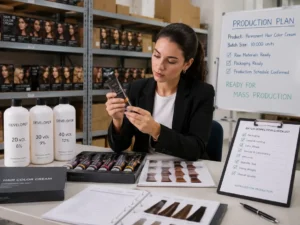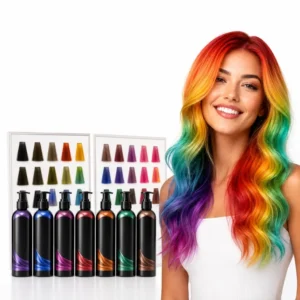
A hair dye sample can look promising and still be unready for production. The shade may be attractive on one tress but inconsistent on gray hair. The formula may apply smoothly from a laboratory container but become difficult to dispense from the final tube. A permanent color may also perform differently when paired with another developer, ratio, or processing time.
That is why professional sample approval should be a controlled decision process, not a quick visual check.
This guide explains how beauty brands, salon brands, distributors, and ecommerce sellers can test hair dye samples before bulk production. You will learn how to define acceptance criteria, build a test matrix, evaluate the complete color system, record revisions, and freeze an approved “golden sample” for manufacturing. Brands still defining their product scope can use a private label hair dye manufacturer page to prepare the formula, shade, developer, packaging, and sampling questions that belong in the brief.
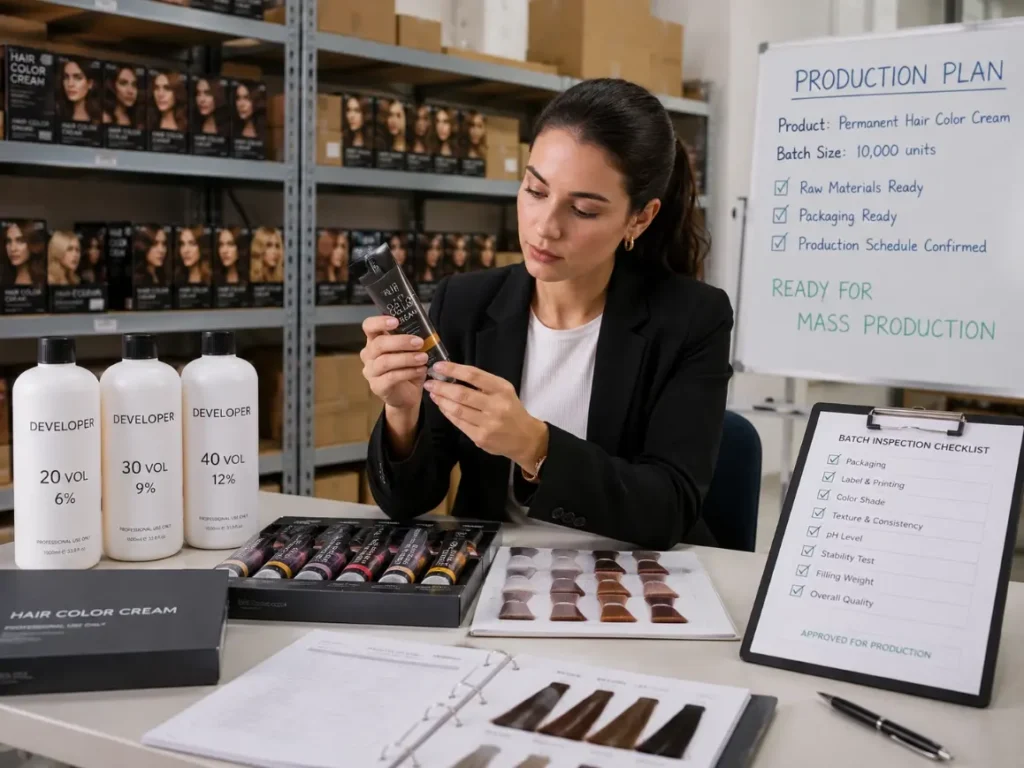
What a Hair Dye Sample Test Can Evaluate
A controlled evaluation can compare shade direction, depth, tonal balance, gray coverage, root-to-end uniformity, ease of mixing, application spread, odor, rinsing behavior, post-color feel, staining tendency, and color change after defined wash cycles. It can also reveal practical packaging issues such as leakage, poor dispensing, label damage, or a mismatch between component quantities.
| Evaluation area | What to record | Why it matters |
|---|---|---|
| Color result | Starting tress, formula ID, developer, ratio, time, final shade | Makes the result reproducible |
| Application | Mix texture, spread, drip, odor, rinse behavior | Connects lab performance with user experience |
| Hair condition | Combability, feel, visible dryness, breakage observations | Helps compare versions without overclaiming |
| Durability | Wash method, cycle count, tone and depth change | Shows relative fade behavior under one protocol |
| Packaging | Fill, seal, dispensing, leakage, artwork condition | Tests the commercial pack, not only the formula |
What a Sample Test Cannot Prove
A good tress result does not prove that a cosmetic is safe for every user, stable for its entire intended shelf life, compliant in every country, or identical to future bulk batches. The U.S. FDA explains that cosmetic businesses are responsible for product safety and that it does not prescribe one universal test list for every cosmetic; the evidence should be scientifically sound and appropriate to the product. See the FDA’s guidance on product testing of cosmetics.
Treat performance testing, safety substantiation, regulatory assessment, stability, microbiological quality where applicable, packaging compatibility, and production quality control as connected but distinct workstreams.
How to Test Hair Dye Samples Before Bulk Production
The following seven-step method creates a traceable path from the first prototype to a defensible production decision.
Step 1: Define the Test Objective and Approval Criteria
Begin before the sample arrives. Write a one-page brief that states:
- product type and intended user;
- target market and sales channel;
- reference shade or benchmark;
- starting hair conditions to be evaluated;
- developer specification, ratio, application amount, and processing time;
- packaging format and kit components;
- claims or performance targets that require evidence;
- required documents and unresolved compliance questions;
- pass, revise, and reject criteria.
“Rich brown,” “low odor,” or “good coverage” are too vague on their own. Translate them into observable comparisons. For example: the approved result should match the signed reference swatch under defined lighting; cover the agreed percentage and type of gray tress; mix without visible separation; dispense without leakage; and remain within an approved appearance range after a specified wash protocol.
If your project requires a new base, adjusted shade architecture, ingredient restrictions, or a benchmark-led formula, clarify the development route through a custom hair care formulation brief before scoring samples. The formula route affects what can change, which revisions are included, and what ultimately becomes the approved specification.
Step 2: Build a Sample Matrix and Version Log
Give every item a unique identifier. A useful ID connects the project, formula, shade, revision, developer, packaging version, and date. Never rely on “new brown sample” in email threads or chat messages.
Your matrix should include controlled variables such as:
- untreated, previously colored, bleached, or gray hair tresses;
- hair source, lot, texture, and starting level where known;
- shade and formula revision;
- developer type and strength, if applicable;
- mix ratio, application weight, processing time, and temperature;
- wash method and number of cycles;
- evaluator, date, lighting, and photo file name.
Photograph the untouched tress beside the processed result with the sample ID visible. Use the same lighting, camera position, background, and white-balance method. Photos support the record, but the physical tress should remain the primary reference when possible.
The European Commission distinguishes temporary, semi-permanent, and permanent hair dye products and describes permanent oxidative color as a reaction involving color precursors and an oxidizing agent. That difference affects the test matrix. Review its overview of hair dye products when defining the system.
For Permanent or Oxidative Hair Color
Record the exact developer, mix ratio, application amount, processing time, and starting substrate for every result. Treat color cream and developer as one tested system. Changing either component creates a new condition that may need fresh evaluation.
For Semi-Permanent, Direct Dye, or Color Shampoo
Record whether the product was applied to dry or wet hair, the application amount, processing and rinse method, starting porosity, and wash schedule. Bleached and highly porous hair can produce a result that is not representative of untreated hair, so keep substrates separate.
Step 3: Inspect the Formula, Packaging, and Developer System
Before coloring a tress, inspect what was shipped. Check the sample ID, shade code, batch or laboratory reference, net quantity, container, closure, tamper features, label, instructions, and any accompanying developer or aftercare.
For a cream or developer, note color, odor, apparent uniformity, flow, ease of dispensing, and any visible separation or container deformation. Do not “fix” a sample by shaking, warming, diluting, or substituting components unless the written instructions call for it. An undocumented adjustment makes the result difficult to reproduce.
For oxidative color, confirm:
- the exact developer specification;
- intended ratio by weight or volume;
- permitted shade pairings;
- processing conditions;
- dye and developer quantities in the retail kit;
- cautions and instructions supplied for review.
If the brand plans to source both components, use a written system specification rather than two unrelated product sheets. This guide to developing hair dye and developer together explains why the pairing, pack sizes, instructions, and approval record should stay connected.
Step 4: Run a Controlled Tress Test
Prepare a written test method that another trained evaluator can repeat. Condition and label the tresses consistently. Weigh or measure the product and developer, follow the defined ratio, mix for the same duration, apply a consistent amount, and use the specified processing time and temperature range.
Include a control where it helps interpretation: an approved benchmark, a previous version, an untreated reference, or a market product tested under the same appropriate conditions. Do not compare products with incompatible instructions as if the comparison were equivalent.
Keep test zones clean and separate to prevent transfer. Record deviations immediately, including delays, unexpected temperature, missing product, tress damage, or application errors. A surprising result is not automatically a formula failure; it may be a test-control failure.
After processing, rinse and finish each tress using the same documented procedure. Allow samples to dry fully before final color assessment unless wet appearance is itself an evaluation point.
Step 5: Evaluate Shade, Coverage, Application, and Hair Condition
Score results only after defining the scale. A simple five-point scale can work if each score has a description and the go/no-go threshold is written in advance.
Assess color under controlled, color-appropriate lighting and, where possible, compare it with the signed physical reference. Record:
- depth and tone;
- warmth, coolness, or unwanted reflect;
- gray coverage and blending;
- root-to-end or tress uniformity;
- visible patchiness;
- staining and rinse behavior;
- mix consistency and application control;
- dry and wet combability;
- tactile feel and visible surface condition.
Avoid turning observation into an unsupported claim. “Evaluator rated wet combability better than version B under this method” is more defensible than “repairs damaged hair.” If the final marketing claim depends on instrumental, clinical, consumer, or laboratory evidence, specify that evidence separately.
Use at least two reviewers for important shade decisions when practical. If they disagree, do not average away the problem. Recheck the reference, lighting, method, and acceptance language, then document the resolution.
Step 6: Review Fade, Stability, Packaging Compatibility, and Technical Evidence
A day-one swatch is only one part of approval. Run a defined wash-and-fade comparison appropriate to the product. Keep water conditions, shampoo, wash duration, drying, and assessment intervals consistent. Record tone shift as well as loss of depth; a shade that stays dark but becomes noticeably warmer may still fail the brief.
Next, review the manufacturer’s proposed stability and packaging-compatibility plan. ISO/TR 18811 provides a framework for cosmetic stability testing but does not set one universal condition or acceptance criterion; the manufacturer should justify a protocol suited to the formula, pack, storage, and use. See ISO/TR 18811:2018.
Packaging review should consider leakage, sealing, dispensing, paneling or swelling, staining, corrosion where relevant, label adhesion, decoration, carton fit, component interaction, and transport conditions. Test the final or production-representative pack, because a laboratory jar cannot prove that a commercial tube or bottle will work.
Also request the technical evidence appropriate to the product and target market. This may include ingredient information, specifications, safety documentation, stability or compatibility summaries, quality records, and relevant third-party reports. ISO 22716 covers cosmetic GMP guidance for production, control, storage, and shipment; it does not replace product development or safety evaluation. Review the scope of ISO 22716 and verify any supplier certificate directly.
Cosmetic and hair color requirements vary by market. Brands should confirm applicable safety, labeling, notification, ingredient, and claims requirements before launch.
Step 7: Freeze the Golden Sample and Make a Go/No-Go Decision
Do not approve with “looks good” in a message. Use a signed approval sheet that identifies the exact formula revision, shade, developer, test conditions, physical tress, packaging, artwork, instructions, specifications, required documents, and open actions.
| Decision | Use it when | Required next action |
|---|---|---|
| Approve | All defined criteria and required evidence are satisfied | Freeze specifications and retain approved references |
| Approve with conditions | Only listed, non-performance actions remain | Assign owners and deadlines before production release |
| Revise | The direction is viable but one or more criteria fail | Issue a numbered revision brief and retest affected areas |
| Reject | The route cannot meet critical requirements | Document the reason and select another route |
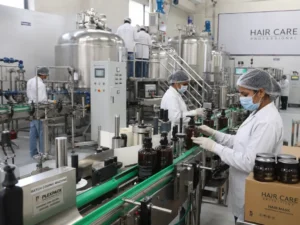
Retain the approved physical sample and tress in suitable conditions, with duplicate references held by the brand and manufacturer when practical. Link them to the approved documents and purchase order. Before production, ask the OEM/ODM hair product manufacturer to confirm that purchasing, compounding, filling, packaging, and QC teams are working from the same released version.
For a first order or a high-risk change, consider a pilot or pre-production verification before committing the full volume. Bulk production should match approved specifications and acceptance methods—not simply resemble a photograph.
Hair Dye Sample Approval Checklist
Use this condensed checklist during the final review:
- Product brief, target market, user, and channel are defined.
- Formula, shade, revision, and sample IDs match the test record.
- Starting hair tresses and preparation method are documented.
- Developer, ratio, quantity, time, and temperature are recorded.
- Shade, coverage, application, rinse, and hair condition meet written criteria.
- Fade testing follows a repeatable wash protocol.
- Final or representative packaging passes the agreed checks.
- Instructions, warnings, artwork, and kit quantities match the tested system.
- Required stability, safety, compliance, and quality evidence has been reviewed by qualified people.
- Golden sample, signed approval, specifications, open actions, and retained references are controlled.
Common Mistakes When Testing Hair Dye Samples
Testing Only One Hair Type
One tress cannot represent gray, bleached, porous, previously colored, and untreated hair. Select substrates that reflect the intended users and claims.
Changing Several Variables at Once
If the formula, developer, ratio, and processing time all change, you cannot identify what caused the result. Change deliberately and record every variable.
Comparing Samples Under Different Lighting
Warm office light and daylight can make the same tress appear different. Use a consistent assessment environment and keep the physical reference nearby.
Approving the Shade but Ignoring the Developer
For oxidative color, the result belongs to the tested pairing. Approving the cream without its developer and ratio leaves a critical specification unresolved.
Relying Only on Fresh Color Results
Day-one appearance does not show fade direction, packaging interaction, or longer-term stability. Make those separate approval gates.
Using Photos as the Only Reference
Camera processing, screens, and messaging apps shift color. Use standardized photos for records, but retain labeled physical tresses whenever possible.
Testing Formula but Not Final Packaging
A formula that works in a lab container may leak, stain, dispense poorly, or interact with the commercial pack. Evaluate a representative final system.
Accepting Verbal Revisions
Unnumbered feedback creates version confusion. Issue a concise revision brief and require the next sample to carry a new identifier.
Treating the Tress Test as a Safety Test
Performance on hair does not establish consumer safety. Keep qualified safety and regulatory review as distinct pre-launch requirements.
Starting Bulk Production Before Closing Open Actions
Artwork, evidence, packaging, or instructions marked “to be confirmed” can become expensive production problems. Use a release checklist and named decision owner.
Test the Complete Hair Color System Before You Scale
Reliable hair dye sample approval is not about creating the largest possible test program. It is about controlling the variables that matter, collecting evidence appropriate to the risk, and making one traceable decision.
Define the target. Label every version. Test representative hair substrates. Keep the developer and formula together. Review fade, packaging, instructions, and technical evidence. Then freeze the golden sample and release only the version everyone approved.
That discipline makes feedback clearer for the manufacturer and gives your brand a stronger reference when bulk production begins. Most importantly, it replaces “we liked the sample” with a practical answer to a better question: what exactly did we test, approve, and authorize for scale?
Frequently Asked Questions
How Many Hair Dye Samples Should a Brand Test?
There is no universal number. Test enough versions and substrates to resolve the defined risks. A single-shade direct dye and a multi-shade oxidative salon system need very different matrices. Ask the manufacturer to quote included rounds and additional revision costs.
How Many Tresses Should Be Used Per Shade?
Use enough replicates to compare the approved substrates and confirm that an unexpected result is not a one-off handling error. Define the number in the protocol rather than choosing it after seeing the outcome.
Should Hair Dye Be Tested With the Final Developer?
Yes, for an oxidative system. The developer specification, ratio, processing conditions, and formula version should match the intended commercial instructions.
How Should Gray Coverage Be Tested?
Use a documented gray-hair substrate appropriate to the target claim, record its composition or source where available, apply a controlled amount, and assess coverage and blending against written acceptance criteria.
How Long Should Fade Testing Run?
Long enough to answer the brand’s specific performance question under a defined wash protocol. Avoid presenting a wash count as a universal consumer-life promise unless suitable evidence supports that claim.
Can a Salon Test Replace Laboratory Testing?
No. A salon evaluation can provide valuable professional-use feedback, but it does not replace stability, compatibility, safety, regulatory, or quality work performed under the appropriate protocols.
Is a Consumer Patch Test the Same as Sample Approval?
No. Sample approval is a B2B product-development decision. Consumer allergy-test or caution directions are separate label and use matters. The FDA’s hair dye guidance explains important U.S. cautions; follow the applicable requirements and approved instructions for each market.
What Is a Golden Sample?
A golden sample is the signed, retained physical reference connected to the approved formula, shade, packaging, specifications, and test record. It supports production handoff and future comparison but does not override written specifications.
What Should Happen if Bulk Color Differs From the Approved Sample?
Quarantine the affected goods, preserve samples and records, compare them using the approved method, and start a documented investigation with the manufacturer. Do not release product based only on an informal visual judgment.