The different types of hair masks can look similar on the shelf but serve different purposes. Some help rough lengths feel softer, some address damage-related concerns, and others temporarily refresh hair color or care for the scalp.
This guide explains seven common categories, what each can realistically do, and how to choose by your hair’s needs, the formula’s feel, and the results after rinsing and drying.
What Are the Main Types of Hair Masks?
The seven main categories are moisturizing, protein, bond-repair, smoothing, color-protecting, color-depositing, and scalp masks. They describe intended benefits, not standardized recipes: one product may fit more than one category. Scalp masks are included as a related treatment type because they target skin rather than the hair lengths.
| Type | Main goal | When to consider it | Important limitation |
|---|---|---|---|
| Moisturizing | Softer, more manageable lengths | Hair feels dry or rough | Richer isn’t always better |
| Protein | Protein-based conditioning | You’re considering care for damaged-feeling hair | Protein content doesn’t prove repair performance |
| Bond-repair | Targeted damage-care claims | Hair has a history of chemical processing | Technology and evidence vary by product |
| Smoothing | Easier detangling and less frizzy-looking hair | Flyaways and roughness bother you | Doesn’t permanently straighten hair |
| Color-protecting | Care for colored lengths | You want to maintain your current shade | Doesn’t necessarily contain pigment |
| Color-depositing or toning | Temporary color adjustment | Your shade needs refreshing | Results depend on your starting color |
| Scalp mask | Care for the scalp itself | A scalp-specific product suits your needs | Ordinary length masks aren’t interchangeable with it |
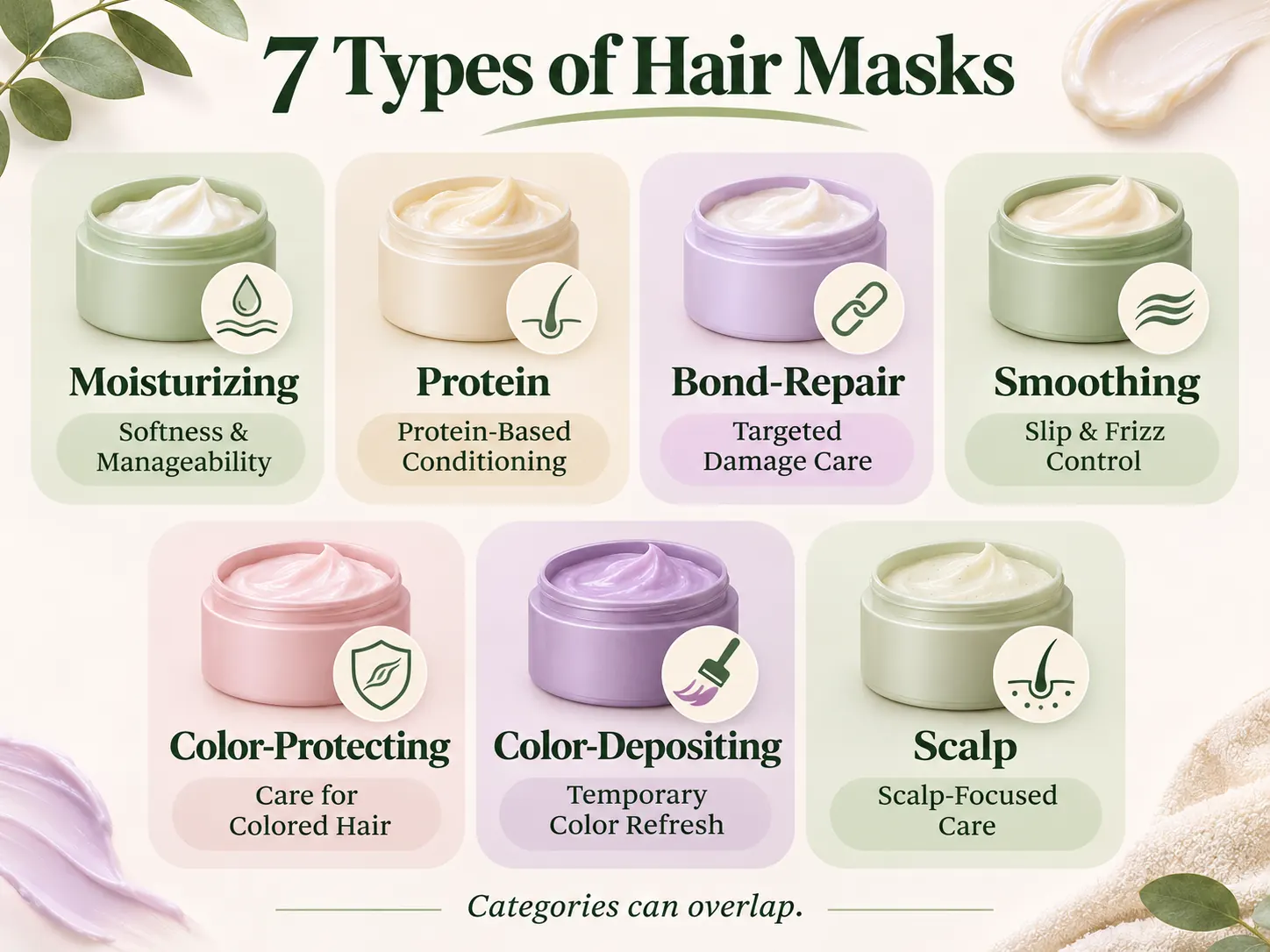
7 Types of Hair Masks and Their Benefits
Start with what you want the product to do. Terms such as "nourishing," "curl-enhancing," and "volumizing" can overlap with the seven types, while "natural" or "vegan" describes other attributes—not how the mask will feel on your hair.
1. Moisturizing Hair Masks
If your ends feel rough and catch when you detangle, a moisturizing hair mask is a reasonable starting point. Look for softness and easier handling without unnecessary weight.
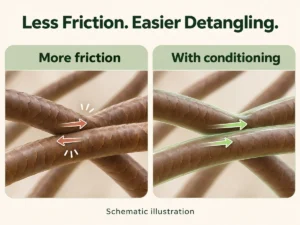
The whole formula matters more than the oil pictured on the jar. Conditioning ingredients can deposit on hair fibers and reduce friction, improving manageability. A rich-looking texture is not proof of a better result: conditioning agents, fatty alcohols, oils, and the way the product rinses all affect its finish. From a formulation perspective, I would start with how the hair should feel after drying, then choose the conditioning system to suit that result. A mask that feels satisfyingly rich on coarse hair may leave fine strands unnecessarily heavy.
For help fitting conditioning into your routine, see how to add moisture without weighing hair down.
2. Protein Hair Masks
Protein masks contain ingredients such as hydrolyzed wheat protein or hydrolyzed keratin. They may be worth comparing for damaged-feeling lengths, particularly when a product has evidence supporting a specific strengthening or conditioning claim.
A protein name on the label doesn’t predict the result. The protein’s form, the surrounding conditioning system, and the directions all matter. If a mask leaves hair stiff or tangled, reassess the finished product rather than assuming you have diagnosed "protein overload."
3. Bond-Repair Hair Masks
Bond-repair masks are marketed for more targeted care of chemically processed hair. Their underlying technologies differ, so look for an explanation of what the finished product has actually demonstrated.
Easier combing, reduced breakage in a defined test, and a specific chemical bond-related mechanism are not interchangeable claims. An acid, peptide, or protein in the ingredient list doesn’t confirm bond-repair performance; product-specific evidence matters, especially when a premium price rests on the claim. My advice is to ask what actually changed in the finished hair fiber and how the result was measured. Better slip is a useful cosmetic outcome, but it isn’t proof that a particular chemical bond was restored.
4. Smoothing and Anti-Frizz Hair Masks
Smoothing and anti-frizz masks can improve slip, detangling, and the appearance of flyaways. Choose by the finish you want—less roughness, better curl definition, or easier styling—rather than treating natural texture as damage.
Smoothing isn’t permanent straightening. Heat protection and lasting humidity resistance are separate claims that need their own support; a styling product may still be useful.
5. Color-Protecting Hair Masks
A color-protecting mask is generally chosen to condition color-treated hair without intentionally adding pigment. Check whether the product merely says it is suitable for dyed hair or makes a specific, supported color-retention claim.
If your goal is to change an unwanted tone or refresh a faded shade, a pigment-containing mask may be more relevant. Softer-feeling hair doesn’t, by itself, show that color has been retained.
6. Color-Depositing and Toning Hair Masks
These masks pair conditioning with pigments that temporarily adjust or refresh hair color. Toning masks address an unwanted cast, while depositing masks can enhance a chosen shade. Results depend on the starting color and hair condition.
For a concrete example, Wella describes its Color Fresh Masks as temporary color-depositing treatments. Its instructions specify clean, towel-dried hair, gloves, a 10-minute application, and thorough rinsing. That timing belongs to this product, not every tinted mask.
Before choosing one:
- Match the shade to your current hair and intended result.
- Check suitability for previously lightened or unevenly colored hair.
- Follow the brand’s strand-test guidance and all other safety instructions.
- Don’t expect a depositing mask to lighten dark hair like bleach.
A strand test helps assess color; it doesn’t replace any allergy precautions required on the label.
7. Scalp Masks and Scalp Treatments
Scalp masks are applied to the skin beneath the hair, not simply to dry or damaged lengths. Use one only when its directions specify scalp application; a rich conditioning mask for the ends may not suit the scalp.
Cosmetic scalp care is not a substitute for assessment of persistent dandruff, inflammation, pain, or unusual hair shedding. Seek professional advice for ongoing symptoms.
Moisturizing vs. Protein Hair Masks: Which Should You Choose?
Choose by the outcome, not a moisture-versus-protein rule. If your goal is softer, more manageable hair, try a well-matched conditioning formula. If breakage after chemical processing is the main concern, compare products with evidence relevant to breakage; protein-containing masks are one option, not an automatic answer.
Moisturizing and protein ingredients can appear together, so separate "protein days" and "moisture days" aren’t essential. Judge the hair after drying and consider heat, brushing, and chemical-service habits if breakage continues.
How Do You Choose the Right Type of Hair Mask?
Choose by your main concern, then assess the product’s texture and directions on your hair. Curl pattern and at-home "porosity tests" alone aren’t reliable shortcuts to the right mask. I find it more useful to think in three stages: application, rinsing, and the feel after complete drying. The first two explain whether a mask is pleasant and practical to use; the last shows whether the finish actually suits your hair. A mask that feels very slippery during rinsing may still leave fine strands heavy.
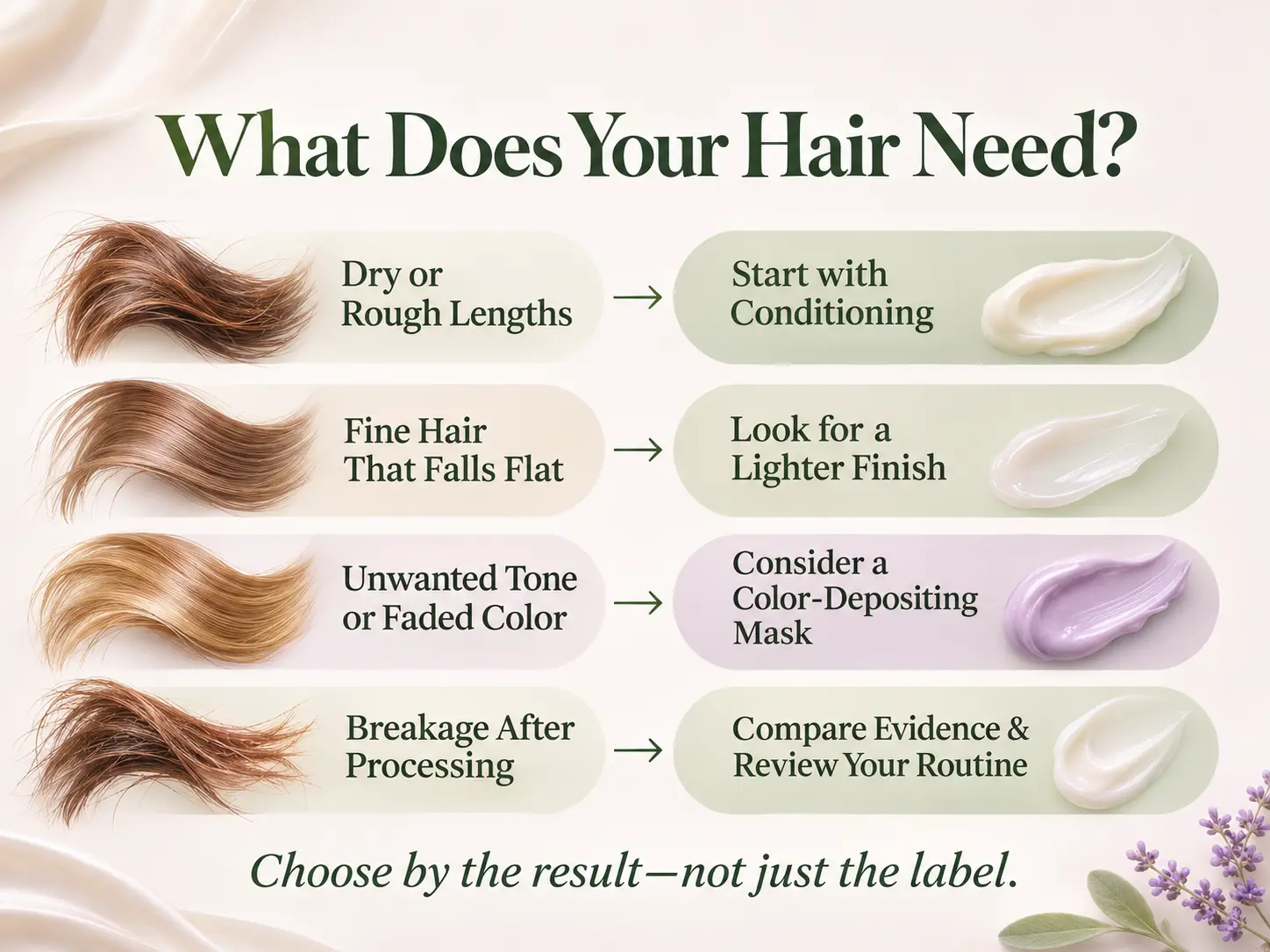
For Fine Hair or Hair That Gets Weighed Down
Aim for manageability without losing the volume you want. Follow the labeled dose and application area. If the dried result feels flat or coated, adjust the amount or choose a lighter finish; a protein mask is not automatically the solution.
For Oily Roots and Dry Ends
Oily roots and dry ends have different needs. Apply a length-conditioning mask only where its directions recommend, and assess whether placement and rinsing leave the roots coated. A richer treatment for the ends won’t fix a scalp-cleansing problem.
For Curly, Coily, or Coarse Hair
Look for enough slip to spread the treatment through the lengths and detangle gently. Sectioning can help distribute product evenly without excessive handling.
The American Academy of Dermatology advises applying conditioner to the ends of fine or straight hair and through the lengths of dry or curly hair. This is conditioner guidance, not a universal instruction for every mask, so also follow your mask’s label.
Fine curls may need a lighter finish than coarse strands. Consider how the mask fits your curly hair care routine and whether you need separate styling hold.
For Bleached, Colored, or Frequently Heat-Styled Hair
Separate changes in hair feel from changes in hair color. For rough ends, prioritize conditioning and manageability. For unwanted warmth or fading, look at an appropriate toning or color-depositing product instead of adding a richer mask. For continuing breakage, consider the treatment’s evidence alongside heat styling, chemical services, and handling habits.
That difference between surface feel and deeper damage has a scientific basis. A 2025 review of hair friction explains that bleaching, coloring, heat, and mechanical wear can accelerate the loss of protective surface lipids, increasing friction between hair fibers. Conditioning materials can help reduce that friction temporarily, but smoother hair should not be confused with complete reversal of chemical damage.
No mask makes repeated damaging practices harmless; preventing further damage remains part of the routine.
Which Ingredients Should You Look for in a Hair Mask?
The ingredient list can explain a formula’s design, but no single ingredient determines the final feel. Conditioning agents, humectants, fatty alcohols, silicones, and proteins can work together, and the same ingredient may be used in a light conditioner or a rich mask.
| Ingredient group | Names you may see | What they can contribute |
|---|---|---|
| Humectants | Glycerin | Attracting and retaining water within a formulation |
| Fatty alcohols | Cetyl Alcohol, Cetearyl Alcohol | Creamy texture, formula structure, and an emollient feel |
| Cationic conditioning agents | Behentrimonium Chloride | Smoothing and easier hair handling |
| Conditioning silicones | Dimethicone, Amodimethicone | Slip, smoothness, and combing performance |
| Hydrolyzed proteins | Hydrolyzed Wheat Protein, Hydrolyzed Keratin | Protein-based conditioning; performance depends on the particular material and formula |
Cetyl and cetearyl alcohol are fatty alcohols, not ethanol. Their names alone aren’t reasons to reject a product. Nor does "silicone-free" guarantee a lighter feel. Check known sensitivities and judge the finished formula, rather than predicting softness or measurable breakage reduction from a short ingredient list.
Rinse-Out, Leave-In, or Pre-Shampoo: Does the Format Matter?
Yes. The format determines when and how the treatment is used; moisturizing or repair-positioned products can be rinse-out, leave-in, or pre-shampoo formulas.
| Format | Where it fits | What to check |
|---|---|---|
| Rinse-out | Often after shampooing | Required hair dampness, processing time, and whether conditioner is needed |
| Leave-in | Remains on hair after application | Dose, application order, and compatibility with later styling steps |
| Pre-shampoo | Before the cleansing step | Whether to apply to wet or dry hair and how to remove it |
Keep rinse-out and leave-in instructions distinct. Leaving an ordinary rinse-out mask on longer doesn’t turn it into a leave-in treatment. Overnight use should be explicitly allowed by the product, not inferred from words such as "intensive."
Do You Need a Hair Mask If You Already Use Conditioner?
Not necessarily. If your conditioner already makes detangling easy and leaves the hair feeling right after drying, a mask isn’t automatically an upgrade.
The distinction matters in product development too. A mask needs a recognizable role beyond "stronger conditioner"—a richer after-feel, a specific post-service routine, a color refresh, or a different frequency of use. The texture, directions, and packaging should match that role. Keronhair discusses these choices when developing masks for a coordinated hair care range. For your own routine, add a mask only when it offers a benefit your conditioner doesn’t.
How Often Should You Use a Hair Mask, and How Should You Apply It?
Follow the frequency on your product’s label, then assess the result. "Hair mask" is not one standardized formula, so different treatments may have different schedules.
How to Start and Adjust Your Routine
Start with the labeled frequency and keep other products reasonably consistent while assessing the result. If hair feels heavy or coated after drying, review the amount, placement, and rinsing before changing masks. If irritation occurs, discontinue the product.
Wet or Dry Hair, and How Long Should You Leave It On?
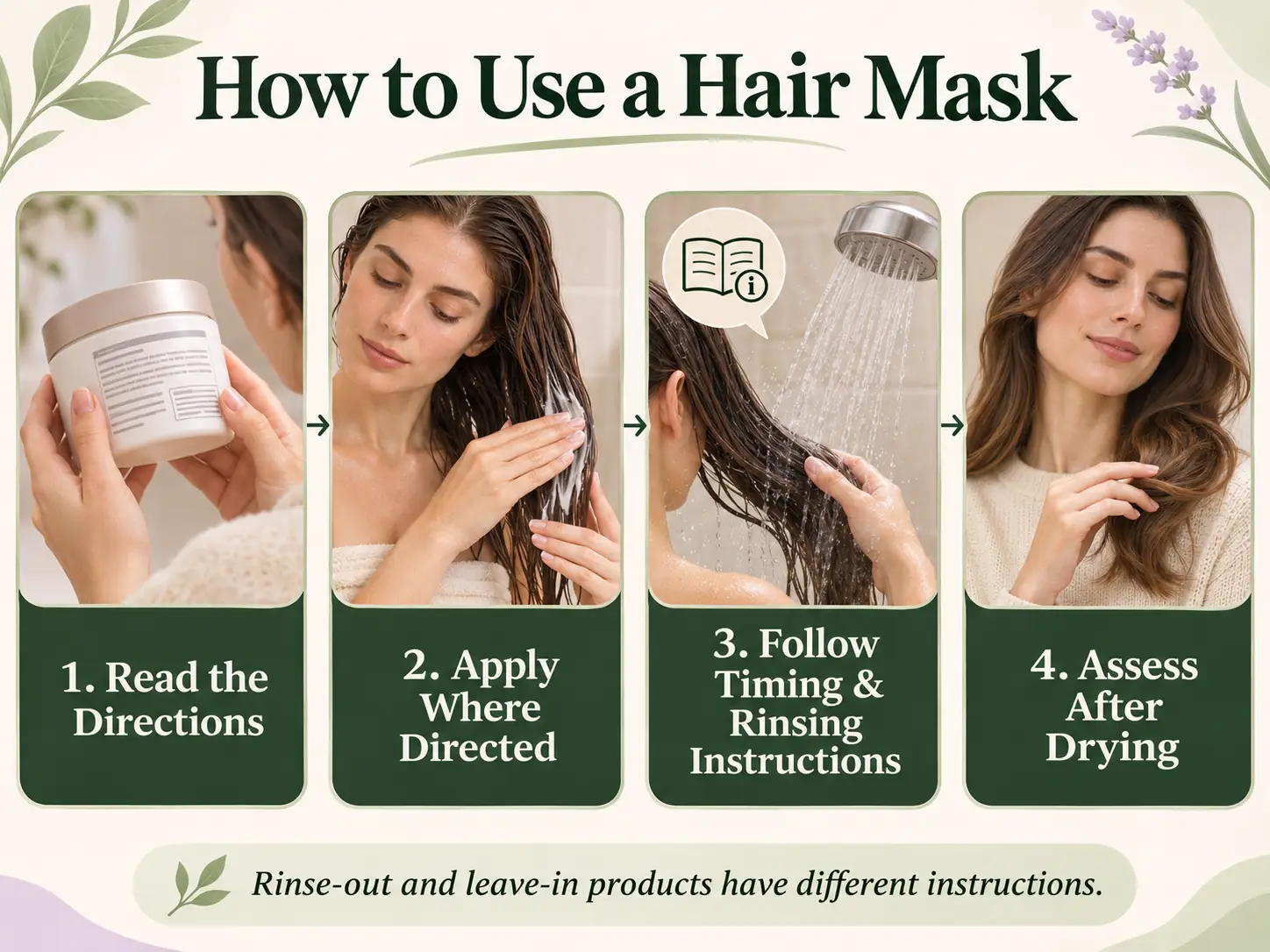
Prepare the hair as directed: a rinse-out mask may call for towel-dried hair, a pre-shampoo treatment may specify dry hair, and a leave-in remains on the hair. The product’s instructions take priority.
- Read the application order, dose, timing, and precautions.
- Prepare your hair as directed, including its wetness or dryness.
- Distribute the product through the specified area without rough handling.
- Rinse or leave it in as instructed, then assess the dry result before adding more.
There is no universal waiting time. The 10-minute instruction for Wella’s Color Fresh Mask applies to that product; don’t extend contact time, use extra heat, or leave another rinse-out mask on overnight unless its directions permit it.
Also review the wash that comes before your treatment. If you’re maintaining a dyed shade, choosing shampoo for color-treated hair deserves attention alongside the mask.
How Can You Tell Whether Your Hair Mask Is Working?
Judge the result after the hair is dry, not only while the mask feels slippery in the shower. Keep the rest of the routine reasonably consistent so changes are easier to interpret.
Ask yourself:
- Is detangling easier without forcing the comb?
- Do the ends feel better after drying?
- Does your hair retain the volume or movement you want?
- Does the product rinse or wear as expected without an unwanted coated feel?
- Is your scalp comfortable?
A recent study shows why it helps to judge these results separately. In research published in 2026 on Walker Type 4 coily hair tresses, selected conditioning treatments reduced measured wet-combing friction by 50%–60%; conditioning or lubricating treatments reduced breakage by 38%–64% during repeated wet combing. Those percentages describe particular treatments, hair samples, and laboratory conditions—not guaranteed benefits of hair masks as a category. They also do not establish how any Keronhair formula performs. A specific breakage-reduction claim needs suitable testing of the finished product used as directed.
If the result is heavy, sticky, or rough, reassess the dose, product, or routine rather than diagnosing a specific ingredient deficiency from feel alone.
Frequently Asked Questions About Hair Masks
These short answers cover common choices and application questions. For timing and safety precautions, your own product’s label takes priority.
Which Type of Hair Mask Is Best for Dry Hair?
Start with a moisturizing mask suited to your hair’s thickness and preferred finish. Look for easier detangling and softer lengths without unwanted weight; the richest formula isn’t automatically the best choice.
Can Fine Hair Use a Hair Mask?
Yes. Choose a suitable formula, follow the suggested dose, and focus on the recommended areas. Assess softness and volume after drying before deciding whether you need a lighter product.
Are Protein Masks and Bond-Repair Masks the Same?
No. Protein masks feature protein-based conditioning ingredients; bond-repair claims depend on specific technologies and evidence. Some products overlap, but the labels aren’t interchangeable.
Should You Use a Hair Mask Before or After Shampoo?
Follow the label. Pre-shampoo treatments go before cleansing, while many rinse-out masks follow shampoo. Leave-in treatments have their own application order and should remain on the hair as directed.
Can You Leave a Hair Mask On Overnight?
Only when its instructions explicitly allow overnight use. Extending a rinse-out treatment’s timing doesn’t guarantee a better result and may not suit your hair or scalp.
Can a Hair Mask Permanently Fix Split Ends?
No. Conditioning can improve feel and temporarily disguise roughness, but it doesn’t permanently restore a split strand. Trimming removes the split portion.
Can You Use More Than One Type of Hair Mask?
You can choose different treatments for different needs, but you don’t need to layer them in one session. Follow their instructions and introduce changes separately so you can judge each product.
Choose a Hair Mask for the Job You Need It to Do
Choose a hair mask for one clear purpose and judge it by the result you can notice after drying. The right treatment should make your routine easier—not add unnecessary steps.
Developing a hair mask for your own brand? Keronhair offers private label and custom development. Bring a brief describing the target hair type, desired result, rinse-out or leave-in use, preferred texture, packaging format, and estimated order quantity. You can also compare private label hair mask manufacturers before choosing a production partner.
References & Sources
These references support the explanations of hair friction, laboratory combing and breakage findings, general care guidance, and the product-specific color-mask instructions cited above. The study percentages apply only to the tested regimens and conditions; they do not establish the effectiveness of every hair mask.
- Weiand, E., et al. (2025). Understanding and controlling the friction of human hair. Advances in Colloid and Interface Science, 345, 103580.
- Malinauskyte, E., et al. (2026). Methods adapted to evaluate products for textured hair: Combing force and breakage. International Journal of Cosmetic Science, 48(Suppl. 1), S70–S83.
- American Academy of Dermatology Association. Tips for Healthy Hair (dermatologist guidance).
- Wella Professionals. Color Fresh Masks: Product Information and Application Instructions.