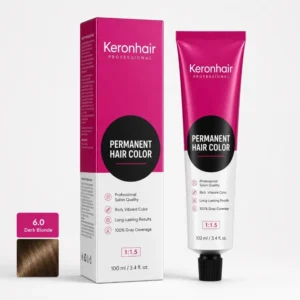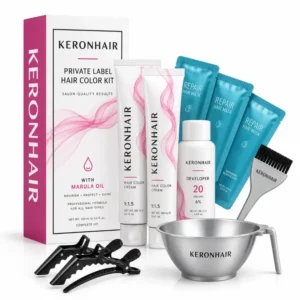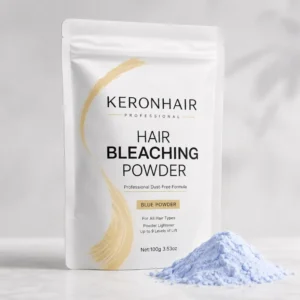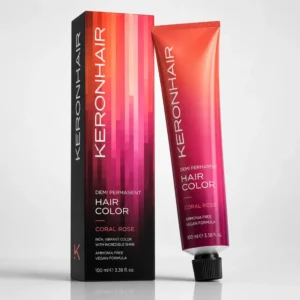
Before placing an order, ask a hair dye manufacturer about product specialization, shade development, formula ownership, regulatory documents, quality controls, testing, MOQ, packaging, lead time and reorder support. Do not approve a supplier on price and samples alone. For every important answer, request evidence that can be reviewed before bulk production begins.
From our side as a manufacturer, we find that the smoothest projects are not the ones with the fewest questions. They are the ones where the brand and factory agree early on the product standard, target market, approval process and responsibilities.
This guide gives you 25 questions to ask a hair dye manufacturer, along with the evidence to request and the warning signs to watch for. Use it when evaluating a private label supplier, OEM partner or custom hair color manufacturer.
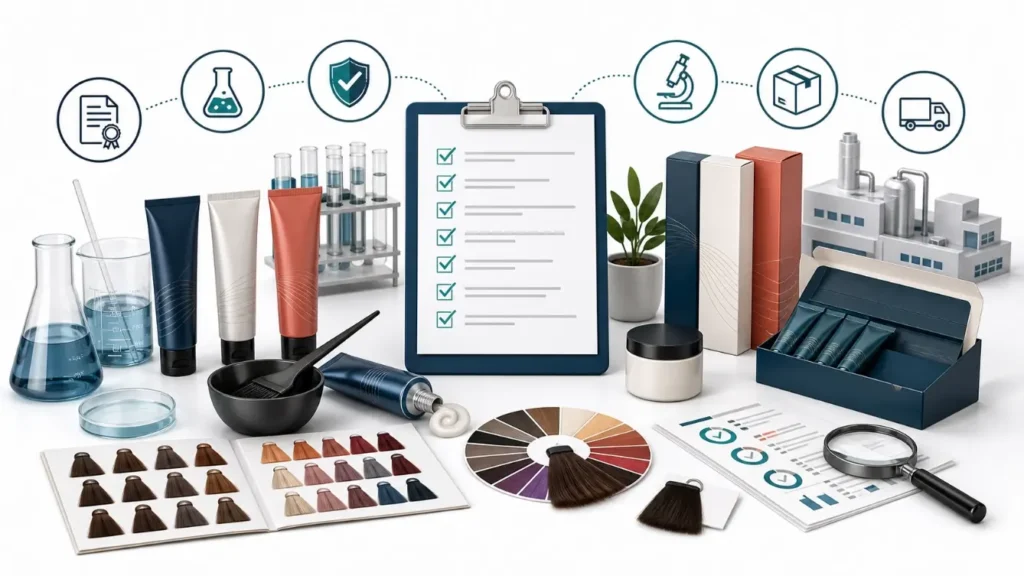
Quick Hair Dye Manufacturer Scorecard
Use this scorecard before comparing quotations. Score each area from 0 to 5, where 0 means the supplier has provided no usable answer or evidence and 5 means the answer is specific, documented and appropriate for your project.
| Evaluation area | Evidence to request | Score |
|---|---|---|
| Product and market fit | Relevant product formats, shade systems and experience with your intended sales channel | 0–5 |
| Formula and shade control | Development process, approved standards, developer compatibility and acceptance criteria | 0–5 |
| Compliance readiness | INCI list, specifications, warnings, label information and target-market documentation | 0–5 |
| Quality and testing | Quality-system evidence, test plan, batch records and retained-sample procedure | 0–5 |
| Commercial fit | MOQ by shade and component, itemized quote and realistic stage-by-stage timeline | 0–5 |
| Communication and scale | Named project contacts, change-control process, reorder plan and scale-up discussion | 0–5 |
This is a working procurement framework, not a certification system. A high total cannot cancel a serious safety, compliance or integrity concern. One critical red flag may be enough to pause approval.
Why Hair Dye Requires Deeper Supplier Due Diligence
Choosing a hair dye manufacturer is different from sourcing a basic rinse-off hair care product. Hair color can involve shade accuracy, oxidation behavior, developer ratios, gray coverage, ingredient restrictions, mandatory warnings, packaging compatibility and repeatability between batches.
In the United States, the FDA explains that certain hair dyes are subject to specific cautionary labeling and preliminary skin-test directions. Requirements also vary with the product and target market, so label language and instructions should never be treated as decorative copy. Review the FDA’s hair dye guidance and obtain qualified regulatory advice for the markets where you plan to sell.
Before contacting factories, prepare a short product brief covering:
- Product type and intended use
- Target customer and sales channel
- Target country or region
- Shade range and performance priorities
- Preferred formula positioning
- Packaging format and kit components
- Estimated order quantity and launch date
If you are still defining the wider selection process, start with our guide to choosing a hair dye manufacturer for your brand. Then return to this checklist when you are ready to question and score shortlisted suppliers.
Product and Brand-Fit Questions
1. Which hair dye formats do you manufacture regularly?
Ask about permanent color cream, demi-permanent color, semi-permanent color, temporary color, color-depositing masks, hair color shampoo, developer, bleach powder, toner and bubble color. A factory that fills shampoo is not automatically equipped or experienced enough to produce every type of hair color.
Evidence to request: A relevant product list, technical data for comparable formats and an explanation of which formats are produced routinely rather than only offered in a catalog.
Red flag: The supplier says it can make every format but cannot explain the differences in production, testing or packaging.
For a direct-dye project, narrow the company list by the exact ready-to-use format and third-party development service. Our semi-permanent hair dye manufacturer guide gives the focused questions to ask before requesting a sample.
2. Have you supported products for my intended sales channel?
A professional salon system, retail box kit, ecommerce product and distributor assortment can require different instructions, components and performance expectations. Explain where the product will be sold and who will apply it.
Evidence to request: Examples of relevant packaging structures, instructions or development workflows with confidential brand information removed.
Red flag: The same product and instructions are recommended for every channel without discussing how the user experience differs.
3. Is this project private label, OEM or custom formulation?
These terms are used differently across the industry. Ask the supplier to define what its service includes. A private label project may use an existing formula. OEM may include formula or packaging changes. A genuinely custom project may require deeper development, testing and commercial commitments.
Evidence to request: A written scope covering formula status, customization limits, sample rounds, development fees, testing, packaging and ownership.
Red flag: The supplier calls a stock formula “exclusive” without defining what has actually been customized.
4. Which hair color products are your strongest specialties?
The best fit is not necessarily the supplier with the longest product list. Ask which formats, shade families and order types the technical team handles most often. A focused answer helps you distinguish genuine hair color experience from general cosmetic manufacturing.
Evidence to request: A clear description of the factory’s core hair color formats, R&D support and typical project workflow.
Red flag: The supplier relies on broad statements such as “we make all cosmetics” and avoids technical follow-up questions.
Formula, Shade and Performance Questions
5. How do you develop and approve shades?
Clarify whether shades are selected from a standard chart, matched to a reference or developed from a technical brief. Discuss the hair swatches or test substrates used, starting color, processing conditions and approval criteria. A shade name or digital image is not a reliable production standard.
Evidence to request: A shade-development plan, physical reference or approved master standard and a documented sample-approval record.
Red flag: Shade approval is based only on phone photographs or an undefined promise to make it “close.”
6. Can you customize the formula format, texture and developer system?
Hair color performance depends on more than pigment. Discuss cream, gel, liquid or shampoo formats, mixing ratio, developer strength, application time, spreadability, rinse behavior and post-color hair feel. If the product needs a developer, treat the color and developer as a system.
Evidence to request: Written mixing instructions, recommended developer compatibility and the specifications used to approve texture and pH.
Include a separate question about who specifies and approves the developer paired with each shade. Our developer planning guide for hair color brands expands that topic into product, packaging and test-plan decisions.
Red flag: The supplier cannot explain which developer was used to produce the sample result.
7. What performance claims can the available evidence support?
Claims such as gray coverage, long-lasting color, shine, low-ammonia positioning or gentle-feeling performance should reflect the formula and the evidence available. Marketing language must also be reviewed for the intended market.
Evidence to request: The test method, test conditions and documentation supporting each important claim.
Red flag: The supplier approves every requested claim without asking how it will be substantiated.
8. Who owns the formula and shade system?
Ask this before paying development fees. Determine whether the product is a stock formula, modified base or exclusive formulation. Clarify whether another brand may use the same base, whether custom shades are exclusive and what happens if the relationship ends.
Evidence to request: Ownership, confidentiality and exclusivity terms in the development or manufacturing agreement.
Red flag: Verbal promises of exclusivity are not reflected in any written agreement.
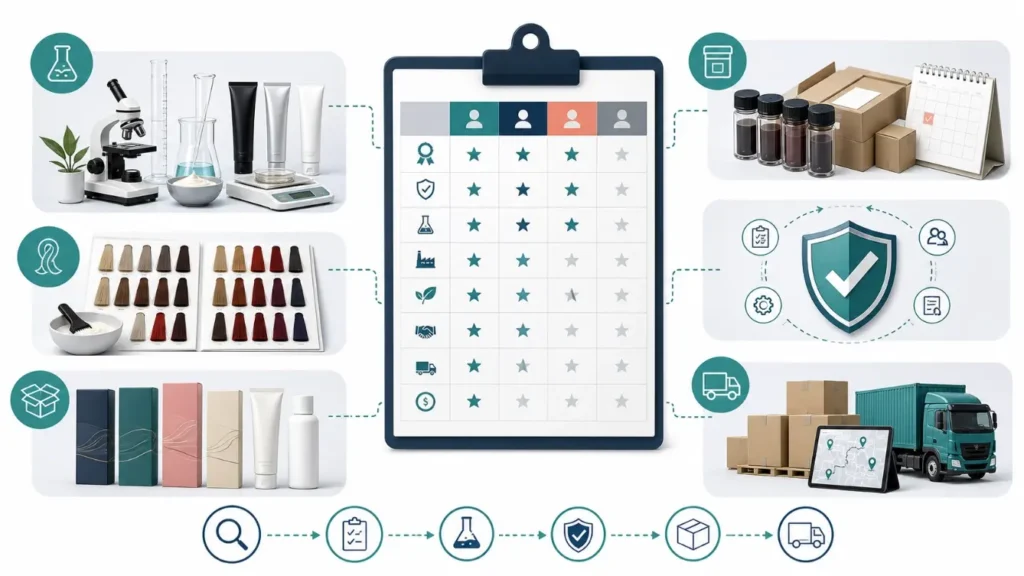
Safety, Compliance and Documentation Questions
Manufacturers can provide technical documentation and practical support, but the brand or responsible party still needs to verify the legal obligations that apply to the final product. Requirements vary by formula, claims, packaging, country and sales channel.
9. Which target markets has this formula been reviewed for?
Name every country or region where the product will be sold. Do not accept “international formula” as a complete answer. The United States, European Union, United Kingdom and Middle Eastern markets do not share one universal ingredient, label or notification framework.
Evidence to request: A market-specific document list and confirmation of which responsibilities belong to the manufacturer, brand, importer or responsible person.
Red flag: The supplier says that one ingredient list and one label are automatically suitable worldwide.
10. Can you provide the INCI list, specifications and safety documents?
Ask what documentation is available before commercial approval. Depending on the product and market, this may include the full INCI list, product specification, Safety Data Sheet where applicable, directions, warnings, formula reference and relevant batch information.
Evidence to request: Controlled documents carrying a revision date or document number, not screenshots copied from unrelated products.
Red flag: Basic formula and specification documents will be released only after the bulk order is completed.
11. Which warnings and preliminary-test directions must appear?
Ask the supplier to identify the warnings and use directions associated with the formula, then have the final label reviewed for the destination market. Discuss gloves, application instructions, prohibited uses and whether an insert is required.
Evidence to request: Proposed warning copy and directions linked to the actual formula and target market.
Red flag: The supplier dismisses caution statements or suggests copying instructions from another brand.
12. What support is available for safety substantiation and product listing?
For the United States, the FDA’s MoCRA resources explain requirements that may include facility registration, product listing, safety substantiation and adverse-event responsibilities. For the EU, consult the Cosmetic Products Regulation (EC) No 1223/2009 and qualified regulatory professionals.
Evidence to request: A responsibility matrix showing who supplies formula data, manufacturing information, safety documents and listing or notification inputs.
Red flag: The factory promises to “handle all compliance” without defining the market, responsible party or deliverables.
13. How do you manage restricted or sensitivity-associated ingredients?
Discuss ingredients relevant to the intended formula and market, including oxidative dye intermediates, peroxide systems, fragrance allergens and any substances restricted by local rules. If you request an ammonia-free, PPD-free or similar positioning, define the claim precisely and verify the complete formula.
Evidence to request: Full ingredient disclosure to the appropriate reviewer, supplier specifications and a process for reviewing formulation changes.
Red flag: The supplier relies on vague statements such as “natural,” “chemical-free” or “completely safe.”
Manufacturing Quality and Testing Questions
14. Which GMP or quality system does the facility follow?
Ask how raw materials, production, filling, cleaning, deviations, records and finished goods are controlled. ISO 22716 provides internationally recognized guidance for cosmetic Good Manufacturing Practices, but a certificate should still be checked for scope, facility, issuer and validity.
Evidence to request: Current certificates where relevant, quality procedures or audit information appropriate to your risk level.
Red flag: A certification logo is provided without the certificate, covered facility or validity dates.
15. Which tests will be completed before approval and release?
The test plan should match the formula, packaging and market. Discuss stability, formula-packaging compatibility, microbiological quality where relevant, pH, viscosity, shade performance, developer compatibility, leakage and transport considerations.
Evidence to request: A written test plan showing test conditions, acceptance criteria, timing and the party responsible for each test.
Red flag: Testing is treated as unnecessary because a similar base formula has been produced before.
16. How do you control shade consistency between batches?
A reorder should be compared with an approved standard, not with someone’s memory of the first batch. Ask how incoming materials, in-process conditions, finished color and developer performance are checked.
Evidence to request: An approved master standard, batch release criteria, production records, retained samples and a deviation or corrective-action process.
Red flag: Batch color is checked only by an informal visual comparison with no defined standard or acceptance range.
17. Will I receive pre-production and retained batch samples?
Define the sample stages before work starts. Lab samples help select direction; a pre-production or production-representative sample helps confirm what will actually be made. Retained samples support later complaint investigation and reorder comparison.
Evidence to request: A sample schedule, approval form, retention period and identification method linking samples to batches.
Red flag: The supplier cannot trace an approved sample to a formula version or production batch.
For a detailed approval workflow, see our seven-step guide to testing hair dye samples before bulk production.
Packaging, MOQ, Lead Time and Cost Questions
18. What is the MOQ by formula, shade, SKU and component?
One project can contain several minimums. Formula batching, each shade, printed tubes, cartons, developer bottles, gloves and instruction leaflets may all have different requirements. Ask how unused packaging or excess bulk will be handled.
Evidence to request: A written MOQ table by formula, shade, finished SKU and custom packaging component.
Red flag: One attractive MOQ is quoted without explaining the minimum for each shade and printed component.
19. What exactly is included in the quotation?
Compare like with like. A unit price may exclude development, samples, tests, decoration, cartons, inserts, accessories, freight or export documents.
Evidence to request: An itemized quotation, applicable Incoterm, payment schedule, quote validity and list of exclusions.
Red flag: Important costs appear only after sample approval or packaging has been ordered.
20. Which packaging formats can you source and test?
Hair color may be supplied in tubes, bottles, sachets or multi-component kits. Packaging must suit the formula and the customer’s use process, not only the brand design.
Evidence to request: Component specifications, samples, dielines, decoration options, MOQ, lead time and compatibility-testing plan.
Red flag: The supplier recommends printing a full packaging order before formula-packaging compatibility has been considered.
21. What is the realistic timeline for samples, production and reorders?
Separate formula discussion, first samples, revisions, testing, packaging procurement, artwork approval, production, quality release and shipping. The shortest quoted production time is not the same as the total project lead time.
Evidence to request: A milestone schedule with dependencies, approval deadlines and a different timeline for repeat orders.
Red flag: The supplier promises a launch date before reviewing the formula, packaging and required tests.
22. What happens if a raw material or packaging component is delayed?
Ask how shortages, discontinuations and delays are communicated. Any substitute that may affect the formula, performance, label or appearance should go through documented approval.
Evidence to request: A change-control process, escalation contact and backup plan for critical components.
Red flag: The supplier reserves the right to substitute materials without prior written approval.
If you are preparing a larger purchase, our guide to buying hair dye in bulk from a manufacturer covers RFQs, landed cost, freight and order control in more detail.
Communication, Reorders and Scale-Up Questions
23. Who manages technical communication during development?
Sales coordination matters, but feedback such as “the shade is too warm,” “gray coverage is weak” or “the mixture is unstable” must reach someone who can interpret it technically.
Evidence to request: Named commercial and technical contacts, expected response times and the method used to record sample revisions.
Red flag: Technical feedback is repeatedly paraphrased through sales messages with no version-controlled record.
24. How are reorders, formula changes and complaints controlled?
Ask how the factory protects consistency while responding to market feedback. A new fragrance, pigment source, tube coating or instruction can create a controlled change rather than a casual adjustment.
Evidence to request: Reorder specifications, retained-sample comparison, change approval and complaint-investigation procedures.
Red flag: Changes can be made without a revised specification or written brand approval.
25. Can production scale without changing the approved standard?
A supplier may be suitable for a pilot order but not for later demand. Discuss realistic capacity, raw-material planning, packaging reservations, reorder lead time and the controls used when batch size increases.
Evidence to request: A practical scale-up plan tied to forecast ranges, lead times and quality checks.
Red flag: Capacity is promised verbally, but no one discusses material planning, equipment fit or quality controls at the larger volume.
Five Supplier Answers That Should Stop the Approval Process
When we help a brand prepare a hair color brief, we recommend pausing the project if a supplier gives any of these answers without a credible explanation and corrective plan:
- “We will confirm the documents after the bulk order.” Documentation should be reviewed early enough to identify formulation, labeling or market-access problems before commercial commitment.
- “The shade may vary, but it should be close.” A supplier should be able to define the approved reference and explain how production batches are evaluated against it.
- “The MOQ is the same for everything.” Formula batches, shades and custom packaging components often have separate minimums. A useful quotation makes them visible.
- “The same formula and label work everywhere.” Market requirements vary. The responsible parties must verify the formula, claims, warnings and documentation for each destination.
- “We do not retain samples or detailed batch records.” Without traceable records and samples, investigating a complaint or comparing a reorder becomes much harder.
None of these points should be solved with a vague assurance. Ask for a written process, document or revised proposal.
How to Score the Manufacturer’s Answers
After the supplier meeting, score the six areas in the opening table and record the evidence received. Use the following ranges as an internal decision aid:
- 25–30: Strong candidate, subject to document verification, sample approval and commercial agreement.
- 19–24: Potential candidate, but close the identified gaps before paying for bulk production.
- 13–18: High-risk candidate. Request corrective actions or compare another supplier.
- 0–12: Insufficient evidence for commercial approval.
Do not average away a critical failure. Missing safety information, unexplained formula substitutions, false documents or refusal to define the approved standard should be handled separately from the numerical score.
Frequently Asked Questions
What should I ask a hair dye manufacturer before ordering?
Ask about product specialization, shade development, formula and shade ownership, developer compatibility, target-market documents, warnings, testing, batch consistency, packaging, MOQ, total cost, lead time, change control and reorder support. Request evidence for every answer that affects safety, compliance, quality or cost.
What documents should a private label hair dye manufacturer provide?
Depending on the formula and market, useful documents may include an INCI list, product specification, Safety Data Sheet where applicable, directions and warnings, test information, batch records and data needed for safety assessment, listing or notification. Confirm the exact requirements with the relevant authority or a qualified regulatory professional.
How can I verify that a hair dye manufacturer is reliable?
Verify the legal business and production location, review the quality-system evidence, examine relevant documents, test product samples under defined conditions and make sure the quotation and agreement match the promises made during sales discussions. An audit or independent inspection may be appropriate for higher-risk or higher-value projects.
What is a typical MOQ for private label hair dye?
There is no universal MOQ. It can vary by formula batch, number of shades, packaging format, decoration method, customization level and kit components. Ask for the minimum by formula, shade, SKU and packaging component rather than relying on one headline number.
Can a manufacturer create custom hair dye shades?
A manufacturer with appropriate R&D and shade-matching capability may be able to develop custom shades. Define the starting hair color, desired result, gray-coverage target, developer, processing conditions, sample rounds and physical approval standard before production.
Should I approve a supplier after the first sample looks good?
No. A promising first sample is only one part of supplier approval. You still need to review documents, confirm formula and packaging specifications, understand testing, agree on batch controls and assess whether the supplier can reproduce the approved result in bulk production and future reorders.
Choose Evidence Over Promises
A reliable hair dye manufacturing relationship starts with a precise product brief and continues through documented sample, packaging and production approvals. Price and MOQ matter, but they should be evaluated alongside shade control, compliance readiness, testing, change management and long-term supply support.
At Keronhair, we encourage buyers to share their product type, target market, shade direction, packaging requirements, estimated quantity and launch schedule before discussing a final manufacturing plan. That information allows both sides to identify technical and commercial gaps earlier.
If you are developing a private label or OEM hair color range, review Keronhair’s hair dye manufacturing capabilities and contact our team with your project brief. We can then discuss whether the requested format, customization path and order plan are a suitable fit.