Dry ends and oily roots can make it hard to know what your hair needs. Adding more cream or oil may leave it flat, while skipping conditioner can make the ends harder to manage. The goal is to give dry areas enough conditioning without weighing down the rest of your hair.
If you’re wondering how to add moisture to hair without a greasy finish, this guide covers a simple wash-day routine, how to choose between conditioning products, and ways to refresh dry areas between washes.

How to Add Moisture to Hair: The Short Answer
I’d keep your current products for the first wash and notice when your hair becomes difficult to manage. Does it feel rough after rinsing, go flat as it dries, or need constant touch-ups? Use that timing to decide which step to adjust.
- Cleanse according to oil, sweat, and product residue.
- Condition the lengths that need easier detangling and a softer feel.
- Add a small amount of leave-in only if you need it.
- Dry gently, then check for roughness, heaviness, and manageability.
Use this as a starting sequence. Your products’ directions take priority, especially for treatments with a different application order.
What Does Moisturizing Your Hair Actually Mean?
When you say your hair needs moisture, you might mean that it feels scratchy, tangles easily, or won’t settle into your usual style. Those are useful observations, but touching your hair doesn’t measure its water content. Its surface condition and shape also affect how it feels.
Look beyond the shine. Can you handle your hair comfortably, without an unwanted coating? Notice where it feels rough, too. A few difficult ends give you a different problem to work on than roughness along the whole strand.
Can Your Roots Be Oily While Your Ends Feel Dry?
Yes. Your scalp and the lengths of your hair don’t always need the same care. You can need a wash at the roots while the ends still need conditioning.
Imagine your roots look greasy but your ends catch on the comb. Before reaching for a richer cream, I’d check where you’re applying conditioner and leave-in. You may need to care for the ends more carefully while keeping that extra product away from the roots.
What Do You Actually Need Before You Start?
Start with your shampoo and rinse-out conditioner. I’d add another product only if a problem remains.
| Product | When it helps | How to avoid overdoing it |
|---|---|---|
| Rinse-out conditioner | Your basic step for softness and easier detangling. | Focus on ends or dry lengths. Check missed sections if some areas still catch; rinse as directed. |
| Leave-in conditioner | For tangling or frizz that persists after rinsing. | Try a little where needed. Skip or reduce it if hair is already soft or goes flat. |
| Hair mask | An option if your conditioner leaves hair rough. | It can overlap with conditioner. Check whether it replaces that step; “mask” doesn’t automatically mean better. |
| Hair oil | An optional finish for smoother-feeling ends. | Pure oil adds no water and doesn’t replace conditioning. Skip it if the finish is already right. |
For curls and coils, see our guide to product options for natural hair.
Build Your Wash-Day Routine in Four Steps
Start with the routine below, then adjust it to your products and hair. The American Academy of Dermatology’s healthy-hair tips support washing according to oiliness and dirt, conditioning after shampoo, and gentle handling. You don’t need the same schedule or product amount as someone with a different scalp or styling routine.
Step 1: Cleanse According to What Needs Removing
Don’t keep postponing a needed wash because your ends feel dry. Check your scalp and the products you’ve used since your last shampoo. Several layers of styler leave you with a different starting point from a week with very little product.
Focus cleansing on the scalp, while also addressing residue on the lengths when necessary. Avoid scrubbing your ends together. A clarifying product can be useful for some buildup, but repeated strong washing isn’t a dependable answer to every rough patch.
Before changing shampoo, ask whether you’re rinsing thoroughly and cleaning the areas that actually feel coated.
Step 2: Condition the Areas That Need More Slip
Apply your rinse-out conditioner where you need smoother handling. Fine or straight hair may need it mainly at the ends; dry curls may need coverage through the lengths. Follow the label for contact time and rinsing.
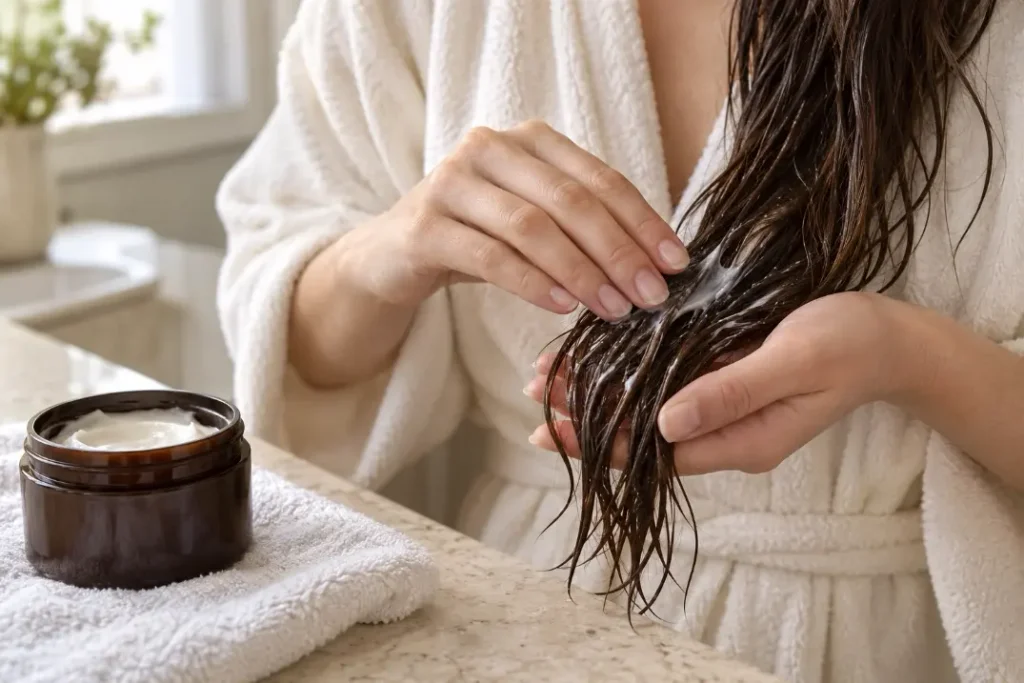
Don’t miss the hair underneath or at the back. If only an inner section still catches, work the conditioner through that section before adding another handful everywhere.
Take your time with knots. Our guide to caring for long hair and fragile ends covers gentle detangling. A slippery feel should help you handle the hair; it isn’t proof that you’ve permanently repaired damage.
Step 3: Add a Leave-In Only Where It Helps
Already happy with how your hair feels after rinsing? You can skip the leave-in. Where you still need help, start with a small amount and take the time to spread it evenly.
Follow the product’s directions on application to damp or dry hair. Avoid concentrating an ordinary hair leave-in on your scalp unless its instructions explicitly allow that use.
Keep your usual styling routine while you try the leave-in. If you also introduce a new cream and oil, you won’t know which change to reconsider if your hair ends up heavy.
Step 4: Dry Gently Before Judging the Result
Blot or gently squeeze out water instead of rubbing hard with a towel. If you use heat, limit exposure and follow the directions for your tool and heat-protection product. An ordinary leave-in isn’t automatically a heat protectant.
Wait until your hair dries before making the final call. That slippery feeling while it’s damp may turn into a flat finish, especially if you keep adding product along the way.
Check the finished style against what you wanted. Did detangling improve? Do your roots still have the lift you like? Those answers are more useful than judging only the first few minutes after application.
Does Hair Oil Actually Add Moisture?
Pure oil doesn’t supply water, but that doesn’t make it useless for moisturizing care. Oil can change surface feel and how water moves into and out of the hair.
In a laboratory study of hair fibers, researchers found that oil films slowed moisture diffusion. Treated samples also took up less moisture under the tested conditions. Oil’s role in that experiment was to change moisture exchange, rather than simply add water or seal all of it inside.
Those lab results don’t identify one best oil or tell you how much to use at home. I’d judge an optional oil step by whether it improves your conditioned hair’s finish without adding unwanted weight.
Also check what the bottle contains. A product called a hair oil may be a blend, not a pure plant oil. Judge the formula and its directions rather than assuming every product with the same name behaves alike. If your existing routine already gives you the finish you want, you can leave this step out.
How Should You Adjust for Your Hair Type?
Your hair type can help you choose where to start, but the descriptions overlap. Fine strands can also be curly; colored hair can be fine or coarse. Adjust for those combinations and the result you want.
Fine Hair That Goes Flat Easily
Start with a lighter leave-in if you need one. The AAD’s leave-in conditioner advice specifically recommends lighter formulas for fine, straight hair to help avoid a limp, greasy appearance.
Before giving up on conditioner, check whether you’re using a rich rinse-out product plus a cream and oil afterward. I’d reduce one optional layer first. A spray format can be convenient, but the container alone doesn’t guarantee a weightless result.
Curly or Coily Hair That Needs More Coverage
A section you missed can stay difficult to manage even when the rest of your hair feels well conditioned. Check the coverage before deciding the formula needs to be heavier.
Curl shape doesn’t tell you strand thickness or density. You may need better coverage without wanting a richer finish. For the styling side, see our guide to choosing products for curly hair, rather than adding more conditioner to solve every definition problem.
Colored or Heat-Styled Hair With Rough Ends
Conditioning can improve handling, but continued chemical or heat damage may keep frustrating your routine. Look at those habits alongside your product choices.
Our guide to choosing shampoo for colored hair explains that part of the decision. Don’t assume rough ends automatically need protein or a bond treatment. Nor does a softer feel mean you can safely increase the heat next time.
How to Add Moisture to Hair Between Washes
You can address a small area without repeating your entire wash-day routine. Start by checking what has changed since your hair dried. Local tangling, a flattened style, and an oily scalp don’t necessarily call for the same response.
Refresh Only the Areas That Need It
Suppose your ends feel hard to arrange the next morning, but the rest of your hair feels fine. Try a little of a product labeled for refreshing that area, using water if its directions call for damp hair.
Let the section dry before deciding whether it needs more. If the issue is a sleeping dent rather than roughness, simply reshaping the area may be worth trying before adding another conditioning layer.
Know When Another Layer Won’t Help
Pause before topping up if each application seems to make your hair harder to manage. Useful reasons to reassess include:
- A tacky or noticeably coated feel.
- Less volume after every refresh.
- Visible residue or flakes after layering.
- Ends that remain tangled despite repeated applications.
They don’t tell you the cause on their own. They do give you a reason to check whether a wash is due or whether the products you’re combining need another look.
Why Does Your Hair Still Feel Dry or Greasy?
Use this table to choose one reasonable adjustment. It’s a way to organize your observations, not a test for a medical condition or a particular ingredient problem.
| What you notice | Check first | One change to try | What it doesn’t prove |
|---|---|---|---|
| Hair dries greasy and flat | Leave-in amount and placement | Use less of one optional layer | That your scalp is producing too much oil |
| Most hair feels smooth, but ends still catch | Coverage and visible wear at the ends | Improve conditioner distribution there | That the whole head needs a richer mask |
| Refreshing leaves flakes or residue | Existing buildup and products layered together | Return to a clean, simpler routine | That the flakes are definitely dandruff |
| More products haven’t improved roughness | Handling, heat use, and multiple recent changes | Keep products steady and reduce rough handling | That you have a diagnosed moisture or protein imbalance |
If a change helps your ends but weighs down the roots, narrow where you apply it next time. You can adjust the two areas separately.
Persistent breakage, pain, sores, significant irritation, or hair loss deserves professional assessment. Stop a product that causes a reaction rather than continuing the experiment.
What Would I Change Next Wash Day?
I’d choose the smallest change linked to the problem you’ve actually noticed. If your hair is soft but flat, reducing an optional layer is a clearer experiment than replacing your shampoo, conditioner, and styler together.
Keep a short note if you tend to forget what you changed:
- Which product, amount, or application area did you change?
- How did your hair feel and look once dry?
- Did you need repeated touch-ups before the next wash?
- Was your scalp comfortable throughout?
Compare similar styling days when you can; a change in weather or drying method can muddy the result. Keep what helps your hair stay manageable, and reconsider the products you keep having to compensate for.
A Note for Brands Developing Moisturizing Products
If you’re developing a moisturizing product, include the intended hair type, dose, application method, and companion products in your brief. Keronhair’s private-label hair care development services offer a place to discuss those requirements alongside formula and packaging options.
Frequently Asked Questions
These answers cover common application questions. Check your product’s directions before changing how you use it.
Can I Add Moisture to My Hair With Water Alone?
Water wets your hair, but may not provide lasting softness or easier detangling. If your hair remains rough after drying, review your conditioning and handling rather than repeatedly misting it.
Should I Apply Leave-In Conditioner to Wet or Dry Hair?
Follow the label. Many leave-ins are intended for damp hair, while some allow dry-hair touch-ups. Apply evenly and avoid adding extra simply because the hair hasn’t dried yet.
Can I Moisturize My Hair Every Day?
You can use a suitable product as directed when your hair needs it, but daily layering isn’t necessary for everyone. Reduce or reassess applications if your hair becomes heavy, sticky, or coated.
Can I Use Rinse-Out Conditioner as a Leave-In?
Only if its label explicitly allows both uses. Otherwise, rinse it out and choose a dedicated leave-in. Don’t turn ordinary conditioner into a homemade leave-in by diluting and storing it.
Will Moisturizing Repair Split Ends?
No, not permanently. Conditioning may improve feel and temporarily disguise rough ends, but it won’t restore a split strand to its original structure. Trimming removes the affected ends.